

This is technically part four of the County House series, even though it does not directly concern the old tavern/hotel.
Samuel Stewart and Anna Smith had an interesting connection with each other and with Flemington’s courthouse and Alexander’s tavern, as well as other 18th-century residents of the town. If you haven’t yet read PART THREE of my series, The County House, I strongly recommend that you do that first.
In 1795, Samuel Robert Stewart was an up-and-coming attorney in Flemington. Son of the prominent Revolutionary War colonel, Charles Stewart, he had been practicing law and representing clients in the Flemington Court of Common Pleas ever since 1790 when he was admitted to the bar.
He grew up on his father’s plantation known as “Landsdown” near Hamden in what was then Kingwood Township, later to become part of Franklin Township.1
Following the birth of his son Charles S. Stewart in 1795, Samuel R. Stewart acquired some property in Flemington, as was described in a letter by David Frazer to James Martin:
“Col. Charles Stewart & family is all well, I believe his fortune is much better by the sale of some of the Wyoming [PA] lands, he purchased his old farm & two others extending to [Mores? hill] very Cheap for £1800 Cash, his son Saml. Stewart has purchased the farm at Flemmington once Gorsham Lee’s for £2200 after it was much improved with buildings erected thereon by Thos. Lowrey” [my emphasis].2
I suspect that this reference to property once owned by Gershom Lee and Thomas Lowrey is a red herring. But I cannot prove it.
The farm that once belonged to Gershom Lee may have been the 21+ acres that Lee sold to Thomas Lowrey in 1769. Gershom Lee had been a partner with Thomas Lowrey in the 1760s when they purchased large tracts of land in the north part of Flemington and on the east side of Main Street. But Lee also bought another property on his own. This was 94.25 acres sold to him by Daniel Reading on March 16, 1758.3
It was part of the estate of Daniel’s father, John Reading,
being part of the 3,333 acres of right which the sd John Reading purchased from Daniel, John & Wm Coxe in 1745 [month/day left blank], and the sd John Reading, by deed of gift conveyed on May 6, 1751 to his sons John, George, Daniel & Thomas Reading as tenants in common the above tract of land, 112 acres thereof severed from the east end which they sold to John Barker and upon division of ye remainder between the four brothers, there fell to Daniel Reading the quantity of 94.25 acres along the south and west end thereof, bordering Strettles land, George Reading, Thomas Reading, Isaac DeCow.
The deed goes on to say that Daniel Reading sold 94.25 acres out of his share to Gershom Lee on March 16, 1768, and that Lee then divided it into seven lots which he sold “at public vendue.”
On Dec 10, 1769, Gershom Lee, yeoman of Amwell, sold to Thomas Lowrey of same Lot #7, being a lot of 21 acres 32 perches. (The original 94.25 acres bordered “Strettles land,” George Reading, Thomas Reading and Isaac DeCow. The deed did not give bordering owners for the 21+ acre-lot.)
Apparently, Lowrey made good use of the lot, according to the Frazer letter: “It was much improved with buildings erected thereon by Thos. Lowrey.”
The deed from Lee to Lowrey was not recorded until 1806. Why the delay? Did something happen in 1806 to compel Lowrey to record it? In 1806, Thomas Lowrey was selling off tracts of land out of the enormous property he owned around Frenchtown. I know of no particular reason for him to record the deed of 1768 in 1806.
Unfortunately, there is no deed recorded from Thomas Lowrey to Samuel R. Stewart. Because I cannot directly link this 21+ acres to Samuel R. Stewart, I cannot be certain that this was where he settled his new family in 1795. In fact, I rather doubt it.
Col. Charles Stewart
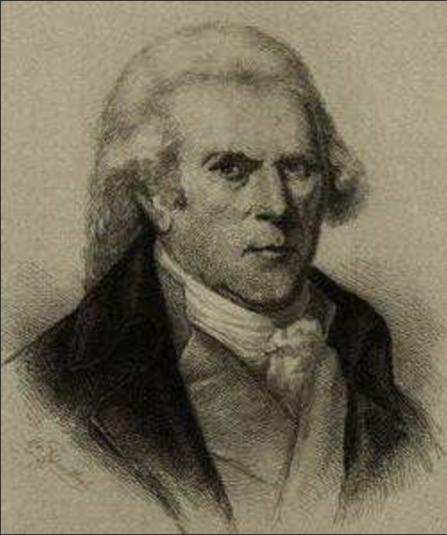 In 1797, the widower Col. Charles Stewart retired from ‘Landsdown,’ his plantation and home near Hamden, and removed to Flemington, probably to live near son Samuel, who was 32 years old at the time.
The chronology is intriguing. Two years after Charles Stewart’s move to Flemington, and only two months before the birth of Samuel R. Stewart’s second child, Samuel and common-law wife Anna Smith were married on April 9, 1799 by Rev. Thomas Grant of the Flemington Presbyterian Church, which was located adjacent to what became, or already was, a lot owned by Samuel R. Stewart along East Main Street. Perhaps it was Charles’ influence that convinced Samuel to finally marry Anna. [See Part Three]
About one year later, on May 20, 1800, Joseph Robeson and wife Mary, residents of Amwell Township, conveyed to Charles Stewart, also of Amwell, for £2,350, a tract of 351.6 acres, bordered by Amos Grigg, Arthur Gray, Daniel Reading, Wm Bennett, John Runkle, Isaac Gray, and the great road from Flemington to the old Union Iron Works (in Union Township).
Here is an outline of the property overlaid on the 1850 map of Raritan Township, showing how the Robeson-Stewart tract covered most of Flemington from the Civil War monument north.
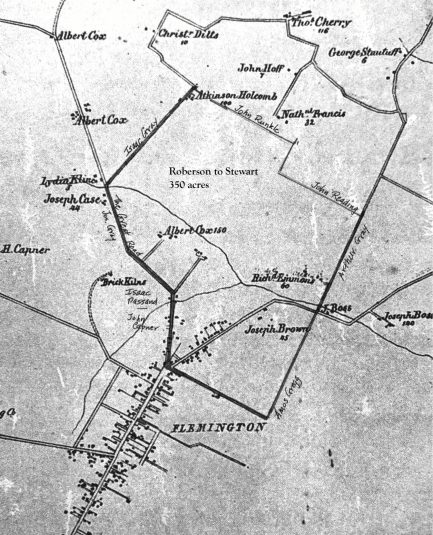
Four lots were excepted from this conveyance, including a lot sold by the Robesons to the trustees of the Flemington Presbyterian Church in 1793, according to a history of the church by Rev. George S. Mott, who noted that the stones used for the church came “from Large’s land, in Kingwood, where the like stones were got for the court-house.”4
The Robesons had also sold a half-acre lot to Samuel Robert Stewart and Geo. C. Maxwell as tenants in common. Nothing more was said about this lot–neither the date nor its location.
Was this half-acre “the farm at Flemmington once Gorsham Lee’s” that Samuel R. Stewart spent £2200 on? After a lot of research into contemporary deeds, I can say with confidence–probably not. What I cannot say is why Stewart was putting resources into a property he never had a deed for. (I have much more to say about S. R. Stewart’s lot below.)
The deed of 1800 from the Robesons tells us is that Charles Stewart did not own his property in Flemington until well after leaving Landsdown. This surprised me. I had always assumed that Charles Stewart retired to property he already owned. Since that was not the case, one must wonder whether Charles moved in with son Samuel’s household before his purchase in 1800. I should think so.
Joseph Robeson
Joseph Robeson/Roberson (1731-1801) was an interesting character. He was living in Solebury, Bucks County in 1765 when he acquired a tavern license there and also ran the ferry across the Delaware. He and wife Hannah (maiden name not known) had a daughter Susannah in 1753, who married Samuel Opdycke (son of John & Margaret) in 1775. (See Green Sergeant’s Covered Bridge.)
In 1772, Robeson moved across the river to manage Howell’s Tavern & Ferry in today’s Stockton Borough. In 1780, he was taxed on 79 acres, a tavern, a ferry and a slave.5
In 1784, he moved on to manage the Ringoes Tavern, which he kept through 1789, when John Meldrum took over.
Wife Hannah died sometime before 1788. That year, Joseph and second wife Mary Robeson sold five lots in and near Ringoes to one Henry Chapese, “physic of Bucks County.”6
In return, Chapese and wife Sarah sold to Robeson a tract of 351.16 acres at Flemington in Amwell, bordering Amos Grigg, Arthur Gray, Daniel Reading, William Bennett, John Runkle, Isaac Gray and the great road from Flemington to the old Union Iron Works. This property had been sold to Chapese by Thomas & Esther Lowrey in 1785. However, the deed of 1785 does not say who sold the property to Lowrey. I do not think it came from Lowrey’s father-in-law Samuel Fleming.7
The property description was the same as the one given in the deed from Robeson to Charles Stewart in 1800.
Joseph Robeson must have had some reason to think about the disposition of his property after his death, because he wrote his will on Oct. 28, 1796, well before selling the 350+ acres to Charles Stewart. Perhaps it was because daughter Susannah Opdycke had died on April 23, 1796, leaving husband Samuel behind with five children.
In 1796, Joseph Robeson was residing in Amwell Township with wife Mary, to whom he left “a certain note obtained in her own name from George Coryell, before my intermarriage with her.” He also left her “bed and bedding, a case of drawers, table, six chairs and other furniture for housekeeping; also, a horse and riding chair and her saddle; likewise, £35 per annum to be paid her, during her life.”
He left all his real estate and the remainder of his personal property to his five grandchildren, “to be equally divided between them or the survivors of them, the boys when 21 and the girls when 18.”8
Sidenote: Joseph Robeson owned several slaves, which were included in his will as follows:
— said granddaughter Mary Opdyke my mulato wench named Phebe, until the said Phebe is 25 years of age, when she is to be manumitted.
— other slaves, Patrick and his wife Dinah, to be sold to Phillip Case, until said boy is 25 years of age when he is to be manumitted.
— another wench, named Margaret (daughter of Patrick and Dinah) I have sold to Joseph Atkinson until she is 21, when she is to be manumitted.
— Charles (youngest son of Patrick and Dinah) is to be manumitted when he is 25.
Joseph Robeson died on Jan. 14, 1801, at age 69.
Robeson’s real estate included not only the 350+ acres in Flemington sold to Charles Stewart, but also a tract of 207 acres located in today’s Delaware Township, near the Wickecheoke Creek, where Robeson was living when he died, parts of which were sold by his heirs to Charles Sergeant and John Opdycke.
2. Charles Stewart’s Estate
Only a month after Stewart’s land purchase from the Robesons, on June 24, 1800, Col. Charles Stewart died at the age of 71, without writing a will. He was buried in the Presbyterian Cemetery at Grandin, next to wife Mary.
On July 2, 1800, Administration of the estate was granted to Charles’ daughter Mary Wilson, to his son Samuel Robert Stewart and to Joseph Hankinson Jr; fellowbondsmen were Joseph Hankinson [Sr], Charles Reading and Alexander Bonnell.
Charles Stewart died a wealthy man. The inventory of his property, made by Henry Bailie and Alexander Bonnell, amounted to $17,083.43 (about $440,000 today), not including his real estate.
It is surprising that he did not write a will. It was left to daughter Martha and son Samuel to determine how that wealth got distributed. Part of it was shared with their sisters Mary Stewart (1762-1827), who married John Wilson, Esq. (1754-1830) of Kingwood in 1785, and Sarah S. Stewart (1768-1824).9
Sarah S. Stewart was identified as Sarah Cottman in several deeds. I have not been able to identify the Cottman she was married to, but since he was never mentioned in Charles Stewart’s estate records, I must presume he died well before 1800. Sarah had no children with this Cottman. Sarah’s second husband was Col. Ferrand Stranahan (1778-1826) of Cooperstown, NY, who was a full ten years younger than Sarah. He was a colonel in the War of 1812, and a member of the New York State Senate, 1814-1816.
Martha Stewart Wilson
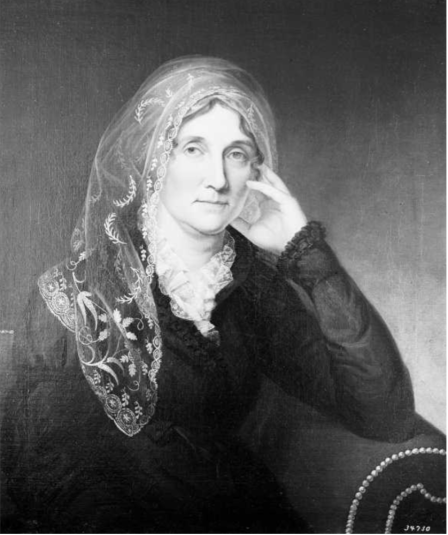 Martha Stewart (1758-1852), eldest child of Charles Stewart and Mary Johnson, married in January 1776 Robert Wilson (1751-1779). In his History of Hunterdon County, James P. Snell (p.326) wrote that Robert Wilson was an Irish immigrant who “volunteered in the Continental army soon after the battle of Lexington. He was wounded and taken prisoner at the battle of Germantown. Capt. Wilson died in Hackettstown in 1779 at the early age of 28.”
Both Robert and John Wilson, who married Martha’s sister Mary, were Irish immigrants, whose parents are not known to me. The likelihood that they were brothers is pretty high.
Martha never remarried despite her social position and her beauty, as Snell wrote:
“Mrs. Wilson was distinguished for beauty and for a brilliant and cultured mind. Mrs. Elllet, in her ‘Women of the American Revolution,’ devotes a chapter to this lady, the daughter of one of Flemington’s early residents.”
For a while, Martha lived on the Stewart property in Flemington, gradually selling off parts of her father’s large property. In 1803 she moved to Otsego County, NY to live with daughter Margaretha Bowers (1778-1872) and her family. She died on March 15, 1852 at the remarkable age of 93, and was buried in the Lakewood Cemetery in Cooperstown, NY.
On October 25, 1809 the two surviving daughters of Col. Charles Stewart petitioned the Orphans’ Court for a division of his property.
The court named three men as commissioners to make a division of the property, Benjamin Guild, Nathaniel Saxton and John E. Forman. The property that was divided was the remainder of Charles Stewart’s 350+ acres after excepting out the lots sold to the Presbyterian Church and son Samuel R. Stewart (described above in Deed Book 2 p. 439.) It was divided into three large parcels, all of them conveyed to Charles Bartles and Aaron Vansyckle.10
Martha Wilson’s account of her father’s estate included several payments to her brother Samuel. On Oct 13, 1800 she paid him $9.00 for “hauling six loads of boards and shingles to Flemington.” In April 1801, Samuel was paid $4 “for his time going to Philadelphia to meet Luzerne Commissioners 4 days, plus his expenses amounting to $10.00.
In August 1801, Samuel was paid $7 for the 7 days it took him his to go to Wyoming [PA] to see Commissioners, plus expenses of $10.50. Then in October, he was paid a dollar a day for the 10 days he spent going to Philadelphia to settle with “the Proprietaries,” plus $20 for expenses.
3. Stewart’s Debts
During this time, Samuel R. Stewart was representing clients in court, mostly defendants being sued for debts. He was probably very sympathetic to his clients because he himself was also in debt.
Here we come upon another mystery. Being an heir of Charles Stewart had to mean that son Samuel came into a sizable inheritance. So why was it that by 1800, he had stopped paying his bills?
For instance, on April 1, 1800, Stewart purchased from the firm of Painter & Atkinson “divers goods Wares and Merchandies [sic]” costing $300 and promising to pay them when requested. But he never did, and apparently at some point, refused to do so. So, Jacob Painter and Asher Atkinson took “Samuel R. Stewart, Gentleman, one of the Attornies [sic] of the Inferior Court of Common Pleas in and for the County of Hunterdon,” to court, hiring as their attorney, George C. Maxwell, who was also a guardian of Samuel R. Stewart’s children, along with sister Martha.
Lucius W. Stockton
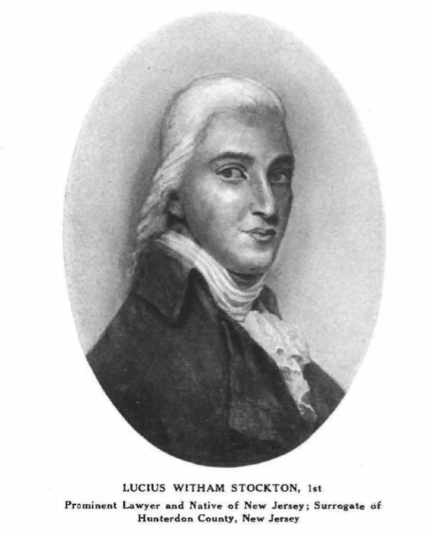 Another case of Stewart being sued for debt took place on November 1, 1801, when Lucius W. Stockton, Esquire, “Clerk of the Court of Common Pleas, Court of General Quarter Sessions in and for the County of Hunterdon,” obtained a ruling from the court against “Samuel R. Stewart, Esquire, Gentleman, one of the attornies [sic] of the said Court present in Court in his proper person.”
Lucious Witham Stockton (1771-1811), the son of Rev. Philip W. Stockton & Catharine Cumming, was admitted to the Bar in 1793.11
In 1794, Stockton became Clerk to the Court of Common Pleas. The next year, he married Elizabeth Augusta Coxe (1775- ), daughter of Charles Coxe & Rebecca Wells.
Then in 1796, Stockton was involved in creation of the new road in 1796 that became Mine Street in Flemington (as described in Part Two of the County House.
A year later, in 1797, Stockton acquired from Alexander Bonnell a lot just south of the courthouse lot.12 Stockton acquired property on the west side of Flemington owned by his mother Catharine, sold in 1800 by Roger Bowman to Stockton’s uncle John N. Cumming.13
Stockton claimed that Stewart owed him $845.18 for “sundry services done and performed by the said Lucius W. Stockton Clerk of the county . . . for the use of him the said Samuel R. Stewart, Esquire as one of the attornies [sic] of the said Court.” Stewart had promised that he would pay the amount “when he should be thereunto afterward requested.” But Stockton stated that Stewart had “fraudulently, craftily and subtlely intended to deceive and defraud him.”
A year later, Stockton claimed Stewart owed him $422.59 in damages. The court decided that
said Lucius ought to recover his damages against the said Samuel by reason of the non-performance of the several promises & Assumptions aforesaid but because one court before us doth not know what damages the said Lucius hath sustained by reason of the promises aforesaid, Therefore We command you that by the oath of twelve good & lawful men of your bailiwick you diligently enquire what damages the said Lucius hath sustained as will by reason of the non-performance of the several promises & assumptions aforesaid.
As clerk, Stockton was the one to sign this order.14
What was the outcome? I have not pursued this interesting case. Also, I am not providing a short biography of Lucius W. Stockton for the simple reason it would take too much space and is only indirectly relevant. Perhaps in a future article.
4. Samuel R. Stewart’s Last Will & Testament
On October 14, 1799, Samuel and Anna Stewart, at last a married couple, had their second child, Robert S. Stewart.
It may be that administering his father’s estate, along with having a second child focused Stewart’s attention on his own mortality and the burden that the lack of a will would place on his heirs.
Samuel R. Stewart signed his will on Christmas Eve, Dec. 24, 1800, when he was only 35 years old, identifying himself as Samuel R. Stewart of Flemington, Amwell, Counsellor at Law.
He named friends Samuel Leake (Barrister at Law), George C Maxwell (Counsellor at Law) and Jacob Anderson as Executors. It was witnessed by Alexander Reading, William Geary and Nathaniel Saxton.
To his wife Anna, he left the sum of £500, in lieu of her right of dower. This meant Anna would not have to depend on the future value of her dower right in Samuel’s property. He probably learned this lesson after helping Anna’s mother claim her dower right in the courthouse lot.
Stewart also left to his infant sons, Charles and Robert, the residue of his estate once they reached the age of 21. Even though Anna Smith Stewart was still alive at the time, Samuel named as guardians for his children his sister Martha Wilson and Geo. C. Maxwell. This suggests that Anna may have been unable to deal with the legal complications involved.
Others named in the will were Philip J. Stewart, Margaretha Wilson and Elizabeth Lawson. The only one of these that I can directly connect with Samuel R. Stewart is Margaretha, daughter of Samuel’s sister Martha Wilson.
Samuel R. Stewart died on September 15, 1802 at the age of 36. Considering his young age and his making a will only two years earlier, it seems likely that Stewart was suffering from a disease of some sort.
On September 29th, an inventory of his estate was taken by James Griggs (the man who was given charge of the deed from George Alexander to the Freeholders in 1793) and by Alexander Bonnell, by that time owner of George Alexander’s tavern lot. The inventory was valued at $2,022.21 and included a list of books. The next day, Samuel Leake renounced his position as Stewart’s executor (witnessed by Charles Ewing and George C. Maxwell). The will was recorded the same day.
Anna Smith Stewart died on March 22, 1806, at the same age as her husband.
NOTE: I have no record of when Anna’s mother Susanna Smith died.
The burial location for Samuel and Anna is not known. They might have been buried in the Grandin cemetery with Samuel’s parents, or they might have been buried in the unknown location where Samuel & Esther Fleming and George & Mary Alexander were also buried.
5. Stewart’s Half-Acre Lot
Given Samuel R. Stewart’s connection with the old tavern lot through his wife Anna’s mother, Susanna Smith, I couldn’t help but wonder where Samuel & Anna Smith were living. To my frustration, I could not find any evidence for the house Samuel built in 1795, other than what was described in the letter that year from David Frazer (see above). Frazer might have been mistaken about Stewart purchasing the property on which the house was built. If Samuel really did spend £2,200 on the Gershom Lee property, he failed to record the deed, and he did not get a mortgage.
I suspected that the house that Samuel R. Stewart built in 1795 was located on the half-acre lot that he bequeathed to his two sons, and that it was the same as the half-acre lot sold to Stewart and Geo. C. Maxwell as tenants in common by Joseph & Mary Robeson sometime before May 1800.15
James P. Snell wrote that Samuel R. Stewart’s son Charles “was born in a house his father occupied, near the present [1881] residence of John C. Hopewell.”16 John C. Hopewell’s mansion was located along East Main Street. (See “One Man Makes a Difference.”)
After Stewart’s death, his half-acre lot was sold, but not until Feb. 1, 1810. At the time Stewart’s son Charles was 15 and son Robert was 11, so it was their guardians, Martha Wilson and George C. Maxwell Esq. of Flemington, who sold the property. The purchaser was Elnathan Moore who paid $650 for it.17
The deed described the property as bordering the great road leading through Flemington to the South Branch of the Raritan River [i.e., East Main Street], the Tavern lot lately purchased by Elnathan Moore, and heirs of Col. Charles Stewart dec’d. Moore’s tavern lot was located where the Civil War memorial stands today. Property owned by the “heirs of Col. Charles Stewart, dec’d” was the remainder of the 350+ acres purchased in 1800.
By plotting the deed for the half-acre lot along with all the bordering properties named in the deed from Martha Wilson & Geo. C. Maxwell to Elnathan Moore, as well as later deeds for the half-acre lot, I was able to determine that the Stewart lot was eventually owned by Charles Green, who’s property appears on the 1850 map titled “Plan of the Township of Raritan” (below); also on the Cornell Map of 1851.
“C. Green” is shown on the east side of East Main Street, between Hiram Green and John Skillman.
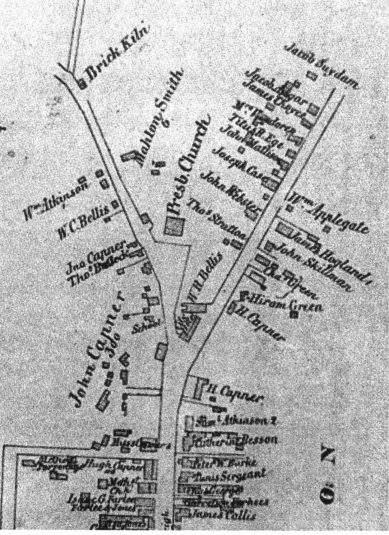 George C. Maxwell had been a tenant in common with Samuel R. Stewart when they purchased the half-acre lot from Joseph Robeson sometime before May 20, 1800. So, he had a double reason to be one of the grantors of this property.
Perhaps the delay of eight years after Stewart’s death was due to the challenge of administering the estate of Charles Stewart at the same time as that of Samuel Stewart. It was not until October 1909 that the Orphans Court decreed that the Guardians of Samuel’s children, Martha Wilson & George Maxwell, could sell the property to benefit the sons.18 Samuel’s son Charles came of age in 1816, Robert in 1820.
Having located the home of Samuel R. Stewart, attorney for Susanna Smith, his client in 1793 as part owner of the old Alexander tavern lot, and husband of Susannah’s daughter Anna, it is time to return to the history of the County House, which I expect to do in my next article.
Note: A history of the life of Samuel R. and Anna Stewart’s first child, Charles S. Stewart, was written by John W. Kuhl in 2009 and published in the Hunterdon Historical Newsletter, Spring 2009 edition.
End of Part Four of the County House series
Part Five will return to the Alexander tavern
and its new owner, Alexander Bonnell.
Footnotes:
- There are too many articles 0n this website mentioning people with the name Stewart for me to include links here. If interested, please search on the name Stewart. ↩
- Letter from David Frazer of Hunterdon Co. to Col. James Martin of Stokes Co., NC. In the possession of Francie Lane of California, Nov. 28, 2010. ↩
- Hunterdon Co. Deed, Book 13 p.169. This deed has a very helpful recital, describing the history of the property’s ownership, going all the way back to 1745 when a tract of 533.5 acres was surveyed for John Reading. See Union Hotel, part one. ↩
- Rev. George S. Mott, History of the Presbyterian Church in Flemington, p. 39; drawing of the church following page 40. ↩
- The tavern at Howell’s Ferry was located at the intersection of Routes 29 and 523, not at the present day located at the head of Bridge Street. ↩
- Deed Book 1 p.283. ↩
- Deed Book 1 p.48. ↩
- 1796 Oct 28, LW&T Joseph Robeson of Amwell, NJA 1986J. ↩
- Some genealogists claim additional children for Charles & Mary Stewart, but I have no record of them. ↩
- Deed Book 55 p.199. ↩
- I have struggled to determine which spelling is correct for Stockton’s middle name: was it Withan or Witham? Regrettably, clerks in the early 19th century were as confused as I am—both spellings were used. Presumably, Withan/m was a family name—I suspect Witham was the original spelling. ↩
- H.C. Deed Book 5 p.380. ↩
- The transactions involving this property are described in Dennis Bertland, Preservation Plan for Fleming Castle; Prepared by Historic Building Architects, LLC, and Dennis Bertland Associates, November 2006, III-1. ↩
- Hunterdon County, Miscellaneous Court Records, 1713-1860, found on Family Search, using a full text search. The original is located at the County Clerk’s Office in Flemington. ↩
- Deed Book 2 p. 439. ↩
- History of Hunterdon County, 1881, p.207. ↩
- Deed Book 16 p.469. ↩
- A document was recorded on Nov. 3, 1813 in which Guardianship of Robert and Charles P. Stewart, sons of Samuel R. Stewart Esq. of Amwell Twp. dec’d, was granted to Mrs. Martha S. Wilson. Sureties were George C. Maxwell and Alexander Bonnell. See H.C. Surrogate’s Court, Accounts 1815-1818, and Guardianship Files, #1256, 1279. This was probably meant to clarify that Martha Wilson was from then on, the sole guardian of the Stewart children. ↩