
The Sutton Family Burying Ground

by Marfy Goodspeed on May 18, 2013

in Delaware Township

The Sutton Family Burying Ground

The Sutton Family Burying Ground

This article is about one of Delaware Township’s most secretive burying grounds, and is part of a series on Delaware Township cemeteries. It is also a follow-up to my series of articles on Buchanan’s Tavern, since Archibald Buchanan was buried here.1 

The Cemetery

The plot is located on the farm that belonged to the family of Archibald’s wife Delilah Sutton Buchanan. It is on the old Mason Farm, in what is now part of the Robin Hill Development, off of Sutton Farm Road. It is not very far from another secretive burial place, which I call the Kitchen-Thatcher Burying Ground, and have written about previously, here and here.

The Sutton Burying Ground is about 30 by 60 feet in size, with an old stone wall, or what remains of one, surrounding it. There was a huge and very ancient tulip poplar tree there, that was hollow by the time Hiram Deats came to visit in 1922; he thought it had been there since the Revolution. When the subdivision called Robin Hill was made in the 1980s, an easement was created for the cemetery, and a fund of $2000 was required for its maintenance. I’ll bet no one has made use of that money for quite a long time.

The Farm

The Sutton Farm first belonged to Jonas Sutton, who first came here sometime before 1744.2 We can’t be sure because Mr. Sutton never recorded his deed. He was born on April 18, 1721 in Piscataway, NJ, grandson of a family who moved to New Jersey from Plymouth, Massachusetts.

We also do not know the name of his first wife, but it appears he married her around the time he arrived in old Amwell Township, because his first four children were born from 1748 to around 1755. He married his second wife, Elizabeth Runyon, in 1764, and had five more children with her. A genealogy written by Olive Barrick Rowland in 1935 described his house this way:

Jonas Sutton’s house was “a long inn-like structure, the first story built of stone surfaced with plaster, and the second story of wood.  There is a verandah the full length of the second story front, the house being built on the side of a hill. Originally a lane lead from the buildings to the Flemington highway [Route 523]; but the only present approach is by way of another long and neglected lane, a continuation of the lane of a neighboring farm, in from Sandbrook.”3

The house is no longer standing. It was long gone before the new development was built. When Jonas Sutton wrote his will on March 25, 1797, he left his farm to his wife Elizabeth, to be shared with his son Amos during her lifetime, and then all the property to Amos who was to pay legacies to his many siblings.

This Amos Sutton (1765-1828) was the father of Delilah Sutton Buchanan. He married Jane Robins, daughter of John Robins and Elizabeth Taylor, in 1785, after the Revolution was over. He had served in Capt. David Seeley’s Company in 1780 when they were bogged down in Hackensack, New Jersey. Sutton, who was only 15, decided he’d had enough and returned home.4 Apparently no one ever bothered to charge him with desertion. And given the fact that his father gave him all the property and made him sole executor, he must have been a trustworthy person. He ran a distillery on his farm that was very well-known; people thought its products were superior because the main ingredient, water, came from a cold spring on the property.5

Amos and Jane Sutton had ten children. Two of them, John (1802-1885) and Jonas (1804-1879), acquired the family farm after their father’s death, but they had to buy it at a sheriff’s sale as their father had gone into debt. John did not remain on the property; his brother Jonas did. He married Mary A. Besson (1806-1861), daughter of Francis Besson and Elizabeth Thatcher, around 1830; they had six children. Jonas Sutton served on the Delaware Township Committee in 1840, and continued the distillery. He also kept racing horses on his farm and advertised them for breeding.

After his death, in 1880, his executors were obliged to offer the farm for sale, now reduced to 115.48 acres, which then passed out of the Sutton family.

The Stones

Most of the stones in the Sutton Burying Ground are no longer visible. Thankfully, in 1922, Hiram E. Deats found this place and made note of the graves that were still standing at the time. At the bottom of his list he wrote: “There are at least fifty graves. Enclosed stone wall, about 40 ft. square. Copied Sept. 27, 1922. H.E. Deats.” If you go there today, you won’t be able to find most of the stones that Deats found, and many of the surviving ones are unmarked.

Brian E. Rounsavill, who has been researching his family for many years, made a visit to the cemetery in 2001, and published a Rounsavell genealogy that included a chapter on the burying ground.6 He had a difficult time locating the cemetery, and at first could not find the gravestones belonging to Rounsavell family members. During a second visit, he succeeded in finding the Rounsavell stones that Deats had listed, buried beneath the soil and severely damaged. With approval from the Delaware Township Committee, he uprighted and restored them.

Here is the list of stones that Hiram E. Deats found in 1922, arranged by families:

I. S. | 1797 | Agd 76

This was Jonas Sutton Sr., born April 18, 1721, Piscataway, son of Richard Sutton and Sarah Runyon. In the 18th century, a J was often written as I. He wrote his will on March 25, 1797, and it was recorded on November 11, 1797.7 His plantation went to son Amos after his wife Elizabeth died, and the other 8 children were to receive payments of £120 each, except for son Nathan who only got £75.

I. S. | 1795

John Sutton (1748-1795), son of Jonas Sutton and his first wife, married Dinah Bonham (1756-1810), daughter of Uriah Bonham and Anchor Fox, in 1773. He lived on a farm one mile west of Locktown. John Sutton was only 47 when he died. It was obviously unexpected; he did not write a will. His widow Dinah died at the Locktown farm when she was 54, but I do not know where she was buried. They were survived by 6 of their 7 children, all daughters except for son Uriah Sutton (1779-1849).

Amos Sutton | died April 6, 1828 | age 63

This was the son of Jonas Sr. who inherited the farm. Because of his indebtedness, he did not have property to bequeath.

Jane | Relict of Amos Sutton | died March 15, 1834 age 69

She was the daughter of John Robins (c.1720-1802) and Elizabeth Taylor (c.1725-bef 1777), and probably grew up on the farm adjacent to the Sutton farm. She and Amos Sutton married in 1785 and had 10 children, including Delilah Sutton, born about 1790.

Archibald Buchanan | died April 20, 1819 | age 29

Archibald Buchanan 1819

Archibald Buchanan 1819

Archibald Buchanan was the son of  John Buchanan and his second wife, Azubah Lake. He married Delilah Sutton, daughter of Amos Sutton and Jane Robins. Her gravestone has not been not found; she died around 1848. Archibald Buchanan died only one year after his father died. His was the only stone with a readable epitaph:

In Memory of
Archibald Buchanan
who departed this life
April 20th A.D. 1819
in the 29th year
of his age
Dear friends farewell I go to dwell
With Jesus Christ on high;
There for to sing Praise to my king;
Thro’ all eternity.

 E. H. L.

This is probably Elisha H. Large (1823-1853), the son of Jacob Large (1790-1854) and Sarah Sutton (1789-1863). Sarah Sutton was the daughter of Amos Sutton and Jane Robins. She married Jacob Large in 1813, and they had 9 children. She and Jacob must have had a falling out because in 1850, Jacob was counted by himself, living in the household of Rev. Israel Poulson, but Sarah is nowhere to be found (not with her children and not with her siblings). In 1860, she was living with her youngest son William, a master carpenter of Lambertville, who married Abigail Holcombe Case about 1856. She died there in 1863, but I do not know where she was buried.

Given that son Elisha H. Large was only 29 years old when he died, it seems likely he was a victim of an accident, of typhoid fever or consumption.

Amos Robbins | Sept. 15, 1827 | 79-4-0

Amos Robins was the son of John Robins and Elizabeth Runyon, and brother to Jane Robins who married Amos Sutton. He lived on the other Robins farm, the one along the Boarshead Road, and for a time ran the Boarshead Inn/Hotel on Route 579. He married Ruth Barnes (1758-1823) on October 26, 1777; they had at least two children, Job, born about 1785, and Sarah, who married a cousin, Joseph Robbins.

Ruth, wife of Amos Robins | died November 23, 1823 aged 65

The wife of Amos Robins was Ruth Barnes, daughter of William Barnes (c.1725-c.1785) and Hannah Kitchen (c.1727-?). William and Hannah Barnes owned a farm on Route 579 not too far north of the intersection with Route 523.

B. A.

No one in my database with those initials has any connection with the Sutton family.

J. H. M. 1816

R. H. M.

The common middle initial and surname initial suggests they were siblings. I cannot identify them. I looked for possible relatives of the Sutton family whose surname began with M, and found Elizabeth B. Sutton (c.1835-1891), daughter of Jonas Sutton and Mary A. Besson, who married Gideon C. Moore (1837-1904) about 1865, but that was too late for these stones.

The Rounsavell Family

R. R.

Richard Rounsavell | 1777 | Ag’d 43

Isaac Rounsavell | Dec. 28, 1839 in 76th year

The original ancestor, Richard Rounsavell (believed to have been the son of Roger Rounsavall and Mary Warne), was born on March 12, 1658 and christened on March 22, 1658 in the village of Padstow in Cornwall, England. He immigrated to New England and was present in Stratford, Connecticut from about 1680 to 1690. From there he moved to Wickapogue, Southampton, Long Island until about 1700, when he moved to Hopewell Township, in what was then Burlington County, where he wrote his will in 1703.8.

His son, typically referred to as Richard Rounsavell Sr., was born around 1690, and appears to have settled in Readington Township around 1725. But in 1743, he acquired a farm just south of the Jonas Sutton farm. The Rounsavell family was not related to the Sutton family, even though they were close neighbors. He had married his wife Rebeccah Bogart in Albany, NY in 1718, but she died in 1747, not long after arriving in Amwell Township. She is probably buried here, but her grave is long gone. They had 7 children, but only sons Richard and Henry had any presence in this neighborhood.

In 1757, Richard Rounsavell, Sr., together with Daniel Robins and George Trimmer, witnessed the will of Thomas Kitchen. In 1773, he wrote his own will, as yeoman of Amwell, dividing his home plantation between his sons Richard and Henry. By December 1775, he was dead, and it is believed that the stone with the initials R. R. belongs to him.9

Gravestone of Richard Rounsavell, Jr.  Inscription reads, “Richard Rounsavell, 1777, Ag’d 43.”   This is the oldest stone in the Sutton Burying Ground. Photo courtesy of Brian E. Rounsavill of Newtown, Pennsylvania

Gravestone of Richard Rounsavell, Jr.
Inscription reads, “Richard Rounsavell, 1777, Ag’d 43.”
This is the oldest stone in the Sutton Burying Ground.
Photo courtesy of Brian E. Rounsavill of Newtown, Pennsylvania

Brian Rounsavill wrote:  ”It should be noted that this Richard Rounsavell, who was a minor when his father died in 1703, was commonly referred to as “Richard Rounsavell, Sr.,” although he was actually Richard Rounsavell II.  At the same time, his son Richard, born in 1734, was referred to as “Richard Rounsavell, Jr.,” although he was actually Richard Rounsavell III.  The reason that people referred to them as “Sr.” and “Jr.,” and not II and III, was due to the fact that Richard Rounsavell I passed away in 1703 while Richard Rounsavell, Sr., who was born circa 1695, was less than ten years of age. As a result, there is little remaining documented evidence of the first Richard Rounsavell in Hunterdon County (then Burlington County), New Jersey. Richard Rounsavell I’s children were most likely raised either by their widowed mother or other relatives or families. In contrast, Richard Rounsavell, Sr. and Richard Rounsavell, Jr. were both actively involved in Hunterdon County, New Jersey throughout the mid to late 1700s, often in the same place at the same time on the same transaction. Therefore, individuals would have found it necessary to differentiate between the two Richard Rounsavells. Since they were in fact father and son, they were aptly called “Sr.” and Jr.” As fate would have it, they also died within two years of each other, in 1775 and 1777 respectfully. This also accounts for why neither Richard Rounsavell, Sr. nor Jr., both active and well-respected citizens at the time, were ever documented as serving in the Revolution.”

Gravestone of Isaac Rounsavell, which was crushed by a large tree root  and pieced back together by Brian Rounsavill. Photo courtesy of Brian E. Rounsavill of Newtown, Pennsylvania

Gravestone of Isaac Rounsavell, which was crushed by a large tree root
and pieced back together by Brian Rounsavill.
Photo courtesy of Brian E. Rounsavill of Newtown, Pennsylvania

Richard Rounsavell Jr. (1734-1777) married Rachel Stout in about 1753, daughter of Freegift Stout and Mary Higgins. He was frequently called upon to assist in the settlement of his neighbors’ estates. He wrote his own will on January 20, 1777, and died only three weeks later at the age of 42, leaving his widow alone to raise their 7 children.

One of those children was Isaac Rounsavell, born on March 3, 1764. About 1785, he married Catharine Larew, daughter of Abraham Larew and Mary Thatcher. He wrote his will on January 14, 1839, when he was 75 years old, leaving most of his estate to his grandson Harrison Rounsavell, the son of Stout Rounsavel and Elizabeth Thompson.

Many thanks to Brian E. Rounsavill for contributing information about the Rounsavell family and photos of the Rounsavell stones.

Postscript: The Trouts

I am intrigued by the fact that no members of the Trout family appear to have been buried here. George Trout (1773-1843) and wife Annie Besson (1783-1866) lived on the large farm just south of the old Robins tract, and must have been well-known to the Sutton family, since his farm ran along the northern border of the Sutton farm. Not finding any Trout stones here, I checked on the Kitchen-Thatcher burying ground nearby, but there is no evidence of them there either. As it turns out, George and Annie Trout were buried in the Lower Amwell Old Yard, the cemetery associated with the Amwell Baptist (Dunkard) Church. His daughters Sarah (wife of Jacob N. Thatcher) and Lucretia (wife of Ephraim Robbins) were also buried there; son John and his first wife, Mary Y. Brewer were buried in the Sand Brook Cemetery. Daughter Margaret (wife of Shf. Robert Thatcher) is buried in the Prospect Hill Cemetery in Flemington.

Postscript: Another Burying Ground

There is another, smaller, cemetery near the Sutton Family Burying Ground. It is across Route 579, in the Raritan Township section of the Robin Hill development, hiding in someone’s backyard. I recently got the chance to visit this previously unknown to me burying ground. It has a low stone wall, and three large old marble stones, made in the same design as the one for Archibald Buchanan, pictured above. Sadly, the inscriptions have been erased by time and weather, and are now unreadable. John Micek told me that he recalled that one of the stones was a Buchanan, and perhaps this is where the missing grave of Delilah Sutton Buchanan rests. Given its location, it seems more likely to me that members of the John Robins family would have been buried here. You can learn more about that family in this post from the series on Buchanan’s Tavern.


  1. To see the series of articles on Buchanan’s Tavern, click on the topic in the right-hand column.
  2. That year he bordered Andrew Pettit who had applied for a mortgage from the Hunterdon Co. Loan Office (No.182).
  3. Olive Barrick Rowland, Genealogical Notes on Sutton and Rittenhouse Families of Hunterdon County, NJ, An Ancestral Chart & Handbook, Richmond, VA: 1935.
  4. From a pension application filed by William Marts, No. S2724.
  5. Cornelius W. Larison, N.D., “Skech of the Fisher family of old Amwell township in Hunterdon County, NJ.,” Fonic Publishing, 1890.
  6. Richard Rounsavell and His Descendants, vol. 2, by Mark P. Rounsavall and Brian E. Rounsavill, 2002, 1220 p., $60. Contact Mark Rounsavall at mrounsavall@crg.org for an order form. Notice that each of the names has a different vowel in the last syllable.
  7. New Jersey Archives, estate no. 1815J
  8. Richard Rounsavell and His Descendants, vol. 2, by Mark P. Rounsavall and Brian E. Rounsavill, 2002, 1220 p.
  9. For more information about him, see the Rounsavell Genealogy.

{ 2 comments }

Pine Hill Cemetery

by Marfy Goodspeed on May 15, 2013

in Delaware Township

Pine Hill Cemetery 2009

Pine Hill Cemetery 2009

In 2009, I published an article about this interesting cemetery on the website The Delaware Township Post. This coming June, this cemetery will be the focus of a celebration; most of the original Williamson farm has been purchased from Bryce Thompson by the N. J. Conservation Foundation in partnership with the State of New Jersey, Hunterdon County and Delaware Township. The cemetery is part of this new addition to preserved lands in our town. I am delighted! Here is the article:

William Williamson was born about 1708 in Gravesend (Brooklyn) to Cornelis Williamson and Grietje Gulick. His great-grandfather Willem Gerritsen had emigrated from Holland to Bermuda, and then to Amersfoort (Flatbush) in New Netherland in 1659. About 1730-32, William Williamson married Patience Hull, the daughter of Samuel Hull and wife Margaret. Their first child Margaret was born about 1732.

In 1735, William Williamson bought a large tract of land from Tunis and Paul Amerman in Amwell (Delaware Twp.). This property extended north from Pavlica Road. The Williamson family remained there, with six more children born after Margaret. In 1742, William Williamson bought another large tract of land to add to his original purchase. In 1752, he was named an overseer of roads for Amwell Township.

J W 1750

J W 1750

The earliest stone found in the cemetery is  “J  W / F 14 / 1750.” Williamson researchers cannot identify who this might be. Perhaps it was a child of William and Patience Williamson who died young.

The next earliest stone is “AP 10  1765  W W.” It is generally agreed by Williamson researchers that this is  William Williamson, the first settler. He wrote his will 0n January 20, 1764. It was not recorded until June 16, 1774, suggesting that he died close to that date, which is usually the case. But this family is different. His eldest son Cornelius was very reluctant to carry out the provisions of the will, which eventually led to a court battle that Dickens would have appreciated. In fact, court papers confirm that William Williamson did die in 1765; the stone sets the date at April 10th.

The next to be buried here, as far as we know, is William’s father. This stone was only recently discovered by Dot Williamson. It was lying about a foot underground.  It reads: “May 11, 1772 C W  AG 100.” Williamson descendants have concluded that this must be Williams’ father Cornelius Williamson, who died May 11, 1772 age 100. This is remarkable for two reasons. First, the Williamson descendants had been having a hard time locating this Cornelius, so discovery of this stone was a real breakthrough, and secondly, that he lived to the age of 100 in the 18th century. Most unusual. His son William was only 57 when he died.

C W 1772

C W 1772

The next earliest stone, “A.W. 1781 AP 24” {backwards 4}, belongs to one of the sons of William and Patience, Abraham Williamson, born about 1743. It is thought he might have had some kind of handicap, as his father left an extra £100 for him in his will and it appears he never married.

In December 1787, William’s wife Patience Hull died and was buried here. Her stone reads “P W.”

Later members of the Williamson family who are buried here are William (d.1848), Asher (d.1860), and Moykee (d.1868).

William Williamson,
died October 21, 1848, age 79-2-3.

He was the son of Cornelius Williamson and grandson of William Williamson and Patience Hull. He never married. I think he might be the “Uncle Billy” who used his 7-foot musket to shoot and kill a large panther on a farm on Reading Road. This story was told by Jonathan M. Hoppock in an article published in the Democrat in 1902.

Asher Williamson,
died May 28, 1860, age 83-1-3

Asher Williamson was the brother of William, above, and another son of Cornelius. He also never married, but had a very active and contentious life. He took advantage of gullible relatives to acquire rights in the estate of his grandfather William Williamson. He was sued for this in 1824, but it took until 1843 for the court to rule against him.

Moykee Williamson,
March 6, 1785-December 8, 1868, age 83-9-2

Asher Williamson’s sister Moykee Williamson was buried next to him. She also did not marry. She kept house for her brother Asher, who had left the bulk of his estate to her in his will.

One inventory of the Cemetery lists this stone: “R. W. 1899.” It is no longer to be found in the cemetery, and has not been identified.

In the 19th century other families began to use this plot. The earliest found was “W. S. died October 4, 1792.” The S is reversed. The name was probably William Sergeant. This makes him a contemporary of Charles, John and Joseph Sergeant of Sergeantsville, but I have not been able to link him to that family.

Another mystery is L. S. 1807. The father of Charles, John and Joseph Sergeant, Joseph Sergeant Sr., died without a will in 1807. The ‘S’ on this grave stone is written backwards. But there is no mistaking the L. It is not a J. So it probably isn’t Joseph Sergeant Sr. But who is it? There was a Loman Sergeant, born 1763, died 1852, who was a son of Joseph Sergeant Jr. Perhaps there was an earlier Loman Sergeant.

At least we can be clear about Charles Sergeant.

Charles Sergeant,
died April 11, 1833 in his 74th year. b.1760

Sarah Green Sergeant, widow of Charles,
died March 27, 1835

He ordered in his will that an iron fence be installed around the graves of his wife and himself. Charles Sergeant’s wife was Sarah Green, daughter of Samuel Green and Elizabeth Waterhouse, and granddaughter of Richard Green and Elizabeth Woolverton. The son of Charles and Sarah Green Sergeant was named Richard Green Sergeant, but he was always known as Green Sergeant, the name that attaches to the covered bridge today. But his grave is not here.

A short history of the Sergeant family would mention that Charles, John and Joseph Sergeant are said to have been storekeepers in Skunktown (later Sergeantsville) before the Revolution, that Charles Sergeant, born on March 30, 1760, enlisted in 1781 in the Amwell militia, and returned to storekeeping after the war. Charles began acquiring property in the 1790s, gradually building up his wealth. When the Opdycke family offered the mill property at the covered bridge for sale in 1805, Charles bought it and made improvements. The area around the mill and the bridge came to be known as Sergeant’s Mills. After his death in 1833, his executors had a lot of work selling off his many properties.

In a deposition in a court case involving the estate of Margaret Williamson Larew Hull, daughter of the original William Williamson, Charles Sergeant testified that he was Margaret’s nephew. I have never been able to determine how he was related to her. Perhaps someday the mystery will be solved.

There were two members of the Heath family buried in this cemetery. The Heaths owned large acreage north of the Williamson farm, between Locktown-Sergeantsville Road and Ferry Road. Buried here is M. Heath 1806 and J. Heath 1819. This is John Heath, born 1724, died March 11, 1819, and his wife Mary, born 1728, died 1806, maiden name not known. John Heath was one of the nine children of Andrew Heath (c.1695-1745) and wife Mary. I do not know when he moved from Amwell to Kingwood Township, but that is where he was living when he died at the age of 94. His obituary read: “Mr. John Heath, in the 94th year of his age. . . was esteemed as an useful and respectable man; he had led an active and temperate life, and it is believed that within the last year he could have walked from three to four miles per hour, for several hours in succession, without any unusual exertion.”

Mary Lake is buried here. She was born Mary Sergeant in 1765, sister of Charles Sergeant, and died age 48 on April 15, 1813. About 1790, she married Cornelius Lake, who owned the Gilde farm in Sergeantsville. Cornelius was Commissioner of Deeds for many years, and his name appears in hundreds of deeds for that reason. Cornelius Lake died age 80 in 1842 and is buried in the Lower Amwell Old Yard.

The latest stone to be found at Pine Hill belongs to Abraham Rounsavell, who died age 67 on Aug. 17, 1853. He never married. According to the Rounsavell Genealogy, Abraham was an invalid from birth. His father’s will, dated Jan. 14, 1839 when Abraham was 53 years old, stipulated that Abraham be cared for by the Executors of the will and that Isaac Huffman (one of the executors) be Abraham’s guardian.

Correction, 5/20/2013:  I took the date 1853 from the Hiram Deats Inventory list at the Hunterdon Co. Historical Society. But today, while scrolling through Dennis Sutton’s excerpts from the Hunterdon County Democrat, I discovered that Abraham died on Aug 17, 1863, not 1853.

His parents were Isaac Rounsavel, who died in 1839 and is buried in the Sutton family burying ground, and Catharine Larew, who died on April 5, 1832 and is said to have been buried at Pine Hill, although her stone is missing. As a sidebar, I note that the Hunterdon Gazette reported on Jan. 7, 1829 that “Isaac Rounsavell lately delivered a Hog at the store of D. & P. Brewer, Head Quarters, in this township, which was about 20 months old, and weighed 680 lbs. He measured 6 feet 7½ inches in the girt before he was slaughtered, and 7 feet 11½ inches from the end of the nose to the root of the tail.”

Two other stones may be members of the Rounsavell family: C. R. and S x R.

One would expect other members of the Larew family to be buried here. I have already mentioned William Williamson’s daughter Margaret who married Daniel Larew (c.1720-1762). Their farm was on Reading Road, adjacent to his brother Moses Larew (1740-1797) and wife Urania Thatcher. Both farms backed up to Pavlica Road, just south of the Williamson farm. Another Larew, David (c.1740-1787) and wife Abigail Rittenhouse lived somewhere nearby, and the fourth brother, Abraham (1727-1806) and wife Mary (possibly Thatcher) owned the Donald Jones farm. There is a stone here that probably belongs to Moses Larew: M. L. There is also a stone that reads A. L. and A. Larowe, son. There are any number of possibilities for A. L. The name Abraham was a favorite in the Larew family.

The final mystery is a stone that reads “I.F. May 14  1831.” I thought perhaps it could have been Isaac Rounsavel, the F a mistake for R, and 1831 a mistake for 1839. But Isaac died on Dec. 28th, so there’s no question it is not the husband of Catharine Larew.

One possibility is John Furman (born 1755, died 1831, married Elizabeth Wildman). He owned the farm and farmhouse on Locktown-Sergeantsville Road where Plum Brook crosses. J’s were often written as I’s in the 18th and 19th centuries. However, the stone was broken in several pieces, so we can’t be sure that the inscription is correct.

In 1816, owners of the Williamson Farm in exchange for $6.40 conveyed enough land to John Sergeant, James Larue, Thomas Lake and Asher Williamson to enlarge the existing graveyard to a square of about a quarter acre, with privilege to build walls and maintain it.  Oddly enough, none of these gentlemen (except Asher Williamson) are known to be buried in this cemetery, even though all were residents of Delaware Twp.

It is hard not to think that there are other stones buried a foot or more beneath the surface at Pine Hill. Dot Williamson and her husband Jack who live in Vermont have been making regular trips to the plot to beat back the weeds and banish the woodchucks, with the help of Helen Maliszewski of Cherryville. It is a never-ending task, but they have done a marvelous job. Perhaps they will soon be rewarded with another remarkable find.

I want to thank to Richard Williamson, Helen Maliszewski, Dot Williamson, Perry Streeter, and Marilyn Schmidt for their generous help with research for this article.

{ 0 comments }

1838 Township Business: The Dog Tax

by Marfy Goodspeed on May 15, 2013

in Delaware Township

TAKE NOTICE ! THAT the Township Committee of the townships of Amwell, Delaware and Raritan, will meet at John W. Larason’s on Monday the 2d day of April next, to settle with the several township officers. – All persons in said townships having damage done to their Sheep by dogs, are requested to present their bills to said committee on the day above named before 1 o’clock P. M. If there is not a sufficiency of Dog Tax to discharge said bills, there will be a dividend struck at that time, and those not presented will be disbarred from a benefit of the same. – By order of Town Committee. {signed} J. Gary, Clk. March 14, 1838, The Hunterdon Gazette.

When the first annual meeting of Delaware Township was held on April 9, 1838, the committee voted to have a “dog tax to pay for sheep killed by dogs.”

Dogs running loose were a significant problem in 1838, as they were nearly every year. Most of the township farmers kept a few horses, cattle, hogs and sheep, but sheep were (and still are) the easiest targets for dogs.

The 1790 and 1807 tax ratables show that dogs were counted in Amwell Township in order to levy the dog tax. In fact, on May 24, 1787, the state legislature sitting at Burlington passed “An Act to Discourage the Keeping of Dogs, by imposing a Tax on the Owners or Keepers thereof.” The yearly tax was to be 2 shillings and 6 pence for one dog, and 7 shillings and 6 pence for every additional dog more than 6 months old. This was probably done to reduce the incidents of dogs running in packs. There were fines for those who neglected to tell the assessor how many dogs they had. Nothing was said about how the funds collected were to be used, nothing about reimbursing those whose animals had been injured or destroyed by dogs.

A similar bill was passed on March 13, 1806, called an “An Act Concerning Dogs.”

Whereas in some of the counties of this state, great havoc is committeed upon sheep by dogs, which the existing laws are found inadequate to prevent ; for remedy whereof,
Sec. 1. BE IT ENACTED by the council and general assembly of this state, and it is hereby enacted by this state, and it is hereby enacted by the authority of same,
That from and after the passing of this act, the inhabitants of each township be, and they hereby are authorized and empowered at their annual town-meetings, to order to be levied, assessed and collected, such tax on dogs, in addition to the tax already imposed by law, and to make such other regulations and bye-laws to protect their sheep from the ravages of dogs, as a majority of said town-meeting may deem expedient.1

During the 35th session of the NJ Legislature, a more detailed act was passed on February 23, 1811, titled “An Act for the preservation of Sheep.” It stated that “for every person who shall keep or harbor a dog or dogs above the age of 3 months, shall pay yearly and every year for one dog so kept or harbored, the sum of 50 cents, and for every additional dog above one, the sum of $5.00, and for every slut the sum of $5, although said slut be the only dog kept.”2 The proceeds of the tax were to be used to “make good any losses” suffered by any inhabitants of the respective townships “for the destruction or wounding of their sheep by dogs.”

The act also provided that it would be lawful for any person to kill a dog that was harming or threatening sheep, and any dog owner whose dog was responsible for any damage would have to kill the dog himself within twelve hours, under penalty of law.

The act made reference to the earlier laws cited above, stating that so far as they related to the counties of Essex, Somerset, Middlesex, Monmouth, Burlington, Gloucester, Salem, Cumberland and Cape-May, those acts “are hereby repealed,” to be replaced by the new act. “And be it enacted, that nothing in this act, nor any matter or thing therein contained, shall be considered as applicable to or in any way affect the counties of Sussex, Hunterdon, Bergen and Morris; . . .”

I interpret this to mean that Hunterdon and the other counties were not required to meet the standards of the Act of 1811, but were covered under the earlier acts. Whether or not legislation was passed to require Hunterdon to reimburse owners of damaged livestock, by 1838, that was in fact the practice.

On June 29, 1831, the Editor of the Gazette gave a clear account of how serious the problem was:

SHEEP. – Instances of the destruction of this useful animal by dogs are of such frequent occurrence that we seldom notice them. We should like, however, to see a united effort made by farmers to prevent so serious an evil. Many have improved their flock of sheep at considerable labor and expense. How often does it happen, that the labor of years in this laudable pursuit is blasted in a few hours by a pack of useless dogs. An instance of this occurred near this place on Sunday morning last, in the fold of Mr. Hugh Capner. his flock, consisting of 57, was attacked by dogs, and seventeen of them either killed or so badly wounded as to be useless – among the number was a fine buck for which he paid twelve dollars. The compensation allowed by law in these cases, we are told, is seldom equal to the loss actually sustained. If the tax on dogs were doubled or trebled, it would enable the townships more adequately to remunerate such losses, and lessen their frequency by discouraging the useless multiplication of dogs.

Another incident was recounted in the Gazette in 1835:

LOOK OUT FOR YOUR SHEEP. It is seldom we hear of such havoc among sheep by dogs, as follows: – On the night of the 30th March, the sheep fold, containing the beautiful flock of Merinos belonging to John Coryell, Esq. of Lambertville, was entered by dogs, and twenty of the finest were killed, and several severely bitten. The sheep were penned up as usual for security from the dogs, as they had been previously attacked and more or less injured. If they had not succeeded in forcing out from their place of confinement, but few would probably have escaped the rapacity of their destroyers. – Communicated. April 8, 1835.

Sometimes these dogs were simple farm dogs running loose at night. But there was also a considerable, and well-justified, fear of mad dogs, dogs infected with rabies. Interestingly, the term rabies was never used in the Gazette for the period 1825-1865, but there were many instances of mad dogs reported, and one reference to ‘hydrophobia.’3 For instance, there is this from the Gazette of June 17, 1835:

MAD DOGS. – There is at present, and has been for a week past, some alarm through this section of country on the subject of Mad Dogs; and we regret to state that it is not without some foundation. We learn that two persons near Head Quarters have been bitten by dogs which afterwards proved to be in a rabid state; and that a farmer near Lambertville lately lost two cows from their having been bitten by a mad dog. We are told some are killing off their useless dogs, as a measure of precaution; and it would be well if many others would follow the example. A great proportion of those which run at large are worse than useless to their owners, and during the present warm weather endanger the lives of the citizens.

One wonders what happened to those people who were bitten, who did not have the benefit of modern rabies treatment. There was no mention of them in the paper.

Following a story in April, 1836 about a rabid dog that had bitten a cow, the editor wrote:

The increased number of useless dogs in this neighborhood has become a nuisance to which public attention seems to be at present properly directed. As an evidence of this, we state, that Mr. Cox, of this place, had his flock of sheep attacked by dogs on Wednesday night last, and nine killed, and others badly mangled.

In some of the townships of this county, we are informed, the amount of the dog tax for last year fell far short of satisfying the claims presented for sheep destroyed by dogs within the same period. The present rate of dog tax, it appears to us, is entirely too low to secure the ends of protecting the flocks of the farmer from depredation, and the community from the danger arising from the useless multiplication of dogs.

Since it was usually impossible to determine whose dog was responsible for damage to sheep, Hunterdon municipalities maintained what amounts to an insurance policy funded by the dog tax, to reimburse farmers for their losses. I cannot say exactly what the tax amounted to in 1838 because tax records for this period were not saved.

However, by checking through later years in the Gazette, it appears that the usual tax was 50 cents for the first dog and $2 for the second one. In 1848, Raritan Township raised its dog tax to $1, and $2 for two dogs, while East Amwell maintained a tax of 50 cents. Several townships reporting the minutes of their annual meetings did not mention a dog tax, which is surprising. In 1857 (April 22), Lambertville determined that the dog tax would be $1.50 for the first dog, $2 for the second, and “50 cents additional for any others.”

In 1858, Clinton Township levied only 50 cents as its dog tax, but $5 for “sluts.” The Committee also passed a resolution authorizing it to “petition the Legislature at its next sitting for the passage of a law taxing dogs sufficient to pay the damage done to sheep.” Apparently the fund was not sufficient to meet demand.

Some Old Records

Some of the old township records for animal damage claims have been saved. They date from October 1892 through January 4, 1896. None of the dogs was identified. The livestock killed or wounded were predominantly sheep; others were turkeys, geese, ducks and one colt. Generally, two freeholders (in the case of the colt, four) unrelated to the claimant would view the damage and estimate its cost. Then the claimant and appraisers would appear before a justice of the peace or a notary public (or, in one case, a commissioner of deeds) and testify. The value of the livestock ranged from $1.75 for a gander to $5.00 for a sheep to $37.50 for the colt.4 Clint Wilson wrote that the claim for $37.50 by Dr. W. E. Cornog was refused—the only one to be refused. Claims were submitted as late as June 1961, when the Township Committee awarded $200 to Ivan J. Watson for the death of four sheep killed by dogs.5 The claims system was in effect until a dog ordinance was passed in 1970, which eliminated the tax and made the dogs’ owners liable.

Notice to Sportsmen

There was one other category of notice in the Hunterdon Gazette that appeared regularly every fall. That was “Notice to Sportsmen,” informing them that they, their guns and their dogs were not welcome on the property of the undersigned, usually a list of 10-20 names of property owners. Presumably, people did not post their land in those days, and had to resort to the local newspaper to give warning that violators would be treated as trespassers “under penalty of law.”

The first such notice appeared in the June 24 1835 edition of the Hunterdon Gazette:

Caution to Sportsmen! The subscribers hereby caution all persons against trespassing on their lands with dogs and guns, as the law will be enforced against all who may be found so trespassing after this date.

It was signed by Elijah Carman, Andrew Hogeland, Joseph Sergeant, Samuel M. Higgins, Aaron Hogeland, John Higgins and Gershom Sergeant. They were principally Raritan Township landowners.

A second notice posted on August 12, 1835 included Cornelius Williamson, Mahlon Higgins, William Rockafellow, Asher Fulper, Amos Hunt, Henry Suydam, John Barton, Isaac Barton and Christopher Kuhl. Once again, mostly Raritan landowners.

The first notice from Delaware Township landowners was published in the October 21, 1835 edition of the Gazette. They were Jacob Knight, Green Sergeant, Amos Hogeland, John Curl {sic, Corle or Carrell}, Cornelius Lake, Joseph Leigh and Daniel Hortman.6


  1. New Jersey Session Laws, 1806, p. 251-52,
  2. NJ Session Laws, 1811, Session No. 2, p. 327. “Slut,” an early American term for a female dog. The OED’s earliest example was from 1845.
  3. For those readers not familiar with this term, hydrophobia is “a set of symptoms of the later stages of an infection of rabies, in which the victim has difficulty swallowing, shows panic when presented with liquids to drink, and can’t quench its thirst.”
  4. See “Dogs Ran Wild and Killed Farm Stock” by Clint Wilson, in the Lambertville Beacon.
  5. Hunterdon Co. Democrat, June 1, 1961, clipping from Bertha Schuck.
  6. The only notice in the 1838 edition of the Gazette concerned only Raritan township landowners.

{ 1 comment }

Part II, Delaware Twp. Officers, 1838

by Marfy Goodspeed on May 10, 2013

in Delaware Township

Overseers of Roads

At the first town meeting, the Township Committee voted that $1,000 was to be raised for making and repairing roads. Municipalities were responsible for their roads, while the county took responsibility for the bridges. Generally, it was the landowners along the roads who maintained them, so you can imagine what condition they were in: dust in the summer, mud in the spring and downright impassible in the winter, unless you had a sleigh. The township named many people to be Overseers of Roads. It’s hard to say exactly what their responsibilities were. Most likely, they managed the work that was ordered by the Surveyors of Highways.

In my previous post, I described how Amwell Township decided on how to select the Overseers in 1825. They were chosen at a meeting of all those in a road district who paid road taxes. Exactly what those road districts were in 1838 would be interesting to know. Nineteen Overseers were appointed in 1838, which presumably means nineteen road districts. I have attempted to identify (not always successfully) where each of the following Overseers lived at the time, as a way to identify which roads were getting attention.

Gabriel Aller

Gabriel W. Aller (c.1804-1873) might have been the son of Peter Aller and Mary Wolverton. I find the Aller family very confusing. Gabriel Aller had a small farm in the Croton neighborhood, which had once been known as Allertown. His first wife was named Mary Ann, but she died childless in 1841. In 1842 he married his wife Elizabeth Brittain, daughter of John Britton and Grace Holcombe Bellis, and they had a daughter Caroline in 1845. Gabriel Aller ran into trouble in 1844 when he had to assign his property to John Higgins and attorney James N. Reading, who put his personal property (livestock, harvested grain, farm equipment) up for sale in October 1844. And in December 1844, his farm in the Croton neighborhood (bordering Elisha Warford, John Cowdrick and Joseph Robbins) was sold. Gabriel Aller gave up farming and became a carpenter. He moved his family to Frenchtown where he lived for the rest of his life. He died in 1873 age 69; his wife Eliza died sometime after 1878.

Possible Roads:  Old Route 12, Route 579

[Addendum, 5/11/2013: Pamelyn Bush helped me get this family straightened out, along with reference to an article published in the Hunterdon Republican in 1896, written by Egbert T. Bush. Gabriel W. Aller was indeed the son of Peter Aller, but his wife’s name was Amy Wolverton, not Mary. And Amy was almost certainly the daughter of Gabriel Wolverton and Catharine McMurphy. When Peter Aller died in 1828, his sons John and Gabriel were named administrators of his estate. He did not die in Croton. The Allers did not move there until 1829, when the widow Amy and her son John bought a tract of land there. Gabriel W. Aller bought a farm in Croton in 1835, but sold it in 1844 after going into debt. That was the same year that his mother Amy died.]

James Barcroft

James Barcroft (1796-1875) was a farmer who lived at the corner of Route 519 and Strimples Mill Road. His house is still there but it is now a fascinating old stone ruin. He was the son of Ambrose Barcroft and Frances Opdycke, and on March 2, 1822 married Nancy Opdycke (1802-1881), daughter of Thomas Opdycke and Anna Cowell. They had four children, but only two survived to adulthood, William (1822-1876) and Aaron (c.1834-1880). In the 1860 census, James Barcroft was listed as a 63-year old farmer with property worth $7000, which was a high figure for the time. But by 1870, when he was 73, he only had $1000 worth of property. According to the Barcroft Genealogy, his sons inherited his farm, and it stayed in the family for several generations.

Possible Roads: Route 519, Sanford Road, and Strimples Mill Road

Jacob Bodine

Like Gabriel Aller, Jacob Bodine (1806-1867) was a farmer and a carpenter; he was also a cabinet maker. His wife was Catharine Fauss (1806-1884) and they had seven children.  In the 1860 census, he was listed as a 58-year-old farmer with property worth $3100. After 1867, his widow moved in with son Henry Bodine, who became a well-known auctioneer. The Cornell Map of 1851 shows a “J. Bodine” along Ferry road, and deeds mention Jacob Bodine as a bordering owner to Samuel Carrell, who also lived on Ferry Road.

Possible Roads: Ferry Road.

Robert Bonham

Robert Bonham (1779-after 1850) was a wheelwright who might have been the son of Elijah and Margaret Bonham. His wife was Sarah Ann Wolverton (1779-1865), daughter of Gabriel and Catharine Wolverton. I do not know if they had any children. Robert Bonham bought a house and lot of land from Evan Godown in 1813. That is where he lived and ran his wheelright shop until it was sold in 1851. This was the old Maresca farm on Route 523. The Cornell Map of 1851 mistakenly showed “R. Bowman” at that location. Robert Bonham must have died about the time his house and shop were sold, in 1851, to John D. Bowne, wheelwright. [see deed 100-638]

Possible Roads:  Route 523 south of Sergeantsville

Nicholas B. Higgins

Nicholas Britton Higgins (1787-1851) was the son of Nathaniel Higgens and Martha Perrine. He married Hannah Hill (c.1789-1846), daughter of Samuel Hill and Sarah Trout, in 1809. He lived on a farm south of Headquarters on the Lambertville-Headquarters Road, but he also owned property on the west end of Sergeantsville. He was overseer of roads in 1840, and in 1849 served as a Trustee of the Sandy Ridge Baptist Church. One would expect him to be buried there, but his grave is located in the cemetery of the Flemington Baptist Church. His wife Hannah is also there, and several of their children. Fred Higgins, well-known chicken farmer of Sergeantsville, was their great grandson.

Possible Roads: The Lambertville-Headquarters Road.

John C. Holcombe

John Closson Holcombe (1793-1882) was the son of Richard Holcombe and Elizabeth Closson. He married his wife Rebecca Fisher in 1817. They only had two children, Louisa and Edwin. Holcombe was a miller and a farmer. He moved about some; in 1850 he had left Delaware Township to live in East or West Amwell, but from 1860 through 1880 was back in Delaware Township. By 1870 he was very well-to-do, with a farm worth $10,000 and personal property of $10,000. As for where he was living in 1838, I would guess near Lambertville.

Rebecca Holcombe died in 1873, age 79, and was buried in the Barber Cemetery. John C. died in 1882, age 89, and was buried in the Holcombe-Riverview Cemetery near Lambertville.

Possible Roads: Seabrook Rd, Lambertville-Heaquarters Rd and Alexauken Creek Rd.

Nelson Holcombe

This was probably George Nelson Holcombe (1808-1900), one of the twelve children of Robert Holcombe and Elizabeth Pidcock, and brother of John C. Holcombe. Admiral Horatio Nelson was killed in the Battle of Trafalgar in 1805. He was a great hero to many, and, just like George Washington, many children were given the name Nelson in his memory, even American children. I can’t seem to find any other Holcombe with the name Nelson who might have been around in 1838.

Nelson Holcombe married Matilda Case in 1832, and they had six children. In the 1860 census, he was living in or near Sand Brook. He was a farmer all his life, but 1867 served as Delaware Township’s Chosen Freeholder. By 1870 his farm was worth $8000. In 1880, at a rather advanced age, he was working as Delaware Twp’s Town Clerk.[#. Snell, p. 374; I have to wonder if this might be someone else; in the 1880 census he was 71, a retired farmer.] His wife died in 1879, but George N. Holcombe lived to the ripe old age of 92, dying in 1900. Both are buried at Sandy Ridge Cemetery.

Possible Roads:  The Sandbrook-Headquarters Road, Britton Road, parts of Route 523.

Samuel Holcomb

Once again, it is very hard to determine which Samuel Holcombe had this job. It might have been Samuel R. Holcombe (1811-1875), son of Thomas A. Holcombe and Mary Quick, who would have been 27 years old in 1838. He married Lavinia Larison about 1830; of their five children, 2 died young. Samuel R. Holcombe was counted in the 1840 census for Delaware Township, but by 1850, this family was living in Hopewell. One hint on identifying him may be the way he spelled his name, without the final e.

Possible Roads:  This will require a deed search.1

John Hoppock

Another far-too-popular 18th-19th century name. The most likely possibility was John Hoppock (1764-1866) who served as Freeholder from Amwell township in 1832 and 1835. He was the son of Capt. Cornelius Hoppock and Jemima Barber, and husband of Rebecca Wilson (c.1765-c.1861). Cornelius Hoppock left his farm of 156 acres to his son John in his will of 1813, but in 1814, John Hoppock as executor sold the farm to Dr. John Bowne. Which leaves me to wonder where John Hoppock was living.  He was probably the “J. Hoppock” near Barber’s Station, in what was Delaware Twp., in 1851 (Cornell Map), but is now West Amwell.

Possible Roads:  Bowne Station Road.

John Lair

John Lair (1778-1854) was the son of William Lair and Sarah Boss. His wife was Sarah Dilts, daughter of Henry and Juliana Dilts. They had two daughters and one son, Joseph, born 1809. John and Joseph Lair (next, below) lived on the Locktown-Flemington Road.

Possible Roads: Locktown-Flemington Road

Joseph Lair

Joseph Lair (1798-1882) was the brother of John Lair, above. In 1823 he married Elizabeth Werts (1805-1873), daughter of Peter and Elizabeth Werts. Joseph Lair also served as Overseer of Roads in 1840. Joseph Lair was one of the original members of the Locktown Christian Church, which was organized in 1828. In 1832, Lair donated a lot of land out of the southwest portion of his large plantation for the use of the church. That corner, where Locktown-Flemington Rd. meets the Locktown-Sergeantsville Road, is where the church was built. (The present structure replaced the original one in 1868.) Joseph Lair was a farmer, who’s farm ran along Locktown-Flemington Road, and came to him from his father, William Lair. By 1866, when he was 68 years old, he was ready to retire, and sold the farm to William Pegg. He and wife Elizabeth retired to Frenchtown. Both are buried in the Frenchtown cemetery.

Possible Roads: Locktown-Flemington Road, Locktown-Sergeantsville Road.

John H. Ott

John Hart Ott (c.1792-1845) was the son of Joseph Ott and Deborah Hart. He was a grandson of John Hart, signer of the Declaration of Independence. John H. Ott married Ann Servis in 1815; she was the daughter of Capt. Jacob Servis and Elizabeth Boss. Because he died before the 1850 census, I do not have any information on whether they had children. Prior to the formation of Delaware Township, John H. Ott served as Freeholder from the old Amwell Township in 1833 and 1834.

John H. Ott died intestate in 1845. His administrator was James J. Fisher. His estate was insufficient to satisfy his creditors, so his farm of 38.41 acres was sold at auction, adjoining Peter Boss and Jacob H. Holcombe. Because of his association with the Servis and Boss families, I guess that Ott lived near East Amwell. John H. Ott and wife Anna are both buried in the Mt. Hope Cemetery in Lambertville.

Possible Roads:  Bowne Station Road, Route 579.

John D. Pearce

This is one of the most elusive residents of Delaware Twp. He was not present in the Amwell twp. census of 1830, nor in the Delaware twp. census of 1840. And yet, a James D. Pierce of Amwell bought land in East Amwell in 1846. I know next to nothing about this person.

Possible Roads:  This will require a deed search.

Joseph Sergeant

Joseph Sergeant (c.1799-c.1854) was the son of Loman Sergeant and Lydia Wolverton. In 1838, Joseph Sergeant’s son Bartholomew Sergeant, bought a lot in Raven Rock for his parents to live in (now owned by John Kellogg). He stayed there for the rest of his life.

Possible Roads:  Quarry Road, Federal Twist Road

Richard Shepherd

Richard Shepherd (c.1796-1873) was the son of Richard Shepherd Sr. and Mary Servis. In 1817 he married Deborah Rounsavel, daughter of Nathaniel Rounsavel Esq. and Elizabeth Dalrymple. They had five children. He and his family lived on the Sandbrook-Headquarters Road near the Dunkard Church.

Possible Roads:  Sandbrook-Headquarters Road; parts of Route 523; Britten Road

Henry Trimmer

Henry Trimmer (1767-1850) was the son of John G. Trimmer (mother not known). About 1790 he married Margaret Lake (1770-bef 1850), daughter of John Lake and Sarah Ann Robins. From 1799 through 1820 he was involved in the administration of many estates, making inventories, or acting as executor. In 1818 he was twice named Commissioner to divide the real estate of a deceased. In 1835, he did the same for the property of Archibald Buchanan of Buchanan’s Tavern. Henry Trimmer inherited property on the west side of Route 579 south of Buchanan’s Tavern from his father in 1819. He was still there in 1850, when he was counted in the census as an 82-year-old farmer, with wife Dinah, also 82, son Asa 50 and daughter Sarah, widow of Joseph Opdycke, and her children, Henry 17 and Parthana 12. After his death, Henry Trimmer’s property was sold to Henry Crum.

Possible Roads: Route 579 south of Buchanan’s Tavern; Biser Road

Abraham Williamson

Once again, too many Abraham Williamsons.

1)  Abraham (1773-1854) son of Peter and Catherine, married Margaret Wood in1800; lived at or near Saxtonville in 1830.

2)  Abraham (c.1775 – ?) son of William and Elizabeth Williamson, who moved away to Kentucky. It appears that he did too.

3)  Abraham (1783-1851), son of Abraham Williamson and Frances Housel, married Elizabeth Rittenhouse about 1823, daughter of Moses Rittenhouse and Sarah Wood. He may have been living near Sanford Road in 1838, but by 1850 he had moved to Kingwood Township.

4) Abraham (b.c.1800), parents not known, married Frances (Fanny) Larew in 1822. I know nothing else about him.

Possible Roads: I have no idea.

Job Woolverton

Job Woolverton/Wolverton (1788-1864) was the son of Gabriel Wolverton and Catharine McMurphy. in 1808 he married first Anna Housel (1791-1826), daughter of John and Catharine Housel, and had two children born 1809 and 1811. In 1828 he married second Catharine Servis (c.1799-aft 1870), parents not known, by whom he had four children. His farm was located on Covered Bridge Road. He was one of the trustees of the Green Sergeant school when it opened in 1830. He also served as Overseer of Roads in 1840.

Possible Roads:  Covered Bridge Road; Lower Creek Road, Route 523

Samuel Woolverton

Samuel Woolverton (1779-1841), son of John Wolverton and Rachel Quinby, married in 1810 Mary Johnson (1788-1812), daughter of Martin Johnson and Anna Trout, and in 1821 Elizabeth Wilson (1788-1836) daughter of Capt. John Wilson and Jane Deremer. In 1830, he was named an executor of his father’s estate, which was a considerable one, and inherited a 250-acre farm that was once part of John Reading’s Mount Amwell, on the west side of Route 519 south of Rosemont. After his death in 1841, his heirs sold his farm to John Stockton.

Possible Roads:  Route 519 south of Rosemont; the Raven Rock-Rosemont Road

As you can see, there are many unanswered questions here. I would be delighted if any family researchers can add information about these men and their families.

Correction, 5/10/13:  Jack Newman passed on information about the burial place of Nicholas B. Higgins and his family. When I published, I did not know where their graves were.

  1. Which will have to wait until the tree pollen season is over.

{ 3 comments }

Buchanan’s Tavern, The Last Chapter

by Marfy Goodspeed on May 3, 2013

in Hunterdon County

In response to Egbert T. Bush’s article on Buchanan’s Tavern

Where was Buchanan’s Tavern? Recently,1 I found the first tavern where I didn’t expect it, on the west side of Route 579 near the intersection with Route 523. Most people think it was on the east side of the road, where the Miceks now have a small farm. They are right—there was a Buchanan’s tavern there, but it was the second Buchanan’s Tavern, and here is the rest of the story.

John Buchanan, the original tavern owner, died on December 24, 1818, at the age of 78. At least three of his children pre-deceased him, including his son John Buchanan Jr., who died on January 19, 1818 at the age of 46, leaving a widow and 9 children. (Just like the confusing John Robins, there were three generations of John Buchanans, since John Buchanan Jr. also had a son John, born in 1800.)2 Buchanan’s two daughters also died before he did. Margaret, wife of Johann Mathias Case, died in 1808. Sarah, wife of Peter Case, appears to have died before 1796, since she was not mentioned in her husband’s estate records.

Five children of John Buchanan Sr. survived him. Sons Philip and Asher were mentioned in the estate records, but disappear after that, probably having moved west. Son George married into the Fulper family and died in 1826. The remaining two sons, Samuel the eldest and Archibald the youngest, were named to administer the estate.

Archibald Buchanan

On July 29, 1811, Archibald Buchanan married Delilah Sutton, daughter of Amos Sutton (1765-1828) and Jane Robins (1765-1834). The Sutton family had been living on a large property south of the Buchanans since the 1740s. Jane Robins was the daughter of John Robins (ii) and Elizabeth Taylor. So, this marriage brought together two well-established families from the neighborhood. Two years later, Buchanan purchased a lot of 16+ acres across the road from his father’s tavern lot,3 Soon afterwards, in 1813, Archibald Buchanan applied for a tavern license.4 His father stopped applying for licenses that year, so there continued to be one active tavern at this location.

Two years later, in 1815, Archibald Buchanan bought from the estate of John Rake dec’d a woodlot of 6.5 acres for $102.48 per acre, a very high price for woodland.5 But then, he also paid a very high price for his new tavern lot ($3500). Being a young man just setting up housekeeping, it is curious that he had so much money to spend.

In any case, Archibald Buchanan was well-established in his own tavern business by the time his father died in 1818. Archibald and Samuel Buchanan, as administrators, gave an account of John Buchanan’s estate, which included receipts for sums paid to the three other surviving children of John Buchanan: Philip, George and Asher R. Buchanan.

On January 23, 1819, Archibald and Samuel Buchanan petitioned the Orphans Court for permission to divide the real estate of John Buchanan among his several heirs. The Court appointed commissioners to determine if this was feasible. They were William Bishop, Edward Welsted and John G. Trimmer. After viewing the property, the commissioners decided that dividing it would be detrimental to its value, so the Court ordered that it be sold at public vendue and the proceeds divided among the heirs.

In addition to the 60-acre tavern lot near Rte 523, John Buchanan also owned a 100-acre lot further north on Route 579, opposite the old Lazy K. Because he died intestate, his widow Azubah (or “Zuba”) was entitled to a third of the whole estate and the surviving children to the remaining two-thirds. Azubah Buchanan had to bid on her own home in order to keep it. The sale was held on April 13, 1819, and she bid $69.95 per acre, to be paid in three installments. But she was not really out of pocket, since the proceeds were distributed among the heirs, including herself. The other tract of 100 acres was offered for sale on April 17th, when John’s son Samuel bid $23 per acre. If there was any question about which tract of land was the tavern lot, these sales should banish doubt. Clearly the 60-acre tract was far more valuable.

I have wondered about this Samuel Buchanan. Generally, the administrator of an estate, as Samuel Buchanan was, cannot bid on the property when it is offered for public sale. But in this case, court-appointed Commissioners were in charge of the sale, rather than the administrators, so that must have made it all right. I had considered that perhaps the brother of John Buchanan, also named Samuel, might still be alive at this time, but given the advanced age of John Buchanan when he died, I think it doubtful. It will always be a question though, since no estate is recorded for John’s brother, Samuel Buchanan.

Death of Archibald Buchanan

Gravestone of Archibald Buchanan, Sutton Family Cemetery, 1819

Gravestone of Archibald Buchanan, Sutton Family Cemetery, 1819

Archibald Buchanan did not complete his duties as administrator of his father’s estate. He died an untimely death, at the age of 29, on April 20, 1819. This had to have been from an accident or some fatal disease, like typhoid. He was buried in the small family cemetery located on the Sutton family property, now part of the Robins Hill development.6 His gravestone (with doubtful rhyming) reads:

Archibald Buchanan | who departed this life
April 20th A.D. 1819 | in the 29th year | of his age

Dear friends farewell I go to dwell | With Jesus Christ on high; | There for to sing Praise to my king; | Thro’ all eternity.

Comparing Inventories

Since both John and Archibald Buchanan were tavern keepers, and both died within a few months of each other, it is intriguing to compare their inventories, keeping in mind, of course, that John died when he was 78, and Archibald was only 29 years old.

John Buchanan’s Inventory

The Inventory was taken on January 1, 1819, by John G. Trimmer & Isaac Huffman, Buchanan’s neighbor.7

Livestock:  four cows $87;  four young cattle $43;  two horses and one colt $115;  five sheep $11;  four swine $11.00;  and two Hives of Bees $4.50, for a total of $271.50.  Grass & Grain:  Hay in the barracks $45; Hay in the meadow $19; Straw in Barn $6; Corn Stalks $7; Potatoes $15; Corn in the Crib $30; Wheat, Rye, Buckweat & oats $33.65; Cedar Shingles & Grass seed $3.30; Green Grain in the ground $30, amounting to $188.95.  Farm Implements: 2 Laddles [ladders?] $2; Waggon Plough and other implements of Husbandry $70.30; for a total of $72.30.  Sal[t] Meat $46; Household goods $321.07; Weaving Loom and Tackling $16; for a total of $386.57.  Notes against Cornelius Lake, Amos Sutton, Peter Dilts, William Sine, Jeremiah Geary, Peter Geary, George Trout, Bartholomew Vancamp, Josiah Rounsaville, William Dilts, Andrew Dilts, John Jewell, and Henry Rounsaville. Book account $109.95.

Inventory total $2409.77. In addition, an old stove $2; 2 negroes not appraised, harrows, hoes, lye tub and barrel $1.50; 25 Gallons of whisky [no value given].

This inventory shows that Buchanan was both a serious farmer and a weaver. The 25 gallons of whiskey is the only hint that he was also a tavern keeper. Why on earth the “2 negroes” were lumped together with harrow, hoes and a lye tub is beyond understanding. Perhaps they were “not appraised” because they were not meant to be counted as property.  Given Buchanan’s age, I suspect the ‘Negroes” began as slaves and were nearly as old as Buchanan when he died. The most likely people to own slaves in Amwell Township were millers and tavernkeepers.

Archibald Buchanan’s Inventory

Archibald Buchanan’s Inventory was taken on April 30, 1819 by William Bishop and Isaac Huffman, who had also done John Buchanan’s inventory.8

Personal Items:  Purse & Apparel $83.63; Gun and Shot bag $6; One Silver watch $8; totals $97.63.  Household:  Furniture $71; six beds and bedding $95; chairs, tables, stands $ cupboard $35.50; Sundries in the corner cupboard $10.50; kitchen furniture $13.50; tubs empty casks, dicer [?] oil & rum in the celler $37.75; pickled and smoked meat $33; One cythe  shovel and tongs and kitchen furniture $6.75; Sundries of Grain and bags &c. in Chamber $43.75; Spining wheels real and sundries $7.37; Sheets and Table Cloths $13.25’ Set of Books $4; for a total of $371.37.  Livestock:  two horses $67; two cows and one heifer $42;  two hogs $12, amounting to $121. Farm Implements:  two Setts of one horse harness & two Saddles $27.25; Tow [?] one horse waggons Plow harrow &c. $57.50; one stove and two ades [adzes?] $8.25;  cutting box and barn furniture $2.65;  for a total of $95.65.  Grain in the ground $70.  Barr furniture and Liquor $10.51.  “Obligation” $402.12. Amount brought forward $766.21. Amount [total] $1173.38.

The inventories reflect the fact that John Buchanan was an 18th century man, and his son Archibald was a post-Revolutionary War man. John Buchanan was far wealthier than his son when he died, but this is to be expected. The most striking difference is the amount of personal possessions (household goods, cash, apparel, silver watch) that Archibald owned, while his father had far more livestock and crops, and a considerable amount lent at interest. It is also interesting that Archibald’s inventory mentioned “barr furniture,” while John’s only mentioned 25 barrels of whiskey.

Delilah Buchanan

Personal Note: I have long been interested in Delilah Buchanan and was glad to get a chance to piece together her life. Turns out I got more than I bargained for. 

After Archibald Buchanan died, his wife Delilah had to take over management of her husband’s tavern business, while raising their four young children, the eldest of whom was about 6 years old, and the youngest—daughter Harriet—about one and a half.

On May 7, 1819, Delilah Buchanan accomplished two important things. First, she and her father, Amos Sutton, were named administrators of her husband’s estate, with sureties Robert and Jacob Godown.9 On the same day, she was granted guardianship of her children, who were all under the age of 14. The guardianship of Amos S., Lucretia and Harriet Buchanan was to end when the youngest of them reached the age of 14. That would be Harriet, who would be 14 in 1831. The guardianship required a bond of $4000, and was witnessed by the Surrogate, Joseph Bonnell.10

It should be noted that as the widow of a man who died intestate, Delilah Buchanan was only entitled to a third of his estate, which only consisted of the tavern lot, wood lot, and personal property (see inventory above). As administrator of the estate and guardian of the children, she had effective control over the property, but not outright ownership of it.

One final piece of business was to apply for a tavern license in her own name, which she did this same month.11

On May 9, 1820, Delilah Buchanan purchased the 60-acre farm on which the widow Azubah Lake Buchanan was living.12 She paid $4253 for it, which was what Azubah Buchanan had paid at the public sale on April 13th. It didn’t take long for this heavy burden to become just too heavy to carry.

In 1821, a public sale of the real estate of Jacob Rake deceased was held “at the house of Delilah Buchanan,” which is a dead give-away that she was running a tavern that year. Her application for a tavern license for 1821 stated she wished to continue at “old Buchanan’s Stand.”13

Unknown Woman, 1830s, painted by Milton Hopkins

Unknown Woman, 1830s, painted by Milton Hopkins

I have included this picture to show what a woman living in Delilah Buchanan’s time might have looked like. 

Delilah Buchanan and her father Amos Sutton were still administering the estate of Archibald Buchanan in 1825, when an advertisement in the Hunterdon Gazette announced that the Orphans Court would hear accounts on August 5, 1825, including that of Delilah Rea, late Delilah Buchannan, and Amos Sutton, Administrators of Archibald Buchannan, deceased. Delilah Rea? Yes, she had remarried.

Delilah Sutton Buchanan and Isaac Rea of Franklin Township were married by Rev. Bartolette on February 28, 1822 in what had to be a Baptist Church, although I cannot be sure which one; quite possibly the one at Locktown.14 They had two children, Alexander and Mary.15 In 1823 and 1824 it was Isaac Rea who applied for a tavern license, not Delilah Buchanan.16

Delilah Buchanan Loses Custody of Her Children

By 1823, Delilah and Isaac Rea were having trouble paying the amount owed to Azubah Buchanan; so much trouble that in February 1823, Azubah Buchanan sued Isaac Rea and Delilah his wife for the remaining amount owed to her for her 60-acre farm, being $1,375.94. The court ruled in her favor.17 Since the Rea’s did not have that amount on hand, the court ordered a writ of fieri facias, requiring the Sheriff to levy on their goods, chattels and real estate and hold a public sale, which was done in October 1823. The goods consisted of 4 cows, 1 yoke of oxen, 2 horses, 2 waggons & harness, 4 beds & bedding, 3 tables, 12 chairs; also a farm in the township of Amwell containing 70 acres more or less with the appurtenances adjoining lands of Samuel Buchanan, Isaac Huffman, & others, together with all the residue of the goods and chattels lands and tenements of the said defendants valued of 50 cents.18 This “farm of 70 acres” must have been the 60-acre old tavern lot, Azubah’s home, plus perhaps a ten-acre woodlot. Strangely enough, there is no evidence that the farm was put up for public sale, which suggests that some other arrangement was arrived at. The farm remained in Delilah’s possession. But this matter was not yet resolved. In August 1824, Azubah Buchanan again took Delilah and Isaac Rea to court, this time for a debt of $2070.59, considerably more than the previous amount.19

Things just went from bad to worse. In the August term of the Court of Common Pleas, she and her father Amos Sutton were sued by Henry Trimmer, as administrators of Archibald Buchanan deceased, for a debt of $1000, together with court costs of $3.92.20 Since they could not pay this debt, the Court granted another writ of fieri facias on Amos Sutton & Delilah Rea, late Delilah Buchanan, adm’s of Archibald Buchanan dec’d. On February 13, 1826, the Sheriff reported to the Court that Amos Sutton and Delilah Rea had no goods of their own on which to levy, but he could levy on the goods of Archibald Buchanan dec’d, which he did, listing “horses, cattle, sheep, hogs, plows, harrows, waggon, green grain, stills, kettles, beds, bedding and all the residue of the goods & chattels of the defendants.”

Not long after this, Delilah Buchanan’s guardianship of her children was challenged, and given over to a Flemington man, one Charles Bonnell. This must have come after the Orphans Court had heard the account of Isaac and Delilah Rea, given on June 9, 1825. On December 8, 1826, Charles Bonnell and Gabriel Hoff gave a Guardians Bond for $2000, which was approved by the court.21

I am guessing that Bonnell charged Delilah and Isaac Rea for the upkeep of the children and their home, and the Reas disputed the amount, since the matter was handed over to arbitrators (Edward Welsted, William Nixon and Isaac Huffman). As a result, on January 26, 1827, the Reas “as late guardians of the children of Archibald Buchanan dec’d, became bound to Charles Bonnell in the amount of $1000, and in February, the arbitrators changed the amount to $555.10,22 which may not have been paid, since Bonnell took the Reas to court in May 1827.23 Meanwhile, the Reas were also paying off the debt owned to Henry Trimmer; they got help from Azubah Buchanan, who paid $260.49 to Trimmer on March 12, 1827, on a bond of $300.24 The Bonnell case was continued in October 1827, when Andrew Miller confessed judgment on behalf of his clients for the amount of $579.15 with costs.25

Although I have found no record of this, Delilah Buchanan must have gotten matters straightened out, for on March 22, 1828, she petitioned to reclaim guardianship of her children, Lucretia, Harriet and Archibald Jr., all minors. Surprisingly, the sureties for her bond were her mother-in-law Azubah Buchanan, who signed her mark, and her brother Jonas Sutton.26 One week later, on March 31st, Charles Bonnell on behalf of those same children sued Delilah Rea and Isaac Rea over their accounting of estate of the Archibald Buchanan dec’d.27

Delilah’s father Amos Sutton died on April 6, 1828, at the age of 63. He is buried in the Sutton Family Burying Ground. He was survived by ten children, and his wife Jane, who died in 1834.

Isaac Rea Goes to Gaol

While Delilah Buchanan Rea was struggling to keep up with her legal troubles, her husband Isaac Rea had troubles of his own. In December 1825, the court seized his rights in his father’s farm in Franklin Twp. and offered them for public sale on January 5, 1826. They were “seized as the property of Isaac Rea, junior, survivor, &c. and taken in execution” at the suit of the executors of Joseph Bonnell, Esq. deceased. Apparently, Isaac Rea Jr. did not pay his attorney’s bill, always a big mistake.

But Isaac Rea was also sued for debt by Samuel D. Stryker. For that he was arrested and confined to “gaol” as an insolvent debtor. Interestingly, he got the Court of Common Pleas to have him released, but Stryker, represented by Nathaniel Saxton, appealed to the N.J. Supreme Court and in May 1830 they ordered that the Court of Common Pleas had acted incorrectly and Rea should be sent back to “gaol.”28

By this time, Delilah and Isaac Rea were definitely separated, for in 1830, “Dalilah” Buchanan was counted in the census for Amwell Township as head of household, in her 30s, with four children; no one else was living with her.29

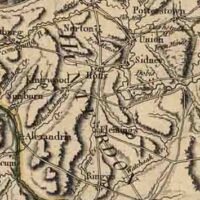
Detail of 1828 Map of New Jersey “Compiled under the Patronage of the Legislature of Said State by Thomas Gordon.”

Detail of 1828 Map of New Jersey “Compiled under the Patronage of the Legislature of Said State by Thomas Gordon.”

Buchanan’s Tavern was never referred to as Rea’s Tavern, even though Isaac Rea got the licenses in 1823 and 1824. I was hoping the tavern license applications would give me a clue as to when Isaac Rea and Delilah Buchanan parted company, but sadly, there is a gap in the minutes of the Court of Common Pleas for tavern licenses; none were recorded in the Minutes for 1825-26 and 1828-32. In 1827 neither Isaac Rea nor Delilah Buchanan applied for a license, but Jonas Sutton, Delilah’s 23-year-old brother, did. The next year, Jonas Sutton signed on as a surety for Delilah in her application to recover guardianship of her children.

Delilah Buchanan’s petition for the year 1829 can be found in the County Archives (#1328), in which she wrote that she was “desirous of continuing her Tavern at the old stand in Amwell and being furnished with all things necessary for the purpose as heretofore, prays your indulgence at this time & begs your honorable body will grant her a license for the ensuing year.” Several citizens, who were acquainted with Mrs. Buchanan and thought her a suitable person to run an inn or tavern, and who also felt that a tavern was necessary in that location, signed the application in her support. They were Wm. Bishop, Jonas Sutton, William Sine, Jacob Moore, Jacob Godown, Isaac Rounsavell, William Sergeant, George Opdycke, George Crons, Benjamin Horn, John Hoppock, George Trout, Joseph Housel and Josiah Prall.

Another item indicating that the marriage did not last is an advertisement in the Gazette for another public sale, to be held in January 1830 at “the house of Delilah Buchanan, innkeeper in the township of Amwell”–no mention of Isaac Rea.

In May of 1830, the Hunterdon Gazette announced that members of the Fifth Troop of Cavalry of the Hunterdon Squadron were to meet at Delilah Buchanan’s Tavern in Amwell, completely equipped for drill. This was a branch of the Hunterdon Militia, something akin to our National Guard. They liked to gather at a place that was centrally located, had enough space for their drills and could supply the necessary refreshments.

Isaac Rea continued to appear in court papers, many involving “sundry creditors,” at least up until 1838, but what became of him I cannot say. He may have moved west, either literally or figuratively. In those days ‘moving west’ or ‘going west’ was sometimes used to mean dead or disappeared.

In 1831, it was announced in the Gazette that taxes for Amwell Township would be collected at Delilah Buchanan’s. This happened again in 1834. The Collector gave a list of important taverns in the Township where he would be available to receive payments. Buchanan’s Tavern was a landmark, no more clearly demonstrated than in the description of the boundary between the new townships of Raritan and Delaware in 1838. It was to run along the Old York Road until it intersected with the road running from Trenton to Quakertown (Route 579), “by way of Ringoes and Buchanan’s Tavern.”

Beginning of the End

Delilah Buchanan got more than she bargained for when she allowed her daughter Harriet to marry a man ten years her elder. Harriet was only 16 years old when she married a neighbor, Asher Trout, who was then 26 years old. Asher Trout was born on August 27, 1807 to John Trout and Annie Besson.30 But his father John died when Asher was only one year old, so he was raised by his uncle George Trout, who also married Asher’s mother, the widow Annie Besson Trout, in 1811. This George Trout owned the large farm just south of the old John Robins tract described in previous posts.

Asher Trout and Harriet Buchanan married on October 24, 1833. On February 17, 1834 Delilah Buchanan, sold them the 60-acre lot that had been the home of John and Azubah Buchanan for $3000. This was directly across the road from Delilah Buchanan’s tavern.31 On the same day, Asher Trout gave her a receipt for $175, as guardian of the heirs of Archable Buchannan dec’d “in full of the money that has come to the hands of said Guardian for the share of Harriet Trout formerly Hariet Buchannan of the Real Estates of John Buchannan dec’d.”32

Azubah Buchanan was still alive at this time. On April 1, 1834, Azubah Buchanan quit claimed to Asher Trout for $500 all her dower right in the 60.8 acres sold to Delilah Buchanan in 1820. What is especially interesting is Azubah’s statement that the property was “where sd Trout and sd Buchanan now live, adjoining Isaac Hoffman & others, the same that my late husband John Buchanan dec’d owned during his lifetime.”33 But by 1840, Azubah Buchanan was not living with Asher and Harriet Trout when the census was taken, nor was she living with Delilah Buchanan, or any of her Lake siblings. Her whereabouts are a mystery to me. She did not die until September 10, 1847, age 71.

Asher Trout was not all that happy with his mother-in-law, and in March 1835 he disputed the amounts that she claimed in an account she submitted for the guardianship, which was supposed to have expired in 1831. What triggered this was news that she had advertised the tavern lot for sale, to be held on March 31st, and that she intended to leave the State of New Jersey.34 A copy of Mrs. Buchanan’s account was included with the complaint, and listed repairs to the house and a shed, and to the fences on the Flemington Road and the Trenton Road, and also construction of a saddler and shoemaking shop. Asher Trout took issue with most of her claims, and stated that she was still holding onto property belonging to her daughter.

In August, the Orphans Court named Commissioners (William Bishop, Henry Trimmer and Adam C. Davis) to divide the real estate for the benefit of the heirs, but they decided to simply put the tavern lot and the woodlot of 6.85 acres up for sale at public auction.35  On October 13, 1835, an advertisement appeared in the Hunterdon Gazette, which read:

Commissioners’ Sale. By virtue of an order of the Orphan’s Court of the county of Hunterdon, Will be Sold, at Public Vendue, At the house of Jacob Buchanan, innkeeper, in the township of Amwell, on Saturday the 12th day of December next, between the hours of 12 and 5 o’clock P. M. of that day – That valuable TAVERN STAND, generally called  BUCHANAN’S  TAVERN,

Together with 16 acres of highly cultivated land attached thereto, situate in the township of Amwell aforesaid, in an angle of the roads leading from Flemington to Sergeantville [sic], and from Quakertown to Ringoes, and adjoins lands of Asher Trout, Joseph Housel and others. The house is large and commodious, the stables and other buildings (including a new saddler’s shop) are in good repair, and sufficiently large for the accommodation of a country tavern. There is likewise on the premises a thrifty young apple orchard, containing more than 100 trees.

Also at the same time and place, a LOT OF WOODLAND containing 7 acres, situate in said township, and on the road leading from Buchanan’s to Sergeantville, & adjoins lands of Acker Moore, Henry Trimmer, Asher Williamson and others. Conditions made known at the sale, by William Bishop, Henry Trimmer and Adams C. Davis, Comm’ers, dated 10 Oct 1835.

It appears from this that Delilah Buchanan had handed over the innkeeping work to her nephew Jacob Fulper Buchanan, but his name only appeared as such in 1835. Other announcements after this year simply say Buchanan’s Tavern, until 1837, when Delilah Buchanan’s name appears again.

The Tavern was offered for sale on December 12, 1835, but not enough bidders were present, so it was postponed to December 26th, when Delilah Buchanan purchased the properties for $2,178.36

Thereafter, meetings and sales were held at either Buchanan’s Tavern or the house of Delilah Buchanan. One of the more interesting ones was held on November 9, 1836. It was a  meeting of the Democratic Republicans of Amwell Twp. to recommend reform of the Caucus system.37

It appears that by 1846, Delilah Buchanan had really had enough of the tavern business. She was 56 years old. On March 31, 1846, Delilah Buchanan sold her tavern lot of 16 acres 30 perches for $3000 to her son-in-law Asher Trout.[#. Deed 86-027] What is especially curious about this is that she kept the personal property for herself. On April 1, 1846, Delilah Buchanan published this advertisement in the Hunterdon Gazette:

“Public Sale of Personal Property. The subscriber intending to relinquish house-keeping, will sell at Public Vendue, on Tuesday, the 7th day of April, inst., at her residence (Buchanan’s Tavern), her entire stock of Household Goods, such as Tables, Chairs, Stands, stoves, looking-glasses, cupboards, carpets, 1 eight day clock, beds, 2 cows, 2 wagons, plough and harrow, sleigh, whiskey, cider, grain by the bushel, green grain in the ground, potatoes by the bushel, hay, hogs, poultry, &c. Sale positive; to commence at 10 o’clock, A. M., when conditions will be made known, and attendance given by Delilah Buchanan. Buchanans’-Ville, April 1, 1846.”

Please note that Delilah’s home was at “Buchanans’-Ville.” That is the only instance I have seen of this identifier. When the Court of Common Pleas accepted petitions for tavern licenses in May 1846, Asher Trout’s name was on the list; Delilah Buchanan’s was not.38 The place was no longer Buchanan’s Tavern; it was Trout’s Tavern.

Azubah Lake Buchanan died on September 10, 1847, at the age of 81. I cannot say where she was buried. Following her death, in November 1847, a final resolution of the estate of her husband was made, distributing cash reserved to Azubah Buchanan during her lifetime to the heirs. The Commissioners reported there were six children:  Samuel (now dead, but has living children), John Jr. (now dead, has living children), George (now dead, but has children Jacob T. Buchanan and Amy Buchanan), Archibald (now dead, has children still living), Margaret (wife of John Case, now deceased, has children still living), Sarah (wife of Peter Case). Said moneys to be divided into six equal shares for each child and their survivors. 39

In 1850, when the census was taken, Asher Trout was listed as age 42, a tavern and hotel keeper, living with Harriet, age 32 and children Ann B. 15, John 11, Archabel 13, Mary 9, and Amies? 3.40 Delilah Buchanan was missing from the census, and had probably died before this year. There was no obituary for her in either the Gazette or the Democrat, which is surprising. She was probably buried next to husband Archibald in the Sutton burying ground, but her stone has been lost or buried under earth. Her husband’s uncle, Samuel Buchanan, got an obit in 1846: ”Died In Raritan township on the 19th inst., Mr. Samuel Buchanan, aged about 80 years.”

Asher Trout did not long remain a tavern keeper. In 1853, his wife Harriet died, and by the 1860 census, he was strictly a farmer. On July 7, 1866, he made it official, by selling the 16-acre lot to his nephew Asa Robbins.41 By 1870, Asher Trout was living in Princes Anne Co., Maryland, with his son Archibald Trout. He died there at the age of 90. The days of Buchanan’s Tavern had finally come to an end.

Correction, 5/6/2013:  Originally I had written that Charles Bonnell was an attorney. He was a member of a very prominent Flemington family, but as far as I know, he was not an attorney.

Comment on Philip and Asher Buchanan, 5/6/2013:  Jim Buchanan has informed me that these two were children of John Buchanan Jr., not John Sr. According to the Buchanan file at the HCHS, they were born about 1804 and in 1818. I was fooled by the fact that they had given receipts to the administrators of John Sr.’s estate. Mr. Bush was also fooled, and presumed they were children of John Sr. The estate papers were certainly ambiguous on the subject.

  1. Click on the topic Buchanan’s Tavern in the right-hand column for all the articles on this subject.
  2. John Buchanan Jr. was buried in the Opdycke Cemetery near Headquarters, next to his wife Elizabeth Rockafellar; John Buchanan Sr.’s grave cannot be found there, even though he married Sarah Opdycke.
  3. As described in the previous post in this series.
  4. Minutes of the Court of Common Pleas, Hunterdon Co. Clerk’s Office (hereafter CPM), vol. 19 pp. 262-63.
  5. This was Block 25 Lot 47-50 on the Delaware Twp. tax map.
  6. The Sutton Burying Ground will be the subject of a future post.
  7. Inventory Bk 4 p. 375
  8. Inventory Bk 5 p. 14
  9. Amos Sutton might not have been the best person to administer the estate. In 1819, he got into debt and a sale of his property was ordered by the court. Fortunately for him, the purchasers were his sons, John and Jonas Sutton. Unfortunately, they ended up suing their father for debt. I do need more details on this situation.
  10. Guardianship Papers, Hunterdon Co. Surrogate’s Court, file No. 73
  11. CPM 20:379-80. There was no record of tavern license applications in the Minutes of the Court of Common Pleas for 1820 through 1822. Other years were also omitted, for reasons I cannot explain.
  12. Deed 30-626.
  13. Hunterdon Co. Archives, tavern license No. 1328;also No. 1265.
  14. Marriage record Bk 2 p. 209
  15. Some researchers think Isaac Rea was also known as Alexander Rea and under that name married his first wife Mary Stires in 1808. According to a genealogical file at the Hunterdon Co. Historial Society, Alexander Rea was shot by the Molly Maguires, but the circumstances were not given and no sources were provided. Isaac Rea’s brother was named Alexander, but seems to have been a different person.
  16. CPM 22:326; 23:078.
  17. CPM Bk 22 p. 376
  18. CPM Bk 22 p. 383
  19. CPM Bk 23 pp. 95, 105
  20. CPM vol. 23, pp. 256, 344
  21. Guardianship Papers, file No. 73.
  22. Guardianship file No. 73
  23. CPM 23-485; Peter I Clark represented Bonnell while attorney Andrew Miller represented the Rea’s. Miller represented this family in most of their court battles.
  24. Guardianship file No.73
  25. CPM Bk 24 pp. 46, 59. It was not paid, so a writ of fieri facias was issued, but I found no record of a public sale at this time.
  26. Guardianship Papers, file No. 73
  27. Guardianship Papers, file No.73; there was no copy of their account in the Guardianship Papers
  28. Supreme Court of New Jersey  11 N.J.L. 319; 1830 N.J. LEXIS 25.
  29. The only Isaac Rea listed in the census was in his 50s, so that must have been a different Isaac Rea. There was an Alexander Rea living in Kingwood, but he was the brother of the Isaac who married Delilah Buchanan. At least, I think so. This family is somewhat mysterious; it would take a lot of research to find out what happened to Isaac Rea. His court appearances for debt were numerous during 1825-1828, but nothing in the Minutes of the Court of Common Pleas mentioned the dissolution of the marriage of Isaac Rea and Delilah Buchanan.
  30. He was grandson of George Trout and Hannah Lequear, and of John Besson and Margaret Opdycke.
  31. Deed 56-455
  32. Guardianship Papers, file No. 73.
  33. Deed 59-512
  34. Guardianship Papers, file No. 73
  35. Minutes of Orphans Court, Bk 7 pp. 239, 254
  36. Deed 63-253; deed recorded on May 3, 1836. There was no day or month written on the deed. I got the date of sale from the Minutes of the Orphans Court, Bk 7 p. 309.
  37. H.C. Gazette, Nov. 23, 1836
  38. CPM Bk 28 p. 479
  39. Minutes of Orphans Court vol. 9 p. 488. According to this, all three of Archibald Buchanan’s children might still be living, but I have found no records for daughter Lucretia or son Amos.
  40. U.S. Census, Raritan Twp., no. 240-265
  41. Deed 134-650, Trout to Robbins for $6200. Actually, the tract looks like the old 60-acre piece on the west side of 579; the acreage in the deed was illegible.

{ 3 comments }

An 1835 Doodle

by Marfy Goodspeed on May 2, 2013

in Hunterdon County

I’ve been hard at work trying finish up the saga of Buchanan’s Tavern, and it still isn’t done. Still some last minute questions to resolve. But I want to share this little surprise I found in the Guardianship papers for the children of Archibald Buchanan dec’d (File No. 73). I guess the Surrogate’s Clerk had some empty moments to fill.

Found on minutes of a hearing in the guardianship papers for Archibald Buchanan dec'd, No. 73

Found on minutes of a hearing in the guardianship papers for Archibald Buchanan dec’d, No. 73

Was the clerk’s name ‘S. Camaken Houd’ ?  Love the tree, the book and the number square.

{ 4 comments }

Delaware Township’s First Meeting, continued

by Marfy Goodspeed on March 27, 2013

in Delaware Township

The Order of Business

We do not have detailed minutes of that first meeting at Henry Wagner’s “house,” on April 9, 1838. The Hunterdon Gazette merely published the names of those elected to office, and three items of business: roads, keeping the poor, and a dog tax.

I have often wondered how these early town meetings were managed. They must have been different from the meetings held today. There is a clue in a report of 1825 issued by Amwell Township (which then included Delaware Township). It set forth some rules on how their meetings were to be conducted, and I think it most likely that subsequent meetings in most towns followed the same procedure. 1

At the Amwell meeting of 1825, it was determined that all future town meetings were to begin between 9 and 10 o’clock in the morning, at which time a moderator and town clerk were to be chosen by voice vote (“vive voce”), presumbaly by all who were in attendance. The article did not say how people knew who was volunteering for those positions, but I expect political parties had lined up candidates before-hand and gotten the word out. In 1838, The Moderator for Delaware Township was John Barber Esq., who already had a long history of serving as Moderator for Amwell Township meetings, and the Town Clerk was A. B. Chamberlin.

The next order of business was to decide on the number of “constables, overseers of the poor and other officers to be chosen” at the meeting. Then, at 10 o’clock, the voting began, by ballot. The Moderator acted as judge of the election, and the town clerk kept the record. Voting was to continue until 3:00 p.m. All the officers were voted on except the Moderator and Clerk, who had already been chosen, and the Overseers of Roads, who had to wait until the elections were finished and all other officers had been selected.

These ballots I mentioned were not for individual candidates, but for whole tickets of candidates. “Every person entitled to vote may vote one ticket, on which shall be written the names of a suitable number of candidates, to fill the several offices respectively.” And “any ticket containing the names of a greater number of candidates for any office than there are officers of that description to be chosen, shall be rejected.”

There are two ways this might have been done. First, individual voters might have written down the names of all the people they were voting for on a piece of paper and handed it in. Alternatively, the political parties could have gotten into the act, and printed up their own tickets, which they could have handed out to party members on election day. The dominant political parties at the time were the National Republicans, supporting John Quincy Adams, and the Democratic Republicans, supporting Andrew Jackson. Political parties always plan ahead of time, so, even though the number of positions to be voted on was not definitely known until after 10 a.m. on the day of election, they probably printed up ballots ahead of time with their favorite candidates listed for each office. In fact, in 1828, the Gazette published a list of candidates for various offices in Amwell Township. Many of them got elected, but not all of them. In the case of Moderator, neither of the candidates were chosen.

It is likely that only the most committed partisans showed up for the 9 o’clock meeting to chose the Moderator and Town Clerk. For the rest of the day, Skunktown must have been a busy place. Annual Meeting day was a social event in the 19th century. By lunch time (it was called dinner back then), voters (men) and their families were coming into town to get some refreshment from Henry Wagner and his wife Catharine, while they decided who to vote for. American elections had long been considered good opportunities for imbibing local brew, and I think we can have confidence that such was the case on that April day in Skunktown.

The County Election, 1852 by George Caleb Bingham

The County Election, 1852, by George Caleb Bingham

The best illustration I’ve seen of voting in 19th-century America—The County Election, 1852. by George Caleb Bingham (1811–1879), at the Saint Louis Art Museum. Click on the picture to see all the wonderful detail.

Once the voting was over, at 3:00 p.m., the Town Clerk counted the votes and the Moderator announced the winners. In Hunterdon County, the Moderator was usually not elected to the Township Committee, and the person chosen as Town Clerk never was. There were some exceptions to this rule. John Barber served as Moderator of Amwell Township’s annual meeting starting in 1831. From 1833 to 1837 he also served on the Township Committee. In 1839 and 1840, Benjamin Horn served as Delaware Township’s Moderator and also on the Township Committee. But in 1842 and 43, Moderator William Wilson declined to serve on the Committee. It all depended on the personality of the Moderator.

With the voting over, the Overseers of Roads were chosen by means of a pre-selection process. It was not all that easy to find people willing to be Overseers. In fact, it was so difficult that Amwell Township set up a procedure for naming them. It involved a meeting of those who paid road tax in each district, at 3:00 p.m. on the Saturday afternoon preceding the next town meeting. They were to vote on a person to be overseer of each road district for the coming year, to make a certificate of the vote signed by three of those present and deliver it to the Moderator before the annual meeting. Their choice would be confirmed at the annual meeting, but if they could not decide on an overseer, one would be named at that meeting.

So those were the rules. It sounds a little chaotic and disorganized, but it seems to have worked well enough for the times.

Township Officers after 1838

The tradition of serving in office for many years began with the first members of Delaware Township’s government. The minutes for the second meeting in 1839 are missing, but from Snell’s History of Hunterdon and Somerset Counties (p. 374) we learn that the Township Committee consisted of Benjamin Horn, Nicholas B. Higgins, John S. Wilson, Adam Williamson, and Asher Lambert. James J. Fisher and James Snyder continued as Chosen Freeholders. A. B. Chamberlin served as town clerk from 1838 to 1844, and Mahlon Smith as Collector 1838-40.

The minutes for the Town Meeting of April 13, 1840 are filed at the Hunterdon County Clerk’s Office. It was held at the house (now the Township Hall) of Isaiah Moore, innkeeper of Sergeantsville, formerly the house of Henry Wagner. The Town Committee was Benjamin Horn (also Moderator), Adam Williamson, John S. Wilson, Asher Lambert, Jonas Sutton. The Town Clerk was Amplius B. Chamberlin; Assessor was William Sergeant; Collector, Mahlon Smith (also overseer of roads); Constable, William Rake; and Judge of Election, John S. Wilson.

The Commissioners of Appeals in 1840 were Benjamin Horn, Jacob F. Buchanan and Mahlon Smith. Chosen Freeholders were James Snyder and Abraham Conover. Surveyors of Highways were John Lambert and John Salter. The School Committee was John Salter and John Lambert, and the Poundkeeper was Isaiah H. Moore.

Many of these names continue to appear as officeholders of one kind or another through many years, demonstrating that once someone competent is elected to office, voters tend to return him (and eventually her) over and over again. Everyone recognizes that the work is necessary, but few are willing to volunteer for it. Whether or not we agree with every decision they make, members of the Township Committee and other township boards and committees should be appreciated for the time they take to make our town a better place.

  1. Hunterdon Gazette and Farmers’ Weekly Advertiser, April 14, 1825.

{ 0 comments }

First Officeholders of Delaware Township

by Marfy Goodspeed on March 23, 2013

in Delaware Township

In my previous post on Delaware Township’s first meeting. I gave brief biographies of the Township Committee members, but neglected the rest. So, here are some of the other officeholders. (I will save Overseers of Roads for the another post.) Many of these biographies are incomplete, either because records are poor, or because I have not spent enough time researching them.

Town Clerk

A. B. Chamberlin

Amplius (or Ampleus) Blake Chamberlin (1807-1879) was actively engaged in civic affairs for most of his life. He was born in Connecticut in 1807. Why he decided to come to Hunterdon County is, so far, a mystery.1 He settled in Locktown a few years before 1830 when he married Elizabeth Myers (1811-1859), daughter of John Myers and Sarah Rockafellar. They had twelve children, only two of whom died as infants. (For the 19th century, that was a good record.) In 1843, he served as Chosen Freeholder from Delaware Twp.

During the Democratic County Convention in March 1844, A. B. Chamberlin was appointed to a committee to nominate candidates for that year’s elections. I cannot tell whether he nominated himself or not, but in October of that year, he handily defeated his opponent in the race for Sheriff, and continued in that position until 1847. By that time he had moved to Kingwood Township, where he was elected Chosen Freeholder in 1848. He was a witness to and administrator of many estates for his neighbors, and made several inventories. In 1866 he joined the Board of Directors of the First National Bank of Flemington.

Chamberlin’s wife Elizabeth died in 1859 (she was only 47, but after 12 children, it’s no wonder she died young). Chamberlin’s second wife was Ann or Amy Bird, whom he married in 1861. She was the widow of David Rittenhouse, who died of cancer, age 38, in 1860. A. B. Chamberlin died near Locktown in Kingwood Township, and wife Amy died in 1898 in Trenton, but I do not know where either them are buried.

Judge of Election

Abraham Conover

Abraham Conover (1792-1881) was the son of Albert Covenhoven and Sarah Bonham; I believe they lived near Headquarters. Abraham married his wife Sarah Bodine on March 1, 1817 and had six children, about whom I know very little. In fact, I’m not quite certain about his parentage. He was born at a time when record-keeping was very casual. I am also completely clueless about the family of Sarah Bodine.

By the 1820s Abraham Conover was witnessing wills and purchasing property. Like almost everyone else, he was a farmer, and lived at the corner of Route 523 and Sand Brook Road. In 1837, he bought a large part of the old John Rake farm at Sand Brook. In 1840, he was Chosen Freeholder for Delaware Township, along with James Snyder. In 1844, he was named to the same nominating committee as A. B. Chamberlin at the County’s Democratic Convention.

By 1860, Conover was a tanner, but by 1870, he was back to farming. That was the year that his wife Sarah died. He died ten years later. Both are buried at the Dunkard Church Cemetery (known as the Lower Amwell Old Yard).

Tax Collector

Mahlon Smith Esq.

Also served as Commissioner of Appeals and Overseer of Roads in 1838.

There are too many Mahlon Smiths (I have eleven in my database). My best guess is that the Mahlon Smith who served as tax collector was born in 1797 to John Smith and Anna Dilts, and in 1825 married Jemima Barton, daughter of John Barton and Charity Golden. They had at least 7 children; the first four died in 1835 of diphtheria, according to Mahlon Smith’s great-grandson Milton Smith, who lived in Locktown until he died in 2012 at the age of 94. The last child, Asher, who died in 1838, was buried with his siblings in the Sandy Ridge Cemetery. The two children of Mahlon and Jemima Smith that reached adulthood were Jacob B. Smith and Isaac Smith.

Mahlon Smith Esq. owned a farm near Locktown. He served as trustee of the Green Sergeant School when it was opened in 1830, which seems a little odd, since there was a school in Locktown as early as 1804. In 1840, Smith was elected tax collector and overseer of roads in District 5, and also named Commissioner to decide tax appeals with Benjamin Horn and Jacob Buchanan. He witnessed many deeds over the ensuing years and continued on as a farmer, until he died in 1868 at the age of 71. His inventory showed that he had lent sums to many people, totaling $7,960. It also included a “Pigeon Net,” which was used to trap passenger pigeons. His wife Jemima died in 1874, age 72. She spent her last years living with her son Jacob Smith. Both Mahlon and Jemima Smith were buried in the Sandy Ridge Cemetery.

Tax Assessor

Jacob Rake

Jacob Rake (c.1801- aft. 1860) was the son of William Rake and Lydia Larew (see William Rake, below, as Constable). His wife was probably Amy Fulper, but I have no information on her. They had a child, John G. Rake, in 1828. Jacob Rake was listed in the Amwell census of 1830 as being in his 30s, living with an unnamed female in her 20s, and 3 children under 5 years of age. He owned land in Delaware twp., near Buchanan’s Tavern, along Route 523.

Given the offices he held in 1838 (he was also an Overseer of the Poor and member of the School Committee), he must have been well thought of. He also served as Overseer of the Poor in 1839, but disappears from Hunterdon records after that.

Research by Geoff Raike has shown that Jacob Rake and his family moved west, first to Ohio, and then to Illinois. In 1882, Jacob Rake returned to Delaware Township to visit relatives, a fact that was noted in the Hunterdon County Democrat. He was 81 years old by then, and must have died not long afterwards in Illinois. His wife Amy went to live with a daughter and died in Iowa at age 85.

Commissioners of Appeals

Jacob F. Buchanan

Jacob Fulper Buchanan (1804-1894) was the son of Samuel Buchanan and Margaret Arnwine, and grandson of John Buchanan, of Buchanan’s Tavern, and Sarah Opdycke. The Buchanans and Fulpers had been close neighbors, which appears to be the reason for Jacob Buchanan’s middle name. In 1836 he married Mary Gordon (1807-1882), daughter of Othniel Gordon and Mary Heath. They had five children: Ann E., Gordon, George, John R. and Elizabeth.

Jacob F. Buchanan was a farmer who lived near Sand Brook. His farm ran between Route 523 and Biser Road, and originally belonged to the Fulper family. In 1834, lightning struck his barn, which caught fire and burned to the ground. Fortunately, only hay and grain were lost, no livestock. The newspaper says nothing about rebuilding his barn, but there is little doubt that he did it with the help of his neighbors.

In 1836, Jacob F. Buchanan was named secretary for a meeting of the Democratic-Republicans of Amwell gathered to support reform of the Caucus nominating system in the county. In 1840, Jacob F. Buchanan served as Commissioner to decide tax appeals along with Benjamin Horn. After this, Buchanan seems to have retired from public life, with the exception of a meeting in October 1861, at which he represented Delaware Township on a nominating committee for the Union Convention, which was called to support “a vigorous prosecution of the war.”

In 1880, Jacob F. and Mary Buchanan, ages 75 and 72, were living alone in Delaware Twp. with their daughter Elizabeth (age 42). Next to them was their son Gordon Buchanan (age 39) and his family. Jacob lived to be 89 years old; he died in 1894 and was buried in the Sand Brook Cemetery next to his wife Mary, who had died in 1882.

Benjamin Horn

As a member of the Township Committee, he has already been profiled. However, I have since found that he served as Tax Collector for Amwell Township in 1836, and have revised the previous post to reflect that.

Mahlon Smith

See above, under Tax Collector.

Constable

William Rake

William Rake (1776-1850) was probably the father of Jacob Rake above.2 He was the son of the first Rake to live in Amwell/Delaware Township—John Rake, who died near Sand Brook in 1805. William Rake’s first child was George Rake, born out of wedlock in 1798 to Ann Hoppock. In 1800 William Rake married first Lydia (Lidda) Larew (1769-1802), daughter of Moses and Urania Larew. They had two children, Jacob F. Rake (born 1801) and Jonathan Hunter Rake (1802-1874). William Rake married second Elizabeth’s sister, Anna Larew, in 1804 and may have had as many as 9 children with her. I only know of two: Peter and Izer Rake.

William Rake was the innkeeper at “Schencktown” (Sergeantsville) in 1821, and for several years previously. He had been running a tavern since 1806, although not necessarily in Sergeantsville. Rake was also a jailer for Hunterdon County, probably in the years 1813, 1814 and 1819, and he appears to have served as Constable for Amwell Township for few years.

In 1824 William Rake was sued in the N.J. Supreme Court by the Inhabitants of Amwell. (I have not yet looked up that case, but suspect it involved debt.) He bought and sold quite a bit of land over the years, but appears to have resided at the farm of his father-in-law, Moses Larew, on Reading Road, later owned by Jacob Johnson.

Like some other officeholders of 1838, William Rake was a Democrat. In 1837, he attended a meeting of the Democratic Citizens of Amwell, and was named a delegate to the county meeting where nominations would be made for the October elections. In 1840, William Rake was elected Constable of Delaware Township, but in 1841, he was sued by the Inhabitants of Delaware Township in the N.J. Supreme Court; another interesting case worth looking up.

William Rake died in 1850 at the age of 73, a short time before the 1850 census was taken. His wife Anna died five years previously. They are not recorded as being buried in the Locktown Christian Church Cemetery, but that is where I would expect to find them since William Rake served as church trustee in 1830 and 1838.

School Committee

Exactly what the duties of the school committee were I cannot say. In 1838 there were several one-room schoolhouses in the township, each one having its own set of trustees. There was no county superintendant of schools to oversee them. Since the State of New Jersey had instituted a “Common School Fund,” perhaps it was the job of the committee to divide the moneys between the various schools. This is suggested by an advertisement in the Hunterdon Gazette of May 11, 1836:

NOTICE is hereby given, that the trustees of the several schools in the township of Amwell must present to the School Committee by the 15th day of June next, the true average number of scholars in each quarter of the preceding year, as no report will be received after that date. The trustees of such schools as have been vacant the whole of the last year, are requested to report their average from the best information they can obtain. [signed] Garret Servis, William K. Oat, D. J. Rockafellar. Amwell School Committee. May 11, 1836.

The idea that some schools were vacant reflects the fact that parents were under no obligation to send their children to school, and often needed them to help with the multitude of chores on the farm.

A. B. Chamberlin

See above under Town Clerk.

Jacob Rake

See above under Assessor.

William Wilson

Once again, too many William Wilsons. I am guessing (again) that the Wilson who was a member of the Township’s first School Committee was William W. Wilson Esq. (1796-1875). Unfortunately, I have not been able to identify his parents. He may be the William Wilson who married Maria Lambert, daughter of Sen. John Lambert and Hannah Little. She died in Feb 1838 and was buried in the Barber Cemetery. But I have a quandary: a William Wilson married Anna Maria Lambert in 1831, who died in 1852 and was also buried in the Barber Cemetery. What is the likelihood that someone would have two wives with the same names? (If I ever resolve this, I will make corrections here.) William Wilson had two children, Mary L. Wilson, born 1832 and Jane Wilson, born 1834. Mary never married and lived with her parents. I do not have information on Jane.

Wilson had a busy life. The earliest record I have of him is 1826 when he was one of the managers from Amwell for the Hunterdon County Bible Society. He was overseer of roads for Amwell Twp. in 1828, and was named to the Executive Committee of the Hunterdon Temperance Society in 1830. Wilson was a strong Democrat. In 1835 he ran against Nathaniel Saxton for the Governor’s Council and won the nomination, and the election. However, he failed to win re-election in 1836, due to a strong anti-caucus-system movement that year; he lost to “anti-monopoly candidate,” Henry S. Hunt. In 1838 Wilson was nominated for Assembly, but not elected.

In 1840, William Wilson presided over the meeting of the Friends of Van Buren and Johnson, where he gave a lengthy speech, which was published in the Hunterdon Gazette. In 1842, he was Moderator of the Delaware Twp. Annual Meeting, and in 1842 presided over the July 4th dinner held at Lambertville (he had also done this in 1836). In 1842 he was again elected to the Council of the NJ Legislature, and in 1843 was again Moderator for Delaware’s Annual Meeting. He continued his many activities after this date, but I will stop here and simply say that William Wilson died “near Dilts Corner” in 1875, age 80, and was buried in the Barber Cemetery.

Was he buried next to the two Maria Lamberts? Sadly, the cemetery stones are so worn down that I couldn’t even find Wm. Wilson’s grave, let alone the two Marias.

Chosen Freeholders

James J. Fisher

As a member of the Township Committee, Fisher was described in a previous post. I would like to mention here that David Bond, who is currently chairman of the planning board and has also served on the Township Committee of Delaware Township, is a descendant of Cornelius Q. Fisher, brother of James J. Fisher. Quite a heritage. Are there any other descendants of the first officeholders still living in Delaware Township?

James Snyder Esq.

James Snyder (1786-1874) might have been the youngest child of John and Christina Snyder, originally of Kingwood, but living in Amwell when John Snyder died in 1809. James Snyder married in 1813 Elizabeth Reed (1795-1835), daughter of Asa Reed and Elizabeth Bray. They had five children, all of whom reached adulthood.

James Snyder’s first land purchase was a lot in Raven Rock, which he bought in 1814 from Jacob and Elizabeth Hunt. In 1816, he bought the 124-acre farm of Richard Green near Rosemont. He was named trustee of the Green Sergeant School when it was first created. By that time, 4 of his 5 children were in need of a school. In 1835, his wife died at the age of 39. In 1840, he married second Lucy Cronce (c.1806-aft 1870), whose parents are not known to me. They had four children.

James Snyder began his public life when he was appointed a Justice of the Peace by the State Legislature in 1825. In 1831, nominations started coming his way. That year he was nominated for freeholder and for Amwell Twp. Committee. In 1832 he was nominated to be Collector for Amwell. In 1834, he was named at a meeting of the Democrats at Flemington to be one of a committee to attend the state convention in Trenton. In 1836, he was again appointed a Justice of the Peace, and in 1837 he was nominated for the Assembly, along with many others. He was nominated again in 1838, and this time won the election as a Democrat. That same year, he was chosen to serve as Freeholder from Delaware Twp.

In 1839, James Snyder ran for the Council and won election. In 1840, he was again Freeholder from Delaware Twp., along with Abraham Conover. He also served on the School Committee that year. This was also the case in 1842. In 1843, he served as Freeholder with A. B. Chamberlin. In 1847 and 1848, he was elected to the Delaware Township Committee. In 1849, he served as a judge of election as well as committee member. In 1850, James Snyder shifted gears and ran for sheriff on the Whig ticket and was elected.3

In 1853, Snyder was a commissioner of the Lumberville-Delaware Bridge Company. Subscribers were invited to visit his office in Flemington to sign up. In 1863, Snyder and Dilts Larue from the Sergeants School District were named to find volunteers for the Civil War draft. In June 1872, the Hunterdon Republican republished a list of the County’s Sheriffs first published by the Hunterdon (or Frenchtown) Independent. Of James Snyder the paper said that he “was a member of the State Council (now Senate) until 1839 and member of the Assembly in 1838. He now resides in Delaware Township and is about 85 years old.”

In the 1860 census, when he was 74 years old, he was called a Gentleman. In 1870, he was still living in Delaware Twp., age 84, calling himself a “retired gardener.” His wife Lucy was still keeping house, and they lived with the family of their daughter Mary Ann and her husband James W. Johnson. James Snyder died “universally respected” in 1874 and was buried in the Rosemont Cemetery next to his first wife. His wife Lucy survived until 1894, and was also buried at Rosemont.

Surveyors of Highways

John Hoffman

John Hoffman/Huffman is an impossible name to research. I cannot say with certainty who this is. Assuming that an officeholder in 1838 had to have been born in 1810 or earlier, and have lived in Amwell Township, I am left with only one good candidate:  John Hoffman, born about 1775, son of John Hoffman (1754-1837) and Rebecca Rounsavel (1754-1833), who lived near “Buchanansville.” Trouble is, I have information on John Sr. who died in 1837, but none on his son. To complicate matters, the name Hoffman was often spelled Huffman. In some cases, John Hoffman and John Huffman were different people, but often they were the same.

Any descendants who can clear this up are invited to contact me.

Albertus K. Wagner

Albertus K. Wagner (1810-1871) was the son of David and Elizabeth Wagner. When he was 20 years old, his father David died, in 1830. His obituary stated that he had served as constable in Amwell Township and “left a large family to mourn his loss.” Albertus Wagner had 7 brothers and sisters, and appears to have grown up in the vicinity of Ferry Road and Locktown-Flemington Roads.

I have four Albertus K.’s in my database. The other three were named Albertus King, so it seems likely that Albertus Wagner was Albertus King Wagner. The popular “King” is no doubt Albertus King (1781-1845), son of Jeremiah King and Sarah Rittenhouse, who set up a sawmill at Croton in 1811.4

When he was appointed a Surveyor of Highways in 1838, Albertus Wagner was only 28. He was probably living in Delaware Twp. with his widowed mother in 1840. (The census that year does not give names of everyone in the household.) Sometime after that, Wagner moved to Baptistown where he built a tailor shop, and in 1845, was appointed postmaster at Baptistown. His term expired in 1846, when he moved to a farm in the neighborhood of Headquarters “on the road to Barber’s Station,” and married Rhoda Moore (1811-1881), daughter of David Moore and Elizabeth Hudnut. They only had 3 children, one of whom died as an infant. The other two were Emma E. Wagner (1847-1926), who never married, and Frank Pierce Wagner (1852-1922).

Albertus Wagner was listed in the Delaware Twp. census of 1850. Living with him was the widow Elizabeth Wagner, age 66. Albertus K. Wagner, was 40 years old, his wife Rhoda was 37, and daughter Emma age 3. Also with them was his brother David R. Wagner, 24. Albertus K. Wagner was also listed in the 1860 and 1870 censuses for Delaware Township. On Aug. 23, 1871, this obituary was published in the Hunterdon Democrat:

“Local Affairs: Albertus K. Wagner, one of the Vice Presidents of the Hunterdon County Agricultural Society, and a well-known Republican politician, died at his residence in Delaware township on the 12th inst.”

He was buried in the Sand Brook Cemetery. His widow Rhoda went to live with their son Frank and was counted in the 1880 census. She died on January 22, 1881, but the location of her grave is not known. Given that she belonged to the Moore family, she might have been buried in the Moore family burying ground; if so, her gravestone has been lost.

Thoughts on Longevity

If there is one thing most of these men have in common, it is their longevity. They all lived well past the usual period for that time. In 1830, only one-third of Americans would live past the age of 60. The average lifespan back then was only about 39 years. Childhood mortality was quite high, and many women died from childbirth. Most people who survived childhood died from tuberculosis. So what was it about these gentlemen that allowed them to reach a ripe old age? Could it be that volunteering for one’s community gives one better immunity against diseases? Or is it that those people who volunteer start off with an advantage?

The next post may deal with the business conducted at that first meeting, or I might instead describe the many people who were named Overseers of Roads. To see all the articles concerning the events of 1838, click on the topic in the right-hand column.

  1. Mr. Chamberlin’s parents, John and Lydia, were very creative when naming their children; the siblings of Ampleus Blake were named Royal Tyler, John Peter, Alurad Clark, Harlem G., Pearl C., Joseph Hosford, and Octavius Perkins.
  2. Thanks to Geoff Rake for sharing his extensive research on William Rake and his family.
  3. The Abstracts of the Hunterdon Gazette for 1851 do not give names of those elected to office that year, but Snyder’s obituary confirms that he did serve as Sheriff. Snell states that he served 1850-1852.
  4. I do not know the maiden name of Albertus Wagner’s mother Elizabeth, but she was not the sister of Albertus King. Why  David and Elizabeth Wagner named their son Albertus K. Wagner remains a mystery.

{ 1 comment }

Delaware Township’s First Town Meeting

by Marfy Goodspeed on March 16, 2013

in Delaware Township

This is a revised version of an article first published April 2, 2008
on the website “The Delaware Township Post”

In light of the politics involved in the division of old Amwell Township and the local distress it caused, Delaware Township did not have a very auspicious beginning. But once the furor died down, local residents got to work and did what was necessary to set up a new township government.

New Jersey law, passed in 1798, required township committees to have five members serving one-year terms, whose duties were to manage the finances of the township and hold an annual town meeting. The legislation creating Delaware, Raritan and Amwell Townships ordered that “this act shall take effect and be in force on and after the first Monday of April next.” That was April 2, 1838. So, one might say that April 2nd is the birthday of Delaware Township. It is probably more correct to say the birthday was April 9th, for that was the day of the first town meeting.

The Sergeantsville Hotel, late 19th or early 20th century

The Sergeantsville Hotel, late 19th or early 20th century

The meeting was held “at the house” of Henry Wagner, innkeeper of Sergeantsville, in what we now know as the Township Hall. Here it must be said that, except for Perth Amboy’s City Hall, which came into use in 1767, Delaware Township probably holds the record for a municipal building with the longest period of use for town meetings. The Township Hall was an inn when it was first used for town meetings, and continued as an inn until Prohibition.1

Henry Wagner was born in Pennsylvania in either 1782 or 1792, depending on whether you trust the 1850 census or his gravestone. Since his first child, Alpheus, was born in 1818, the birthdate for Henry Wagner of 1792 makes the most sense. He and his wife Catharine also had daughters Catharine (1821) and Ann M. (c.1822).

Although Henry Wagner was the innkeeper in 1838, the owner of the hotel was Neal Hart of Flemington. Hart was himself an innkeeper, who ran the hotel in Flemington for many years. Neal Hart died on September 4, 1837, but his estate was unresolved until the Orphans Court ordered that a sale be made of his properties, including the Sergeantsville tavern house, on December 28, 1838. The purchaser was John Parker of Raritan Township. Henry Wagner stayed on as innkeeper throughout 1839, as one can see from announcements in the Hunterdon Gazette, but he was gone by 1840, probably around the time that John Parker sold the tavern to Isaiah Moore.2

Our First Township Committee

The New Jersey law of 1798 that laid out the privileges and duties of township governments stated that members of the township committee were required to “examine and report to the town meeting the accounts and vouchers of the township officers, to superintend the expenditure of monies of the township and in case of neglect of the township meeting to supply vacancies, to fill such vacancies among the township officers as may occur.” The term of office was for one year. As a reflection of the fact that population was so low that practically everyone had to serve in some way, the law provided that if a person refused to serve, he had to pay a fine and was then excused from serving for five years.

It is hard to say whether the practice of holding an annual town meeting in New Jersey was the same as the town meetings of New England. I suspect there was far less opportunity for citizens to speak out and to vote on township matters. But the annual meeting in which officers are chosen continues to this day, the only difference being that today our meetings are held on January first rather than in April.

In the 19th century, townships in Hunterdon County did not elect mayors. Rather, the township committee elected a “Moderator” to run the annual meeting. It also appears that the only meeting held by the Township Committee was the annual one in April when the Township’s officers were chosen, i.e, Township Committee, Clerk, Tax Assessor and Tax Collector, Constable, Commissioner of Deeds, Keeper of the Poor, Surveyors of Highways, Judge of Elections and two Chosen Freeholders. The Moderator was chosen from among the new members of the Township Committee.

John Barber Esq.

The first Moderator of Delaware Township was John Barber, Esq. (1787-1867). This was the same John Barber who chaired the “large and respectable meeting” held the previous March.3 Barber first appears as an elected official in 1828 when he was chosen Amwell Township Inspector. I cannot say what it was he inspected, but suspect it was related to election returns.

Barber first held the position of Moderator for the Amwell Township Committee in 1831, and that year he ran as an anti-Jackson candidate for the Assembly (he lost). In 1832 he was a candidate for Assessor in Amwell, but lost again. But in 1833 he was elected moderator for Amwell Township’s Annual Meeting. In 1834 he was again a member of the township committee, and also ran as the Whig candidate for Council, an election he lost to Nathanial Saxton. He was again Moderator in 1835 and was also a “Judge of Election” and a member of the school committee. He was re-elected Moderator in 1836 and 1837.4

John Barber must have been a man of some character to be chosen to moderate the very Democratic town of Amwell, since he was himself a Whig. He was born in August 1787. His father was Samuel Barber (1756-1847), a Revolutionary War veteran and Chosen Freeholder for Amwell Township in 1816-21, and 1824, His mother was Anne Hoppock (1767-1813), daughter of Capt. Cornelius Hoppock and Catharine Corle. On his father’s side, his grandparents were John Barber (c.1720-1795) and Magdalen Johnson. His great grandparents, Samuel Barber (c.1690-1751) and Alida Johnson, settled along what is now Lambertville-Headquarters Road, in what is now Delaware Township, in the 1730’s and acquired a large acreage. On December 19, 1812, John Barber married Anne Skillman (ca. 1790-1867). They set up housekeeping on the Barber plantation and had seven children who all survived to adulthood.

John Barber was a farmer and also a very successful tanner, as is shown in the Industrial Schedule of the 1850 Federal Census.5 In addition to farming, Barber was also an investor who bought and sold a considerable amount of land, besides inheriting his father’s farm. He was also part-owner of the Quickstep and Tadpole Fisheries, which operated on the Delaware River.

Barber was named a Justice of the Peace by the Joint Meeting of the legislature (controlled by the Whigs) in March 1838. He had been first named a Justice in 1833 and again in 1837 (hence the “Esq.”). His last appointment as Justice was in 1842. In 1838 he was named to a Committee of Correspondence at the Whig convention. Later that year, he was chosen to be a delegate to the state convention held by the “Democratic Whigs.”

In 1846 the Democratic legislature named Barber a Justice of the Court of Common Pleas. He served as Assistant U.S. Marshal in 1850. That year the census showed that he owned 90 acres valued at $5000 ($55.55/acre, which was a good price), plus 11 head of cattle, 20 sheep and 9 hogs. John Barber died on January 1, 1867 at the age of 79, and his wife Anne died in November of the same year.

The other members of the first township committee were Adam Williamson, Benjamin Horn, James J. Fisher and William Sergeant.

Adam Williamson

Adam Williamson (c.1786-1868) was a weaver and farmer. He was probably the son of Peter Williamson and Catherine Broach of Somerset County. He was active in the Kingwood Baptist Church, probably attending its branch in Locktown. His wife was Eleanor Williamson, daughter of Abraham Williamson and Frances Housel. They married on March 1, 1806, and had eight children, all surviving to adulthood.

Adam Williamson was licensed to preach at the Locktown Baptist Church in 1820. At the time he was living in Kingwood Township, where he was Tax Collector in 1829 and 1830. By 1835 he and his family had moved to a farm north of Rosemont on the west side of the road from Howell’s Ferry to Johnson’s Tavern (today’s Route 519). In 1835 and 1837, he served on the Amwell Township Committee. He served on the original Delaware Township Committee in 1838, and served again in 1840. In 1850, he and his family shared a farm with his son-in-law Jehu Huffman; Adam’s share was valued at $4000. By 1860, his assets were somewhat reduced (real estate worth $1500; personal property worth $3800), but he was prosperous enough to be described as a “Gentleman” in the census of that year. He died in 1868, age 82, and was buried in Rosemont Cemetery next to his wife Eleanor who had died in 1867, age 85.

Benjamin Horn

Benjamin Horn (c.1797-1874) was a chairmaker who lived along Ferry Road, a short distance south of Locktown-Flemington Road. He and his brother Isaac probably learned the craft of chairmaking from their father Isaac Horne. 6 Isaac Horne is one of those elusive characters who somehow managed to stay out of the records. He was taxed in Kingwood Township in 1789, but that is the only tax record I have found for him. He had no estate filed in Hunterdon County when he died. There is the smallest hint of his presence in Delaware Township when a lot of 7.5 acres was sold in 1832 by Benjamin and Isaac Horn and their brother-in-law Isaac Servis.7

from William MacDonald's Central New Jersey Chairmaking

from William MacDonald’s Central New Jersey Chairmaking

The illustration above shows the type of chairs that were produced
in Benjamin Horn’s chairmaking shop.

Benjamin Horn’s first appearance in the records was when he married his wife Sarah Bearder on February 7, 1824. Sarah Bearder (c.1796-1855) was the daughter of Jacob Bearder and Elizabeth Trimmer. In 1825 Benjamin Horn purchased 11.25 acres from his wife’s brother Andrew Bearder along Ferry Road, near Plum Brook. Horn is thought to have had a chair shop at his home on Ferry Road, and to have used water power from Plum Brook to turn his lathes.

Benjamin and Sarah Horn had two children, George B. Horn (1825-1853) who married Amelia Smith, and Elizabeth Ann (1827-?) who married John C. Sine. In the 1850 census he was identified as a “turner” with land worth $1800. Both children were still at home, son George also working as a “turner” in the chair factory.

{Addendum, 3/19/2013: Benjamin Horn was involved in local politics before 1838. In 1835, 1836 and 1837 he was serving as tax collector for Amwell Township. On Nov. 23, 1836, he advertised in the Gazette that he would be at several locations (all of them taverns) the following month to receive payments. One of those places was “Delilah Buchanan’s” (her tavern known as Buchanan’s Tavern). Others were Henry Wagner’s tavern in Sergeantsville, and Asher Johnson’s tavern at Centre Bridge (Stockton). The rest of the locations were in Raritan Twp. and the Amwells. In 1839, Horn was again serving on the Delaware Twp. Committee, and was chosen as Moderator for that year’s meeting and for 1840’s. He was also serving on the committee to hear tax appeals in 1840. He was again elected to the Township Committee in 1842, 1843 and 1847. After that, his pubic service seems to have been limited to serving on grand and petit juries. In 1860, he won second prize at the Hunterdon Agricultural Fair for best dairy churn with power attached, presumably an item he made in his workshop.}

Benjamin Horn seems to have retired by the time the 1860 census came around; he was then a widower, living with daughter Elizabeth Sine and her family. By 1870, when he was 72, he was living with the family of John D. Hoppock. Benjamin Horn and his wife are buried in the Sand Brook Cemetery.

Hon. James J. Fisher

James Johnson Fisher (1784-1870), the son of Peter Fisher and Alice Johnson, was a farmer who lived near what was once known as “Barber’s Station,” later called Bowne Station. His wife was Rebecca Pidcock (1789-1854), daughter of Charles Pidcock and Martha Hoagland, but they had no children. James J. Fisher’s two brothers, William P. Fisher and Cornelius Q. Fisher, compensated for that by each naming a son James J. Fisher, the son of Wm. P. born 1824, and the son of Cornelius Q. born 1840.

Peter Fisher, the father of James, Wm. P. and Cornelius, served in the Revolution, and died in 1821. His wife died the same year. By then, their eldest child James was married and witnessing deeds and wills for his neighbors, and administering estates. In 1838, he was elected Chosen Freeholder for Delaware Township. Like John Barber, he was a Whig, and in 1844, together with Barber, was chosen a delegate from Delaware Township to the Whig convention to be held in Princeton.

James J. Fisher prospered as a farmer, being worth $5,250 in the 1850 census, but he spent many years as a childless widower. In 1860 and 1870, nephews and nieces were living with him. He died at the age of 86 at Mt. Airy, and is buried in the Larison’s Corner Cemetery in East Amwell.

William Sergeant

William Sergeant (1794-1865) was the son of Mary Lake (1773-1851). His father was never named in any document I’ve been able to find.8 In 1810, the will of Mary Lake’s brother, Thomas Lake, identified William Sergeant as the son of Mary Lake. Mary Lake never married or had any other children. When she wrote her will in 1843, she left the farm of her father John Lake, located on Sandbrook-Headquarters Road, to her son William Sergeant.

In 1827, William Sergeant married Elizabeth Trimmer, the daughter of John G. Trimmer and Mary Opdycke, and granddaughter of Thomas Opdycke and Anna Cowell. Their only child, John Trimmer Sergeant, was born about 1829.

Being an illegitimate child did not prevent William Sergeant from succeeding in life. He was a prosperous farmer, owning, in addition to his mother’s farm on the east side of Sand Brook-Headquarters Road, another farm on the west side, where he built a handsome stone house.9 I believe this house was built about the time that William Sergeant married, in 1827, but that he might have given it to his son John T. Sergeant when he married about 1850, at which time, William Sergeant probably moved to the old John Lake farm across the road, following the death of his mother in 1851.

In 1839, William Sergeant was chosen as township tax assessor for Delaware Twp. and one of the Overseers of the Poor. That same year he was one of the founding members of the Delaware Vigilante Society, an organization intended mostly to reimburse those whose horses had been stolen, but perhaps to pursue horse thieves when opportunity warranted, which apparently it rarely did.10

In 1840, William Sergeant was again elected township assessor, and for several years was chosen to be Judge of Election. By 1850, he was 55 years old with real estate worth $9,350. In 1856, he became a member of the Fillmore and Donelson Club (Whig candidates for President and Vice-President). But one of his most important positions was Judge of Vegetables at the Hunterdon County Fair of 1856. He must have been at the peak of his popularity then, for in 1856 and 1857, William Sergeant was elected to the New Jersey Assembly.11

William Sergeant died age 70 and was buried in Larison’s Corner Cemetery. His wife, Elizabeth Trimmer, died in 1882 age 82, and was buried next to her husband.

The Business of the New Township

In addition to members of the Township Committee, there were a large number of officers to be elected. The Town Clerk was Amplius B. Chamberlin. The Assessor was Jacob Rake and the Tax Collector was Mahlon Smith. Jacob Rake and Mahlon Smith were also appointed Overseers of the Poor. The Constable was William Rake. Commissioners of Appeals were Benjamin Horn, Mahlon Smith, and Jacob F. Buchanan. Surveyors of Highways were Albertus Wagner and John Hoffman. Chosen Freeholders were James J. Fisher and James Snyder, Esq. Up until 1851, each municipality elected two freeholders.12 Fisher was a Whig and Snyder was a Democrat. Other officers chosen that day were Abraham Conover as “Judge of Election,” Jacob Rake, A. B. Chamberlin and William Wilson as the School Committee, and several men to serve as Overseers of the Roads. Thus it is clear that the Township Committee was not solely responsible for management of the town for the ensuing year.

As to the business conducted during that first meeting, the Committee voted that $1,000 was to be raised for making and repairing roads, and that the Committee should ascertain the amount to be raised for the poor. A dog tax was agreed on to indemnify residents for loss of sheep killed by dogs, which was a significant problem in those years. It was also agreed that elections, which were held annually the second Tuesday of October and the day succeeding, would be held the first day at the house of Peter B. Mellick (who owned property on Seabrook Road near Lambertville), and the second day at the house of Henry Wagner, at Sergeantsville.

As a final act of business, the township committee acknowledged the questionable manner in which the town was created by passing the following resolution:

 “Resolved, That in the opinion of this town-meeting, public convenience will be promoted by the division of the township of Amwell; so far we approve of said division, and we have no desire that the present arrangement should be disturbed. But at the same time we would say that any act of this kind passed without the knowledge or consent of those immediately interested is in direct opposition to the fundamental principles of our form of government.” Signed, John Barber, Moderator and A.B. Chamberlin, Clerk.

The meeting over, libations were undoubtedly had, it being an inn after all, and perhaps a dinner was held at which toasts were given. This was the common practice of the day, but no one took the trouble to report on what was said. With the business of the day ended, the new town officers and the new citizens of Delaware Township returned to their homes, no longer the residents of old Amwell.

A little over two weeks after the first town meeting, a letter appeared in the Hunterdon Co. Gazette from one of the town’s residents, giving advice that must have been the fruit of his own experience. It was addressed to “Young Farmers,” which in those days was practically everyone.

HINTS  TO  YOUNG  FARMERS

POLITICAL DUTIES. – In a free country, offices are created for the public accommodation, not for individual emolument. To deserve them, is worthy of your ambition; to crave them is debasing; and to depend upon them for a livelihood, is to sell yourself, unconditionally, for the fickle and unsubstantial smiles of power. – A thirst for office is almost as bad as a thirst for rum; the more either is indulged in, the more insatiable are its cravings; every repetition begets new desires, until, finally, the passion in one case terminates in delirium tremens, and in the other, delirium candidatum. Many a useful man has been ruined by the latter disease, and ultimately terminated his career under the complicated horrors of both maladies.

In selecting public agents, we ought to adopt the caution that prudence would suggest in private affairs – choose those who have shown an ability to manage a public trust, by having conducted creditably and successfully their private affairs. But the man who cannot or will not provide for his own wants by his own industry, is unfit to be trusted with public matters. Are we then to reject office? No; accept them when proffered from worthy motives, as a duty, not as a source of wealth; but never accept them with conditions, express or implied, which would dishonor you as a freeman; and when you have enjoyed the honors, and fulfilled the duties, sacrifice neither your political nor your religious sentiments to retain them.

[signed] NATHAN, Of Delaware township. April 18, 1838.

Was “Nathan” referring to Joseph Moore when he wrote of thirst for office? His letter had a whiff of the old ideas about political parties and campaigns, whereby the office sought the man rather than the other way around. Nathan was probably an elderly gentleman who had lived through those old days, but who he was remains a mystery.13

The next post in this series will describe the background of the other men who were chosen to hold office in 1838. I wish there were women on this list, but the men and the women of 1838 would have considered that out of the question. Just like elections in those days, town meetings were probably pretty rowdy affairs, not quite suitable for mixed company.

  1. I have written the history of the township hall for the Hunterdon County Historical Society Newsletter, Winter 2006 pg 975. I hope to republish that article here on my website later this year.
  2. Deed 73-247. Wagner was innkeeping in Franklin Township in 1845, but returned to Delaware Township in 1866 when he was buried in the Sergeantsville Methodist Church cemetery.
  3. As described in 175th Anniversary, Part Two
  4. I regret to say that Snell’s History of Hunterdon and Somerset Counties does not have a portrait of John Barber, or any of the other members of the first Delaware Township Committee.
  5. He reported having 200 hides worth $500, 200 skins worth $180, 30 cords of Bark worth $150. He employed two men, paying them $18 a month, and produced annually 400 sides of leather worth $1,000, 200 sides of skins {? word illegible} worth $100, and 25 sets of harness worth $300.
  6. See William H. MacDonald, Central New Jersey Chairmaking of the Nineteenth Century, 1959.
  7. Deed 53-492; There was no recital in the deed to say whether this was land that was inherited or not.
  8. He could have been John, Joseph, Jacob or Daniel Sergeant. There simply isn’t enough information to say with any certainty.
  9. That house burned down in March 2011, as described in this post.
  10. Egbert T. Bush wrote and article titled “Story of Delaware Vigilante Society,” published in the Hunterdon Co. Democrat on Feb. 1, 1934. I hope to republish it here some day. In it, Bush stated that William Sergeant was president until 1868, but Sergeant died in 1865. This was probably a typographical error, since I am sure Mr. Bush was aware of the facts.
  11. This was stated in the NJ Legislative Manual, but was not noticed by the Hunterdon Gazette until it published his obituary in 1865. This is puzzling, and I hope to solve this riddle some day.
  12. A law of 1902 allowed reduction of the number of freeholders from one for each municipality to three elected at large.
  13. Although I do have in my database a couple Nathans living in Delaware Township who might be the author of this letter, I suspect that, once again, this was a case of the writer using a pseudonym, common practice in those days.

{ 0 comments }

The Two Taverns at Robins Hill, part four

by Marfy Goodspeed on March 9, 2013

in Hunterdon County

A response to the article written by Egbert T. Bush on August 7, 1930 entitled “Buchanan’s, A Tavern With A Long History

The three previous articles on this subject and Mr. Bush’s article can be found by clicking on the topic “Buchanan’s Tavern” in the right-hand column.

The Second Buchanan’s Tavern

The landmark house at the intersection of Routes 523 and 579, familiar to all who pass that way (especially in the summer when fresh corn and tomatoes can be had from the Micek farm), was once known as Buchanan’s tavern. It was, in fact, the second Buchanan’s tavern, owned by Archibald Buchanan and his wife Delilah Sutton. But before writing about them, I must return to the Robins family.

The property, which originally amounted to 333 acres, was first owned by Daniel Robins in 1714, and was passed on to his son John Robins around 1737. Mortgages made with the Hunterdon County Loan Office in 1744 show the Robins tract bordering Jonas Sutton and John Taylor, confirming that the 333 acres remained in the family. But what happened to it after that is a little complicated, and somewhat uncertain.

John Robins

One reason for the confusion is that we must sort out three generations of men named John Robins. The first John Robins (i) was born in 1694 to Daniel Robins. The second John Robins (ii) was the son of John Robins (i), born about 1725. And the third John Robins (iii) was the son of the second John, born about 1750. This family was not good at recording family events, so the birthdates are vague. (What I would give for a Robins family bible.) To make things worse, there were other ‘John Robins’ who were cousins of the three I’ve mentioned. Trying to figure out who did what is very difficult. What follows is my best guess.

The Robins House in 1760

The 60.5 acres in two lots, sold to Daniel Robins by Samuel & Mary Kitchen on July 1, 1760, from Ms. Deed Collection 18, No. 15 in oversize deeds, Hunterdon Co. Historical Society

The 60.5 acres in two lots, sold to Daniel Robins by Samuel & Mary Kitchen on July 1, 1760, from Ms. Deed Collection 18, No. 15 in oversize deeds, Hunterdon Co. Historical Society

The earliest hint that a John Robins was living on part of the 333 acres is the deed described in a previous post (Two Taverns, part three), in which Daniel Robins, grandson of Daniel Sr., bought 60.5 acres from Samuel Kitchen. The metes and bounds of the property described in this deed show that before 1760, parts of the 333 acres had been sold off, but most importantly they show that John Robins had a house on the remains of the tract, which included the lot where the Micek family now lives. But the Robins house was not the Micek’s house. The map shows that the Robins house was set well off the road. (Click to enlarge the map.) The question is, which John Robins was living there in 1760, the first John Robins (1694-1777) or the second (c.1725-1802)?

The First John Robins

Daniel and Mary Robins had a son John (i) born on December 23, 1694 in Woodbridge, New Jersey. He came to Amwell Township with his parents, probably around 1715. This John Robins probably married around 1720, but his wife’s name is not known. They had three children: Elizabeth, John (ii) and Daniel. The first wife probably died before 1750, about when John Robins married his second wife, a woman named Eleanor. I have no exact dates for the births of any of the children of either marriage. John (i) and Eleanor had nine children (Anna, Mary, Hannah, Catharine, Jane, Rachel, Lydia, Cornelius, and Job).1

The earliest record I have for John Robins (i) is in 1725 when he served as security for Andrew Heath, administrator of the estate of John Heath deceased. John Heath had owned the tract of land just north of the Robins 333-acre tract on which I think John Robins (i) was living. In a mortgage of 1733, John Robins appears there (on “land formerly Daniel Robins”), bordering the Heath tract which was then owned by Thomas Hunt. The next record I have is in 1745 when James Kitchen named John Robins as trustee for his son Benjamin. These dates are too early for John Robins (ii) to be the owner of the property, so I think we can safely conclude that John Robins (i) was living there in 1760.

In 1755, a John Robins bought 155 acres from Richard Lanning. This was located near Boarshead Road and the Wickecheoke Creek. Robins conveyed that property to his son Daniel Robins, who then sold it to Jeremiah King in 1761. This Daniel was the son of John Robins (i), and should not be confused with Daniel, son of Job Robins, who bought the old tavern lot in 1760.2

The Will of John Robins (i)

John Robins (i) wrote his will on June 29, 1775, leaving the plantation on which he lived to his wife Eleanor for her life, and then to his son John (ii), who was to pay sums to his brothers Job and Cornelius. John (ii) and Daniel Robins were named as his executors.

The daughters named in his will were Anna Robins, Mary Robins, Elizabeth Woolverton, Hannah Robins, Jane Kitchen, Rachel Reily, Lydia Parlee and Catherine Robins. The will was witnessed by James Furman, Israel Chidster and David Chidster. It was recorded on September 16, 1777, so presumably John Robins (i) died about August or September 1777, while the Revolution was distressing the countryside. The inventory was made by Samuel Furman and John Trimmer.

Here are the children of John Robins (i), as far as I know.3

Elizabeth Robins (c1718-c.1800) m. Joel Wolverton (1715-1795)
John Robins (c.1720-1802) m. Elizabeth Taylor, Catharine Pegg
Daniel Robins (c.1725-aft 1776?) m. Ann ___
Jane Robins (c.1750-?) m. __? Kitchen
Rachel Robins (c.1750-?) m. __? Reily
Lydia Robins (c.1750-?) m. Edward Parlee (c.1750-1816)
Mary Robins (c.1755-?) m. William Sutton (c.1755-bef 1797)
Catharine Robins (c.1760-bef 1830) m. Derick Hoagland (c.1750-1835)

The Second and Third John Robins

There were two John Robins owning property in Amwell Township in 1780. One was taxed on 100 acres, 4 horses, 6 cattle, and 4 pigs, and was identified as “John Robins Sr.”  The other was John Robins “Junr” living on 150 acres, with 1 horse, 4 cattle, “belong {sic} to the widow;” in June, he was taxed on 150 acres only, no reference to a widow.4

I believe that “John Robins Sr.” was John Robins (ii), the son of John Robins (i) dec’d, and the other was the son of John Robins (ii) and his first wife Elizabeth Taylor. But Elizabeth Taylor Robins died before 1777. So, who was the widow in 1780? John Robins (ii) did not die until 1802. John Robins (i) named his wife in his will of 1775 and died in 1777. It is likely that his widow was still living in 1780. So, it would appear that John Robins (iii) “Jr.” had property from his grandmother. Also, I believe, but cannot be sure, that John Robins (iii) was the John Robins who married Grace Runyon on June 28, 1780.5

This Elizabeth Taylor, first wife of John Robins (ii), daughter of John and Sarah Taylor, who owned property to the south of the Robins 333 acres. Elizabeth Taylor Robins died before May 1777, when her father John Taylor of Kingwood wrote his will, leaving the residue of his moveable estate to the children of his daughter Elizabeth Robins deceased. John Robins married his second wife Catharine, former wife of Daniel Pegg, on May 15, 1778. In 1771, when Daniel Pegg and his wife Catharine mortgaged the Boarshead tavern, at the intersection of Route 579 and Boarshead Road, John Robins appeared as a bordering landowner.6

Was this landowner of 1771 John Robins (i) or John Robins (ii)? Perhaps it was John Robins (ii) who owned land on Boarshead Road. That would mean that in 1780 the old tract near Buchanan’s Tavern was owned by his son, John Robins (iii).

Daniel Pegg died without a will in 1778. On September 19, 1778, Administration of the estate was granted to his son Daniel Pegg Jr. Some Pegg descendants believe that Catharine and Daniel Pegg were divorced. This would explain the fact that Catharine Pegg married John Robins on May 15, 1778,7 several months before the death of Daniel Pegg. Additional evidence comes from the will of Catharine Pegg Robins, which she wrote on May 22, 1806. She identified herself as the widow and relict of John Robins of Amwell, but made no mention of the children of John Robins; the children and grandchildren she named belonged to her previous marriage with Daniel Pegg.

The John Robins (ii) who married Daniel Pegg’s widow had nine children by his first wife Elizabeth Taylor. By 1778, when John Robins married Catharine Pegg, at least three of his children were still minors. Daniel Pegg’s children were born from 1754 to about 1775. By 1778, when Pegg died, there were at least 3, maybe 4, children who were still minors. Some of the older children of both marriages were probably also living with the new family. This made for a large household. It would have been a logical time to make an addition to the new early houses that can be found on John Robins’ 150 acres near Buchanan’s Tavern. In both houses, the original section is a small stone one-room house, too small to accommodate a really large family.

One of the children of John Robins (ii) and Elizabeth Taylor was Jane, born about 1765, who married Amos Sutton in 1785. Amos Sutton’s family lived on land a short distance south of the Robins tract near Buchanan’s Tavern. Jane Robins and Amos Sutton were the parents of Delilah Sutton who married Archibald Buchanan. The next post in this series will describe the odd history of this family.

A Confusion of Estates

John Robins (ii) died intestate in 1802. On December 20, 1802, his widow Catherine renounced administration of his estate. One of the witnesses was John Buchanan, suggesting John and Catherine Robins lived near Buchanan’s tavern. In fact, John Buchanan made the inventory, along with William Merrill. Administration was granted to John Robins and Amos Sutton; sureties were John Buchanan and William Merrill.

Here’s the problem. A later document stated that John Robins (iii) also died in 1802, before his father did. And to make matters worse, there are no estate documents for John Robins (iii), only for John Robins (ii). So who was the John Robins who administered the estate of John Robins (ii) if his son John (iii) had predeceased him? I am baffled.

On October 27, 1803, Jonathan Robins, one of the children of John Robins (ii), applied for a division of the real estate of his father. The Commissioners to divide the real estate (Paul Kuhl, John Lequear and John Covenhoven) made their report on February 8, 1804, listing the names of the heirs. First were the grandsons and granddaughter of “sd John Robins and children of John Robins Jr. who died before his ancestor John Robins the elder.” Those children were John (iv), Joseph and Elizabeth (married to Barzilla Dunham). The rest of the children named were the children of John Robins (ii): Amos Robins, Job Robins, Jonathan Robins, Anne (wife of Samuel Vanaumer/Vanorman), Jane (wife of Amos Sutton), Mary (wife of William Smith) and Elizabeth (wife of Nathan Sutton).

Two Divisions, Two John Robins

As it turned out, the partition made on June 20, 1804 that was recorded in the Hunterdon Co. Clerk’s Office on October 16, 1804 was for a farm of about 115 acres located on Boarshead Road, bordering Jeremiah King and Joseph Thatcher, and in the possession of Amos Robins.8  John Robins (iii) was listed among the heirs to receive lots out of this partition, but was not identified as deceased.

Neither a Partition nor a Division was recorded for the tract of land near Buchanan’s Tavern. It appears that the heirs of John Robins first attempted to sell the farm in one piece. They placed an ad in a Trenton Newspaper that tells us much about what the John Robins farm was like:

“Public Vendue. To Be Sold on Thursday the 26th day of this instant, May, between the hours of two and six o’clock in the afternoon, on the premises, that Valuable Plantation, Late the property of John Robins, of the township of Amwell, in the county of Hunterdon, dec. containing one hundred and 54 acres, whereon is a stone dwelling house and a large frame barn, about twenty acres of good meadow well watered, about twenty five acres of timberland, and the remainder good arable land, with a sufficiency of water in each field and a number of good fruit trees, such as apple, peach, pear and cherry trees, &c. The plantation is adjoining lands of John Buchannan and others, about 3 miles from Flemington, and about seven from Howell’s Ferry. An indisputable title will be given and the conditions of sale made known on the day of sale, by us, whose names are hereunto subscribed. Amos Robins, John Robins, Job Robins, William Smith, Jonathan Robins, Amos Sutton.”9

As for the exact boundary of this farm, the only way we can learn of it is through deeds from the children who were given lots from the division. These lots have something in common; they nearly all were bordered on the south by George Trout. Lots No. 1 and 2 were bordered on the north by George Kuhl. By piecing the lots together, we get a tract of land running east from the intersection of Routes 523 and 579, amounting to about 150 acres.10

from U.S.G.S. Stockton, NJ - PA, 1954, revised 1970

from U.S.G.S. Stockton, NJ – PA, 1954, revised 1970

What seems really odd to me is that the heirs who benefitted from the Partition of the 155 acres on Boarshead Road were the same heirs who were given lots out of the farm near Buchanan’s Tavern. The most likely explanation is that John Robins (ii) owned both tracts when he died. But the records do not make that clear.

One of the deeds was made on April 30, 1804, in which Amos Robbins and wife Ruth sold to Elijah Carman a lot of about 29 acres bordering George Kuhl on the north, George Trout on the south, Lot 1 on the east, Lot 3 on the west. They also conveyed lot 12, which ran south of the intersection of 523 and 579, and is now the Micek field.11

Another deed, dated June 2, 1804, was made by John Robins of Amwell and wife Catharine and Barzilla Dunham and wife Elizabeth who sold to Elijah Carman a lot of 35 acres 13 perches, being Lot No. 1 bordered on the north by Geo. Kuhl, on the south by George Trout, and on the east by “an old line.” They also sold Lot 9 of 3.5 acres 35 perches in the Miceks’ field.12 In this deed, John Robins and Elizabeth Robins Dunham were identified as grandchildren of John Robins (ii) deceased, and their brother Joseph Robins was said to be a minor.

The deed from Jonathan Robins tells us more. He was the son of John Robins (ii) who petitioned for a division of the real estate. He was assigned Lots No. 4 & 9. He bought Lot No. 5, the lot assigned to his sister Jane Sutton, on May 1806, and Lot No. 3, the lot assigned to brother Job Robins, on June 8, 1807. On April 14, 1813, he sold lots 3, 4, & 5 to Isaac Huffman, who already owned property to the north of John Buchanan’s tavern lot.13 These three lots were all bordered along the south by land of George Trout. Lot No. 4 is now Raritan Twp. Block 63 lot 53, and is the location of the John Robins house of 1760, pictured below. The smaller section on the left is the original house. The larger section was probably added after 1802.

The John Robins House

The John Robins House

By far the most important of the lots for our story was the one that came into possession of Mary Robins, daughter of John Robins (ii) and Elizabeth Taylor, who was born about 1768. She married William Smith, son of Herbert Smith and Charity Deremer. On November 30, 1804, William Smith and wife Mary sold to Elisha Rittenhouse Jr. for $800 a lot of 16 acres 30 perches, which came to be known as Buchanan’s Tavern lot. The key clause in this deed (after naming the heirs of John Robins) read: “and praying for division of the farm whereon the said John Robins Lived and Died.”14

This deed is a sort of smoking gun, in that it tells us that it was John Robins Sr. (ii) who lived and died on the 333-acre tract. I had previously concluded that John Robins (ii) was living on Boarshead Road. He may have lived there at one time, and later allowed his son Amos to live there.

Original section of the Micek house, which faces south down Route 579

Original section of the Micek house, which faces south down Route 579

As for the two 18th-century houses on the John Robins farm, we have documentation of the one standing on bock 63 lot 53, and as for the Micek house on block 63 lot 71, we have support from architectural historian Dennis Bertland, who considers the original section of the house to be 18th century. Circumstantial evidence comes from a comparison of prices for the lots. The lot where the Micek house stands was sold for about $40 per acre, while Lots 1 & 2 sold for only $28.50 and $12.24 per acre. The three lots sold by Jonathan Robins to Isaac Huffman (No.’s 3, 4 & 5) sold together for $42.32 per acre, suggesting that somewhere on those three lots there were substantial improvements. 

One house must have belonged to John Robins (ii) and the other to one of his sons, John (iii), Amos or Job. Amos Robins lived on the Boarshead Road property. I have no information on what happened to Job Robins, and think it most likely that the Micek house was the home of John Robins (iii), his wife Grace, and their three children, who were born in the 1780s. Since Grace was never mentioned in the deeds following division of the farm, I assume that she died before 1802. The only problem with this theory is that in the division, the lot with the Micek house was given to Mary Smith, daughter of John Robins (ii), while the children of John Robins (iii) were given Lot No. 1. But as far as I can tell, there was no house on that lot.

Elisha Rittenhouse Jr.

Elisha Rittenhouse (1768-1846) has a long history in Delaware Township; he was a man of some importance, with considerable real estate holdings, and an active mill. But he was not the Elisha Rittenhouse who purchased the lot of 16+ acres in 1804. That purchaser was Elisha Rittenhouse Jr., which means not necessarily a relative, but someone with the same name who happened to be younger than the better-known Elisha.

This other Elisha was the son of Lot Rittenhouse and Hannah Higgins, a family that lived near Rosemont in the 18th century. He was born about 1768/1769 (the same year as Mary Robins Smith). This younger Elisha Rittenhouse was prone to trouble. In fact, his life was something of a mess.

Mary Smith

In August 1804, one Mary Smith of Kingwood accused Elisha Rittenhouse Jr. of being the father of a male child born to her on February 2, 1804. Apparently Smith and Rittenhouse could not agree on the proper amount for child support (a term that was not used at the time), but they did agree to let arbitrators decide. The court appointed David Bishop and Nathan Price to arbitrate, but nothing further from them was recorded in the court’s minutes. Elisha Rittenhouse was defended in this suit, and in his many many other court cases, by Nathaniel Saxton. Soon after hiring Saxton, Rittenhouse pleaded that the proceedings so far had been irregular and illegal.15

Apparently this strategy did not work, for in February 1805, Elisha Rittenhouse agreed to the judgment against him, and the case was postponed. But Saxton must have come up with new arguments, because in May 1805, the court, referring to the Agreement of Aug. 8, 1804, and the award, which was dated Oct. 2, 1804, set the award aside.

Could this Mary Smith have been the same as Mary Robins, wife of William Smith, who sold the tavern lot to Elisha Rittenhouse in November 1804? It is a little mind-boggling to think so. But Mary Robins and her husband William Smith were indeed residents of Kingwood, and they had a son named Asa R. Smith, born, according to his gravestone, on February 27, 1804, died October 20, 1831.

Before we get led astray, it turns out Mrs. William Smith was not the Mary Smith who was suing Elisha Rittenhouse after all. On August 5, 1805, Elisha Rittenhouse Jr. was again in court, accused of being the father of a child of Mary Smith, whom he had promised to marry (my emphasis), but was refusing to maintain the child.”16 Since Mrs. William Smith was married by about 1797, she must be ruled out. The court awarded Mary Smith $500, and set a bail for Elisha Rittenhouse of $300.

Who the Mary Smith was who was suing Elisha Rittenhouse, I cannot say. The case was again on the calendar in October 1805, but nothing further is recorded, suggesting that either Rittenhouse paid the amount that Mary Smith demanded, or she decided not to pursue the matter further.

Elizabeth Rake

Mary Smith was not the only one to take Elisha Rittenhouse to court for child support. In August, 1806, Elizabeth Rake, by her attorney, George C. Maxwell (who happened to be the law partner of Nathaniel Saxton), sued Elisha Rittenhouse for $1000.17

It quite likely that this was the daughter of John Rake Sr. of Sand Brook. She was born about 1773, she never married, and in her later years removed to Doylestown, PA, where she died in 1834.

This case went on and on, and could involve a separate post all its own. It ended up that the court ordered the sheriff to levy on the goods & chattels of Elisha Rittenhouse in August 1808 (4 horses, 4 cows, store goods and farmers utensils), but he could not levy on the tavern lot because by that time, Rittenhouse had already lost it.

The Sale of the 16 acres and 30 perches

In a court cast of May 1808, William Smith sued for payment of the mortgage he had given to Elisha Rittenhouse; he was asking for $800, with interest from May 1805. The the Court had already ordered the sherriff to levy on the lot of 16 acres 30 perches bordering “John Bohannon,” and also on 1 horse, store goods, house furniture, valued at 50¢.18

Sale of the property was to be held on July 25, 1808 “at the house of Elisha Rittenhouse Jr.” in Amwell Township. We must stop right there. The expression “at the house of” used in early 19th century deeds nearly always meant a tavern house or inn. If in fact Elisha Rittenhouse was keeping a tavern on this lot, it is the first record of such a thing. Unfortunately, there is no record that Elisha Rittenhouse applied for a tavern license.19

No buyers came forward, so the sale was postponed to August 1, 1808, at which time George Holcombe bid $900 and the sale was made.20 The property bordered the Great road leading from John Bohanons to Trenton and in a Line of George Trout’s land, also the road leading from sd Bohanans to Flemington, and Lot No. 7 in the division of the real estate of John Robins dec’d.

What happened to Elisha Rittenhouse after this sale? I do not know. He continued to appear in the court records through 1811, and a few years longer.21 The Sheriff levied on his property more than once, and when he no longer had property to satisfy his creditors, the Sheriff levied on land belonging to his father Lot Rittenhouse and his brother John Rittenhouse. After that he disappeared from the records. I imagine his family was pretty fed up with him. Most likely he moved west, as so many young men did when things went badly for them in Hunterdon County.

George Holcombe

The George Holcombe who purchased the 16+ acres from Elisha Rittenhouse was the very same George Holcombe who was so involved in the development of Raven Rock. To learn more about him, please do a search for his name on the website. You will find that Holcombe was always ready to invest in whatever property seemed available. He apparently had no interest in running a tavern on this particular property and probably rented it out while he owned it.

On May 1, 1813, George Holcombe sold the 16+ acres to Archibald Buchanan for a whopping $3500, or over $218 per acre.22 This was considerably more than Holcombe paid for it. The deed made no mention of a tavern. One wonders if the price reflected substantial improvements to the lot after Holcombe bought it or if it was caused by wartime inflation. On the same day as the lot was sold, George Holcombe gave Archibald and Delilah Buchanan a mortgage on the property for $2625.23 Thus, the Buchanan’s were able to pay Holcombe nearly $900 outright at the time of the sale.

Archibald Buchanan and his wife Delilah Sutton deserve a post of their own, which will be the next (and I hope the last) chapter in this story.

  1. I cannot give a specific citation for this information; it is gleaned mostly from later deeds.
  2. Two Taverns, part three.
  3. I do not know if or who the daughters Ann and Hannah or the sons Cornelius and Job married.
  4. Neither of these men was John Robins, the son of Vincent Robins and Ann Kitchen, because that John Robins moved to Alexandria Township, where he was taxed as a householder in 1785, and died in 1789.
  5. “Rev. William Frazer’s Three Parishes” by Henry Race, PMHB 1888, p. 227
  6. Hunterdon Co. Mortgages, vol. 1 p. 157.
  7. Wm Frazer marriage records
  8. Partitons, vol. 1 p.27, Hunterdon Co. Clerk’s Office. Commissioners to divide this land were John Lequear, Paul Kuhl and Andrew Bearder. This was a very strange partition, since the house was divided in half between Mary Robins Smith and Amos Robins. There were 18 lots, but the partition and map do not give the total acreage.
  9. The Trenton Federalist and New-Jersey State Gazette, May 2, 1803. My deepest thanks to Dennis Bertland for sharing this little gem with me.
  10. See deeds 9-401; 9-404; 10-359; 21-186Also, lots sold by Amos and Jane Sutton to Joseph Housel in 1820, recorded in Deeds 30-660 and 661.
  11. Deed 9-401.
  12. Deed 9-404
  13. Deed 21-186.
  14. Deed 10-359; Mortgage 3-288.
  15. References to this case can be found in the Minutes of the Court of Common Pleas, vol. 17-100, 124, 141, 150, 193, 206, 237.
  16. Hunterdon Co., Miscellaneous Court Records, Affidavit 701; cited in D’Autrechy, More Records of Old Hunterdon Co., vol. 2 p. 198. The Bastardy cases cited by D’Autrechy in her book were only the cases for which there were manuscript court documents in the County Archives. She did not include cases that appeared in the minutes of the Court of Common Pleas.
  17. References to Elizabeth Rake are found in Common Pleas Minutes vol. 17-326, 354, 360, 410; vol. 18-007, 012, 113, 118, 155, 162, 184, 194, 208, 266, 371, 374, 404, 472, 494.
  18. CPM 18-081, 092
  19. This is not to say he did not apply, just that there is no application on file at the state archives or the county archives or in the minutes of the Court of Common Pleas.
  20. Deed 20-113
  21. I stopped when I came to the end of Vol. 18, where most of the entries were, but there were a few more in subsequent volumes.
  22. Deed Bk 21 p. 147
  23. Mortgage vol. 5 p. 368

{ 6 comments }