

PART 2 of THE COUNTY HOUSE
The history of a hotel that once stood on the west side of Flemington’s Main Street has quickly turned into something much more. Part One began with Flemington’s first European property owners and ended with the Revolution. This article goes on from there, but only as far as the 1790s, when Hunterdon County acquired a new courthouse.
If you have not yet read Part One, I strongly recommend it. Some of the events in this article depend on what was portrayed in the previous one, which ended with the purchase in 1779 of a 6.5-acre lot by George Alexander from the Hunterdon Sheriff, Samuel Tucker. It was located on the west side of Flemington’s Main Street, often called “the Great Street running through Flemington.”
The property was for sale because Joseph Smith, its former owner, had abandoned it in December 1776 to join the British Army while it was making its way across New Jersey. Clearly, Smith was a Loyalist, who must have felt threatened by the patriots in the neighborhood who were making life unpleasant for anyone opposed to the Revolution. Nothing more was heard of him.
Smith left behind a nice new house he had built in 1775 on his 6.5 acres. It was almost certainly occupied by George Alexander when he acquired a tavern license in 1777.
Alexander’s petition for a tavern license that year was his first one, as described in Part One. He petitioned again for a license on May 9, 1780, which stated that he “has been indulged with a License to keep a public house of Entertainment where he now lives in Flemington for several years past” which almost certainly means back to 1777.1
After 1778, ferry owner John Sherrerd and wife Elizabeth had left Frenchtown and moved north to Sussex County. Elizabeth’s parents, Samuel and Esther Fleming, had also been living in Frenchtown, possibly with the Sherrerds, since 1774, when Samuel had gotten a tavern license there. He continued to get one each year, up through 1778. Sometime after that year, the Flemings moved back to Flemington, most likely to the old Fleming house that was located on what was then the property of Thomas Lowrey and wife Esther Fleming, another daughter-in-law of Samuel & Esther. The Lowrey property was located just north of the 6.5-acre lot. But Samuel Fleming did not resume tavern keeping. There were three taverns already operating in Flemington, including the one owned by son-in-law George Alexander.
It is thought that Samuel Fleming died on February 10, 1790, although no record of that has survived. Genealogist and local historian Fred Sisser thought the date came from a Bible record that is no longer available. Unfortunately, Fleming’s burial place is not known, nor is that of his wife Esther, who died in 1797.2
The 1780 Amwell Ratables
Washington’s army was spending the winter of 1779-80 in Morristown, New Jersey. That winter was one of the worst ever, an echo of the Little Ice Age. For the army in Morristown, it was worse than Valley Forge, partly because there were no provisions. The government could not provide them because it was deeply in debt, and its paper money (known as Continentals) was nearly worthless.
The usual approach to reducing government debt is to raise taxes, which is what the New Jersey Legislature was obliged to do. The result was a burden for property owners, but a blessing for those of us looking for all-too-scarce information for that time period.
As early as 1773, the New Jersey Assembly ordered its towns to collect taxes on both real estate and personal property (i.e., livestock, carriages, mills, forges, furnaces, taverns, etc.), but the first records available for Amwell Township, where Flemington was located, date from 1780. A sign of how badly revenue was needed is that taxes were levied in both January and June of that year.3
In Amwell Township, John Lambert spent January and February of 1780, no doubt with his quill pen and a chair close to the fireplace, compiling the reports of eight men sent out to assess the value of the 741 properties in the township. (Their names, as spelled by Lambert, were Cornelius Coryell, Jacob Runck, Mattatthius Corsel [?], Thomas Rase [Race], Thomas Ross, Joseph Wilhenson [Williamson], Timothy Scott and Richard Holocmbe Sr.) How they managed to visit all those properties, on horseback, on bad roads, in the dead of winter, is beyond my imagination.
Access to property owners in Flemington was certainly easier, and if you were calling on George Alexander, you would no doubt be welcomed by a nice glass of rum, madeira, or perhaps a local whiskey.
In January, George Alexander did not have any large acreage to be taxed on, the way most of the taxpayers of that and subsequent years did. He was taxed under the category of “houses & lots of 10 acres or less.” Alexander claimed a lot of 5 acres, valued at £16; also, two horses and one “horned cattle.” The total value amounted to £19.10.0. He was designated as a ‘Householder” owning a Tavern.
The final column in this 18th century spreadsheet was “Amount of Rates.” It had me puzzled because the amounts far exceed the value of the property. For George Alexander it was £143.1.0. Those “rates” were so much higher than the “amount on which to levy” because of the worthless paper that taxpayers were expected to use to pay their taxes. By 1780, a pile of $15,000 paper money was only worth about $100 in hard currency.4
In June of 1780, Alexander was again taxed on a five-acre lot, worth much less than in January, only £12, plus two horses and one “horned cattle,” with the “total whereon to levy” being £15.10.0. Again, he was a Householder with one Tavern, and the “Amount of Rates” was £113.16.7, considerably less than in January, but still a lot.
The next year that Amwell Ratables were preserved was 1784, a year after the Revolution had concluded.5 In the Amwell Ratables for that year and for 1786, George Alexander had the same amount of real estate as in 1780. He had sold one of his horses (or else it had died) but still had one cow and a tavern. In 1784, there were eight people in Anderson’s household, which suggests he was running a boarding house or hotel that year, since he and wife Mary Fleming only had three children. The 1786 ratables did not include the number of people in a household. Alexander’s property remained the same, but his tax was lower than in 1784.
In 1789 Alexander again had only the 5-acre lot, with 4 horses, 2 cows, 1 hog, and one tavern. The problem with the Amwell Ratables for 1789 is that the columns are not labeled. Checking other Townships for that year, I found the columns labeled in the Lebanon ratables were “Amount on which to levy,” “Amount of Certainties” and “Amount of Taxes.” It is my understanding that “Amount of Certainties” meant the value of the mills, forges, furnaces, taverns, etc. that were listed.
Extrapolating those labels to Amwell tells us that George Alexander’s “Amount on which to levy” was £7.10, his “Amount of Certainties,” i.e., the tavern, was £1.2.6, and the “Amount of taxes” was £1.12.8. The taxes were considerably lower than in 1780 because Congress had ordered that Continentals be retired.
A Time for New Capitals
It’s important to keep in mind what was happening in the country while George Alexander was operating his tavern on Main Street, starting with May 1787, when the Constitutional Convention was being held in Philadelphia, from May 25th through September 17th.
On July 4, 1787, the anniversary of the Declaration of Independence was celebrated in Trenton with a parade that included the Light Infantry, who “waited on His Excellency the Governor [William Livingston], who had arrived in town the evening before from the Grand Convention in Philadelphia on his way home.”6
New Jersey ratified the new Constitution on Dec. 18, 1787. It was the third state to do so. After the vote was taken, it was
“Resolved unanimously, That it is the Opinion of this Convention, that the State of New Jersey should offer a Cession to Congress of a District, not exceeding ten Miles square, for the Seat of the Government of the United States, over which they may exercise exclusive Legislation.”7
This offer was duly considered and almost came to pass until General Washington stepped in and insisted on a more southern location, something closer to his home on the Potomac River. Until 1800, the U.S. capital roamed up and down the east coast. Not only did it assemble in Trenton, but also in New York City, Philadelphia, and Annapolis.
Finding a better location for a national capital was a challenging decision to make, but there were other capitals to establish at the same, time, i.e., one for the new State of New Jersey, and one for the County of Hunterdon.
1790, New Jersey’s State Capital
Until the year of 1790, New Jersey had two capitals, a practice left over from the time when the state was divided between the Provinces of East New Jersey and West New Jersey.8
The East Jersey capital was in Perth Amboy, which was where the state legislature was meeting in 1790 when Hunterdon residents made their petition for a new courthouse. The West Jersey capital was in the town of Burlington, too far away to suit residents in north Jersey. It was time for one capital, in one central location. Trenton fit the bill, especially with its access to the Delaware River, a primary mode of transportation, and the then U.S. capital in Philadelphia.
I expect that the discussion over where to locate New Jersey’s capital was an intense one, with Newark, New Brunswick, Perth Amboy, Burlington all vying with Trenton. But Trenton had some practice in serving as a capital city. It served as the capital of the new United States, from November to December 1784, while the Confederation Congress was meeting there.
Given Trenton’s history during the Revolution, it was the logical choice for New Jersey’s capital, which became official on November 25, 1790.
Locating a Courthouse
Let’s look back a moment–Hunterdon County was created out of old Burlington County in 1714. The original Hunterdon was huge, running from Trenton north to include all of Sussex County as well as Morris County. Back then, Trenton was the only significant town in that space, so the county seat really had to be located there.
By the time of the Revolution, things had changed dramatically. Hunterdon’s original size had been reduced by the creation of Morris County in 1739, from which Sussex County and then Warren County were created. But its population had exploded, most of it located in Amwell Township, well north of Trenton.
Hunterdon County’s Board of Chosen Freeholders had been meeting at the courthouse in Trenton for the past 45 years, when they weren’t meeting at taverns throughout the county. Taverns provided a public space near locations where bridges were proposed to be built or repaired, with the added benefit of providing refreshment. James P. Snell listed the meeting locations in his History of Hunterdon & Somerset Counties:
- In Trenton, at the houses of Richard Furman (1757), Rachel Horten (1759), Isaac Yard (1767, 1768, 1776) and Richard Tenant (1769, 1770, 1771, 1775).
- In Readington, at the house of Mathias Sharp (1774), John Dally (Aug 1779) and Richard Stillwell (1788); also Mershon’s tavern in 1780, Cornelius Tunison (1786),
- In Bethlehem Twp., at the house of Mahlon Taylor in 1781.
- In Amwell, at the houses of Philip Ringo (June 1748), John Ringo (Sept. 1766), Wm Ringo (1782), John Snyder (1783-84), Joseph Robinson (1785), John Ringo, Esq. (1787).
All of the Ringo taverns were located in the village of Ringoes. In the 1790s, John Meldrum ran that tavern, and the Freeholders met there more frequently than anywhere else.
By 1790, the courthouse in Trenton was badly in need of repairs. Justices and constables complained of its poor condition, and residents were not happy about travelling all the way to the southernmost town in the county to do their business.9
So, “a great number of inhabitants” petitioned the Legislature to pass a law allowing them to vote for a new location for a courthouse, a jail and a jail yard. The Legislature responded on May 26, 1790 by passing a law that allowed
“the Inhabitants of the county of Hunterdon (entitled to vote at the general elections), . . . [to] assemble at the house of John Meldrum, in the township of Amwell, at the place called Ringo Tavern, and by a majority of votes to fix the place where the court-house and goal shall be built for the said county.”10
Note: While researching this period, I found myself confused about the term “county seat.” A chicken and egg question: which came first–naming the location of the county seat, or deciding where to put a county courthouse? Answer: the county courthouse location created the county seat.
Additional note, 12/23/2025: Note the spelling of goal. According to the Oxford English Dictionary (Vol. 1, A-O, Oxford University Press, 1972), the word ‘jail’ was originally Norman (gaile). ‘Goal’ became the standard spelling in legal documents. As for the spelling as gaol, “it is difficult to say whether the form gaol(e, common alike in official and general use, from the 16th to the 18th c., was merely an erroneous spelling of goal; after this had itself become an archaism or was phonetic.” All I can say is that it varied from document to document, sometimes goal and sometimes gaol.
The Referendum
The referendum was not held until October 12th (the second Tuesday in the month), 1790. This was typical. If the referendum had been held during the growing season, June, July, August or September, the turnout would be very low.
Whereupon William Lowry, Esq., High Sheriff of sd county did give the notice required by law that the 2d Tuesday in October next the election would be opened . . . a majority was for the Court House & Goal to be built in Flemington . . .
Much to my surprise, the minutes of the Chosen Board of Freeholders for the year 1790 contain no information concerning selection of a courthouse location. There were very few meetings that year, as if the Freeholders were waiting to see where their courthouse would be built. Information about this referendum and other matters relating to the decision about where to build the courthouse comes from the deed of 1791. (See footnote 9.) It related that:
. . . on the votes being cast up, it appeared that a majority was for the court-house and goal to be built at Flemington (which is in the township of Amwell, in the county of Hunterdon) as by the certificate of the said sheriff, and inspectors of the said election which is in the following words.–viz.:
We do hereby certify to all whom it may concern that at an election begun on the twelfth instant and ended this day agreeable to an act of the Legislature of the State of New Jersey passed at Perth Amboy the twenty-sixth day of May last for the purpose of fixing on a place for building a court-house and goal for the county of Hunterdon, the town of Flemington, extending half a mile on each of the public roads from the house of George Alexander, innkeeper in said town, was fixed by a majority of votes for the above mentioned purpose.
The report was signed Oct 21, 1790, by Sheriff Wm Lowry and the following Inspectors: Nathaniel Temple, Andrew Reeder, Thomas Bowlsby, Rheuben McFerson, Henry Rockefeller, John Dawes, Joseph Scudder, Arthur Henarie, Ezekiel Blue and Charles Reading.
A note from the small world department: Sheriff William Lowrey was the son of Thomas Lowrey & Esther Fleming. His wife was named Mary Howe, but I know nothing about her. Their daughter, Mary Howe Lowrey, married in 1805 Thomas Alexander, son of George Alexander & Mary Fleming.
It is hard to tell, once again, which came first. This language suggests that the decision to locate the courthouse on Alexander’s property had already been made when the vote was taken. Was this the actual wording on the ballot? Perhaps it was a voice vote? After all, the referendum was held at a tavern. Unfortunately, the Freeholders’ minutes do not say. Nor do the records for the Court of Common Pleas.
1791, The First Meeting in Flemington
Since the referendum had resolved that Flemington would serve as the location for the county courthouse, the first freeholder meeting for 1791 was held in that town on January 3, 1791, even though the new courthouse was not yet constructed.
In 1791, Hunterdon County contained ten municipalities. Each one was represented by two men identified as “Chosen Freeholders,” all present at the January 3rd meeting. They were (listed from south to north):
Trenton: Conrad Kotts, John Mott
Maidenhead: Joseph Briarly, Ralph Phillips
Hopewell: John P. Hunk, Henry Baker
Amwell: William Chamberlain, Joseph Lambert
Kingwood: Joseph King, John Louder
Alexandria: Thomas Lowery, John Brink
Bethlehem: John Crawford, Peter Case
Lebanon: Daniel Hunt, Wm. Hazlett
Tewksbury: Tunis Melick, Simeon Fleet
Readington: John Taylor, John Emmons
There were other officials present. First of all, the meeting was called by three Judges of the Court of Common Pleas: Joseph Reading, Joseph Beavers, and Thomas Reading. In addition, there were fourteen Justices: Jacob Anderson, Oliver Barnet, Ezekiel Cole, Charles Cox, David Frazer, John Lambert, Francis McShane, Thomas Reading, Benjamin Smith, John Smith, Thomas Stout, Abraham Vandyke, Elias Wicoff, and Jona. Wolverton.
This was a collection of 34 men, who must have been meeting in a fairly large room. But where?
There is something curious about the Freeholder minutes for this date. Unlike all the other entries for Freeholder minutes, the one for January 3rd was ambiguous about where they were meeting. It states:
“Flemington, January 3d, 1791. The Board of Justices & Freeholders met at this place, agreeable to a notice given them by Order of Joseph Reading, Joseph Beavers and Thomas Reading, Esq.”
“This place”? What place? The first order of business was to decide if “this place” was legal.
The Board then proceeded to Business and the Question was put wether [sic] it was Legal to Go into Business at this Place, or illegal, it was carried by a Majority to be Legal.
“This place” was never identified in the minutes for this date. But how could it not have been at Alexander’s tavern house? Here is the rest of the minutes for January 3, 1791:
The Question being put what Sum should be Rais’d for Building Courthouse Goal &c it was Carried for the Sum of Twenty five Hundred pounds.
Ordered that the Several Assessors of the County of Hunterdon Shall Assess on the ratables &c of the inhabitants of said County the Sum of £2500 by the first Monday in March next on which day they shall Meet at the house formerly Ringoes tavern at Ten O’clock A.M. to Strike the Quotas of the respective Townships, and shall deliver their respective Duplicates to the Coll’rs of the Several Townships on or before the third Monday of the said month of March, and that the respective Collectors of said County shall Collect the said Tax and pay it to the County Collector on or before the first Monday of June Next.
Col. John Taylor, Col. Wm Chamberlin, John Snyder are Appointed to make a draught of a plan of a Court House goal &c to be presented to the next Meeting of this Board. The Board adjourned to meet on Monday the seventeenth Instant at ten O’Clock before noon at the House of Mr. George Alexander in Flemington to proceed to Business. By order of the Board, Ralph Phillips Clk.
On January 17th, nine Justices, plus Freeholders from Amwell, Kingwood, Allexandra [sic], Bethleham [sic], Tukesbury [sic] and Readington
met at the Place Agreeable to Adjournment [i.e., the House of Mr. George Alexander] & not being a Sufficient Number of Freeholders to [_?] Poseed [sic, proceeded] to Business & by order of the Board of Justices & Freeholders to meet on the 27the Inst. at 10 O’Clock at this place. Signed Tho’s Reading Clk.
On January 27, 1791:
The Board of Justices & Freeholders met at the House of George Allickander [sic] in Flemington Agreeable to Notis given by orders of Jo’s Reading, Tho’s Reading & Ezekiel Cole, Esq’s this 27th day of January 1791.
Present Charles Cox, Jo’s Reading, Tho’s Reading, Jacob Anderson, Jon’a Woolverton, Abr’m Vandike, Ezekiel Cole, Jn’l Lambert, Tho’s Stout.
Freeholders Wm Chamberlin, Jn’o Lambert for Amwell, Jo’s King, Jn’l Snider for Kingwood, Tho’s Lowrey, Jn’o Brink for Allexandra, Jos’ Crawford, Phillp Case for Bethleham, Simon Fleet for Tukesbury, and Jos’ Taylor, Jos’ Emmons for Readington. Daniel Hunt, Esq. Moderator, Wm Chamberlin Clk.
A motion was made to Chuse the managers – the Question was put whather Two or three it was carried for three. The votes was then taken. Wm Chamberlin, Tho’s Stout, Esq. & Jo’s Atkinson was Appointed Managers. [Referring to managers for construction of the courthouse. Only Chamberlin was a Freeholder.]
Mr. George Allickander [sic] appeared Before the Board and Offered half an Acre of this Land free Gratis for the use of Building the Coart [sic] House, Goal & goal yard on at the South East Corner of his Dwelling House Lott Exclusive of the Roads which was excepted and sd Buildings is to be Erected thereon on accordingly.
Clearly, the intention to build a courthouse on Alexander’s property goes back to the referendum the previous October. Alexander’s advantage was the large lot he owned on the main road through Flemington opposite the several lots already occupied that had been created by Thomas Lowrey, Gershom Lee, and others in the 1760s. It is also likely that in 1790, Alexander’s was the only tavern open for business in Flemington.11
The Freeholder minutes continue:
The Several Plans was then Brot forward by the Committee Appointed for that Purpos when a Plan of 60 feet By 35 Two story High the first Soty [sic] nine feet. The Second Story Fourteean feet High and to be finish off Compleat Agreeable to sd Plan – was Adopted.
In her article on the Courthouse, Kathleen J. Schreiner wrote that the building was intended to resemble “the Reading home, built in Delaware township in 1787.” That was not stated in the minutes, but perhaps her conclusion was based on the description given above.12
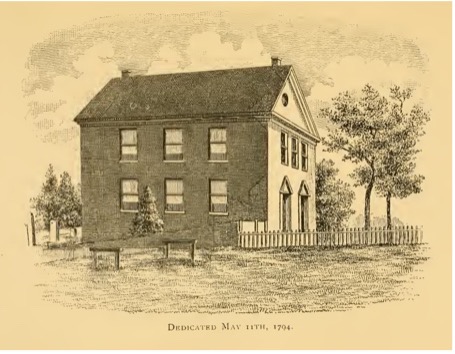 I consulted with architectural historian Dennis Bertland to get his opinion. He thought it was more likely that the new courthouse resembled the first Presbyterian Church to be built in Flemington, which happened about the same time as the courthouse. In 1793, a one-acre lot, located where the current church stands today, was sold to the trustees by Joseph Robeson. Construction was finished in 1794.13
The Freeholders then considered how to finance construction, and came up with this awkwardly expressed conclusion:
A summons was Issued Signed by Jo’s Reading Tho’s Reading & Tho’s Stout Esqr’s to Order the Assessors of the several townships in the County of Hunterdon to meet at the House late Jo’s Ringoes Tavern in the Township of Amwell on the first Tuseday in March next then and their to Strike the Quotaes of the several Townships affor sd to Rais money for Building a Court House Goal & Goal Yard at Flemington affords.
From January 1791 until construction of the courthouse was finished, the Freeholders held all their meetings at Meldrum’s tavern in Ringoes. At the meeting held on October 3, 1791, Rules were adopted for proper behavior at Freeholder meetings. Also, “sundry vouchers being produced by Mr. Samuel W. Stockton for the payment of Certain Books purchased for recording Deeds, Mortgages for Publick use Amounting to £9.13.6. Allowed.”
George Alexander’s Conveyance
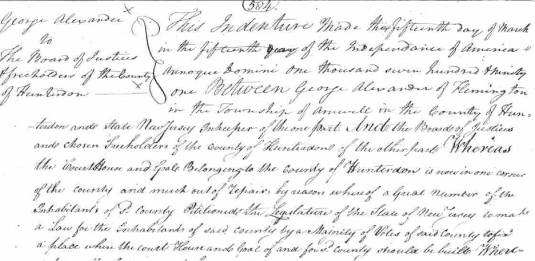 On March 15, 1791, “The 15th year of Independence,” George Alexander of Flemington, Innkeeper, conveyed to the Board of Justices and Chosen Freeholders of Hunterdon County, “for 5 shillings and other consideration,” a half-acre lot on Main Street.14
I have already quoted several passages from the deed, reciting how the decision to build a courthouse in Flemington came about. The deed stated that what Alexander was conveying was:
A lot of one half acre, being part of a lot whereon the said George Alexander lives and on the southeast thereof and on the road leading to Trenton and also butting on the road as now used leading round the said lott to Howells Ferry on Delaware River and the other two sides butting & bounded on other parts of the sd George Alexanders lott as aforesaid, which by the survey thereof runs thus,–
Viz.: beginning at a stone for a corner in a line of four-rod road leading to Trenton; thence south, two degrees east two chains to a stone corner on said road, and also a corner in the turn of a four-rod road leading to Howell’s ferry on Delaware river; thence on a line of that road west two chains to a stone for a corner; thence north sixty-six and one-quarter degrees east, two chains and a half to the place of beginning; containing half an acre of land.
Construction on the new courthouse began in May, when the weather was suitable and spring planting was mostly finished.
While the freeholders were still meeting at Meldrum’s tavern, a letter arrived that took them by surprise. But that story will have to wait for Part Three.
Footnotes:
- Hunterdon County Tavern Licenses, Vol. 1, page 98. ↩
- Fleming family genealogists have speculated about the location of the Flemings’ burial plot, but nothing definite is known. ↩
- Records for Amwell tax returns also exist for 1784, 1786 & 1789. Fortunately, the NJ State Archives has microfilmed and digitized the Amwell Ratables for the 1780s. Amwell Ratables. ↩
- New Jersey in in the American Revolution, edited by Barbara J. Mitnick, 2007, forward by State Sen. Leonard J. Lance. ↩
- None of the townships in Hunterdon have preserved all of the tax records from the 18th century. Unlike Amwell, Lebanon Township has records from 1778, ‘79, ‘80, ‘84, ‘85, ‘86, ‘89, and 1790. ↩
- The Trenton Weekly, July 10, 1787. ↩
- The NJ State Archives has done us the favor by imaging, digitizing and transcribing the Minutes of the convention. ↩
- See East NJ/West NJ. ↩
- Kathleen J. Schreiner, “Our Courthouse,” Hunterdon Historical Newsletter, Winter 1978, Vol. 14, No. 1, p. 3. Her history of the construction of the original courthouse in Flemington is excellent. ↩
- From the recital in H.C. Deed Book 1 p.584. ↩
- I could not find any applications for tavern licenses in 1790 in the minutes of the Court of Common Pleas, where such petitions were made and granted. ↩
- Ms. Schreiner was referring to the Joseph Reading house, Block 51 lot 9, Delaware Township. Purchased in 1939 by Paul Whiteman. ↩
- George S. Mott, History of the Presbyterian Church in Flemington, New Jersey. The image of the church follows p. 40. The deed was never recorded. ↩
- H.C. Deed Book 1 p.584. This deed is of such importance to the history of Flemington and of the county of Hunterdon, that James P. Snell, in his history of the county, included a full transcript. ↩