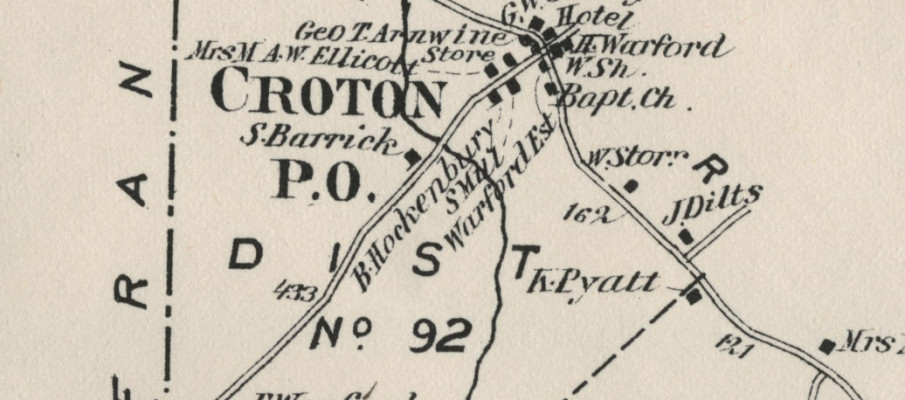
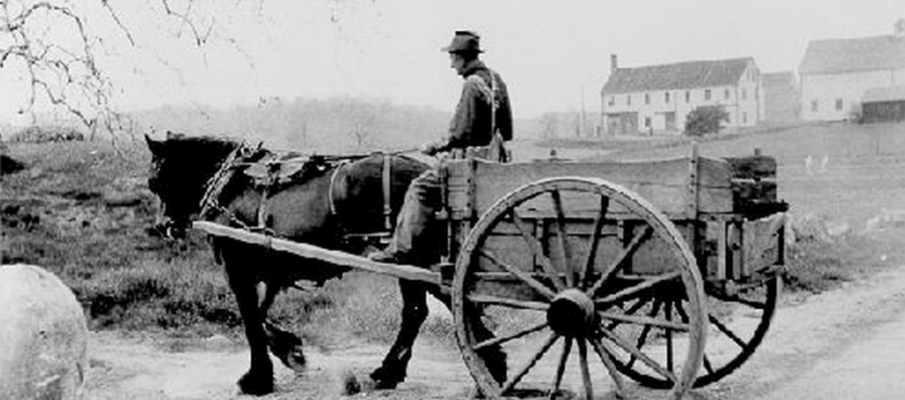
In his diary, Benjamin Ellicott made several references to his father-in-law, Elisha Warford. Warford is a legendary figure in the history of the Locktown-Croton vicinity, so it seems appropriate to publish Mr. Bush’s recollections of the man. He was a controversial figure, extremely wealthy, and extremely litigious. He never hesitated to take his debtors to court, as the papers in the Warford Collection at the Hunterdon County Historical Society will attest. Warford was a difficult personality that Mr. Bush managed to write about without casting aspersions. But then Egbert T. Bush was always a gentleman. As usual, I will take the liberty of making comments and annotations.
Croton
CROTON. The village of Croton straddles the dividing line (Rte 579) between Delaware and Raritan Townships, and is located just north of Highway 12. The old road that ran from Flemington to Frenchtown passed through the village, and is known today as Old Croton Road. It was once a thriving place, with stores, a mill, a blacksmith shop, a church and a school. Many of the original buildings have been lost to fires, and the village has lost some of its charm thanks to the impact of a county road running through it.
Lime and Trees and Other Things
First Trip to Delaware River Kilns an Experience for a Boy
Spoke Making a Lost Trade
by Egbert T. Bush, Stockton, N. J.
published in the Hunterdon Co. Democrat, April 21, 1932
In recognition of the belated arrival of spring, I offer Mr. Bush’s tale of how farmers got lime for their fields in the mid 19th-century. And among those “Other Things,” Mr. Bush describes the business of spoke making.
As our forests were cut off and the stumps rotted away, the land was found to be or soon to become more or less sour. The sorrels began to grow plentifully, especially the tall, reddish brown one that we called “horse sorrel.” That was later known as a sure indication that the land needed lime, tho in the earlier stages little was known about sour land or the indications, or even about lime as a sweetener. Such knowledge, like almost every other kind, grew gradually with experience and observation, until science took hold of such matters and showed us to be sometimes on the right track without knowing exactly why.
Gathering Nuts Was Once An Industry
A Boy Could Make From 30 to 40 cents a Day by Hard Work
Pegg Family Conserved Acres
by Egbert T. Bush, Stockton, N.J.
published by the Hunterdon Co. Democrat, November 21, 1929
This is another in a series of articles by Egbert T. Bush Paying attention to the wonderful trees of old Hunterdon County. A complete list of Bush’s tree articles can be found at the end.