

The County House series, Part One, Chapter Nine. The Road from Flemington to Howell’s Ferry has appeared over and over in descriptions of the County House tavern lot of the 18th and early 19th centuries. It is time to take a closer look at that old road and how it changed as it moved through Flemington.
The Original Route
Howell’s Ferry Road was named for the early ferrymen, Daniel Howell and his son Benjamin Howell. (See A House Divided.) The ferry location, at today’s Stockton Borough, was first known as ‘Reading’s Landing,’ when the property was owned by Amwell’s first settler, John Reading, in 1710. After his death in 1717, his son-in-law, Daniel Howell, was most likely the one to establish a ferry at the landing. After Daniel Howell died in 1733, the ferry property was taken over by his son Benjamin Howell. In 1746, he petitioned for a patent to run a ferry for that year:
“over Delaware river from a certain public Highway & landing in the township of Amwell at the mouth of a Spring of water about a quarter of a mile a little more or less below a grist mill on a stream of water commonly called in the Indian language Wickhecheoke [sic] & also three miles above and three miles below the said place on the said river from New Jersey to Pennsylvania.”1
I wish he had mentioned the ‘highway’ that the ferry connected with on the New Jersey side, but it’s easy to see on a map that the ‘highway’ was today’s Route 523.
The ‘highway’ was originally a path used by the Lenape that ran from the river northeast along the edge of the Croton Swamp, then through what was not yet the village of Flemington, where it intersected with another path that came from the future Trenton and went northwest from there to Easton on the Delaware River. The path from the future Stockton Borough, continued on to the South Branch of the Raritan River, to Whitehouse or Clinton, and parts north.
The importance of the old Howell’s Ferry road is confirmed by the fact that in the 18th century, Lenape chief Tuccamirgan lived along the road on property owned by Johann Phillip Case/Kase.2
It was a winding sort of path, because the Lenape were walking. They were not dividing up the land with straight and perpendicular lines the way Europeans did.

The old ferry road through Flemington is shown on the 1822 map as a straight line running as a diagonal through Flemington. Given the meandering practice of Indians on foot, it is safe to say that the route shown on the map is only an approximation of the original.3
The First Survey
In the 18th century, the largest property through which “the road leading from Flemington to Howell’s Ferry” ran was the 5,000-acre tract first surveyed in 1712 for Daniel Coxe of Trenton, and conveyed by him to the sons of William Penn, Thomas, Richard and William, which you can see in this detail of a map composed by D. Stanton Hammond of the original proprietary tracts in Hunterdon County.4
 The 5,000 acres is almost always referred to as “the Penn tract.” Daniel Coxe was acting as a trustee for William Penn when he had the survey made. The recital in an indenture of 1765 states that in 1737 the sons John, Thomas, and Richard Penn conveyed to Daniel Eveland land that was “part of the 5,000 acres surveyed to Wm Penn, Esq., father of sd grantors.”5
Coxe also had land of his own. The east-west line between the Penn tract and the Coxe tract ran through today’s Civil War monument, Coxe to the north, Penn to the south. That location appears on the Hammond map (on the right side of the detail shown here) where the straight north-south line (Main Street) splits into two roads. Samuel Fleming’s property appears along the diagonal line bordering Richard Lanning.6
That diagonal dotted line through land of Samuel Fleming is the route of the old Howell’s Ferry Road as shown on Snell’s map of 1822. There is also a dotted line extending north out of Flemington through land of Peter Cool and of Gov. John Reading continuing on to the South Branch of the Raritan River.
Creation of Flemington’s Main Street
Flemington’s Main Street is a nice straight line that was created in the 1740s as a result of land sales made by John, Thomas & Richard Penn out of their 5,000-acre tract of land, beginning with the sale to David Eveland in 1737. Three years after Eveland’s purchase, the Penn brothers sold a tract of 210 acres to Samuel Fleming, adjacent to the Eveland tract on the west. No deed was recorded for the Fleming tract, but subsequent deeds establish its boundaries.
The dividing line between these two properties became Main Street.
On June 12, 1762, the Eveland property was purchased by a partnership of Thomas Lowrey, Christopher Marshall, apothecary, James Eddy, merchant, Wm. Morris Jr., merchant, all of Philadelphia, and Gershom Lee, carpenter of Amwell.7 Beginning in 1765, this property was subdivided as shown in a map from the Snell history, called “Plan of Flemington, 1767.” (See Union Hotel Part One.)8

Meanwhile, Samuel Fleming went into debt, and his property was seized by the sheriff, who sold it in 1766 to Fleming’s son-in-law, Thomas Lowrey, and partner Gershom Lee. It was a large acreage that bordered Main Street on the west and northwest.
When Lowrey & Lee carved out the County House tavern lot in 1773, the western boundary ran along Howell’s Ferry Road. The fact that the north and south lot lines were more or less perpendicular to Howell’s Ferry Road, and at an angle to Main Street suggests to me that the Ferry Road was the older one and in 1773, the Ferry Road was still the one most traveled.
 Charles S. Boyer, in his Old Inns and Taverns of West Jersey included a charming map of early Flemington. It does correctly identify the courthouse and Charles Bonnell’s tavern (originally George Alexander’s), but Nathaniel Parker and Joseph Atkinson were probably keeping a different tavern, one started by Samuel Fleming north of Capner Street. And Boyer probably mistook Peter Smith for Peter Smick, who ran the Alexander tavern in the 1820s.
It also correctly shows the approximate route of the old Howell’s Ferry Road, but it mistakenly identifies the Richard Lanning house as “Fleming’s Tavern” and “Nathaniel Lowrey.”
Several Names for Ferry Road
There is no road record for Howell’s Ferry Road. It predated the time when road records were made. Also, the road name depended on which direction you were traveling in. The point where the road name changed was most often at the crossroads just north of the post office, where the Civil War memorial stands.
If you were headed south toward the river, it was Howell’s Ferry Road. If you were headed north, it was sometimes called the road to Union Iron Works. However, the road from Union Iron Works could also refer to Main Street, as in the deed of 1797 when George Alexander sold the tavern lot to Alexander Bonnell (See Part Eight).9
The description given in this deed of 1797 is probably the same description used in 1779 when Sheriff Tucker conveyed the lot to George Alexander. I cannot say for sure because that deed was not recorded in Flemington, and we know of it only because it was a recital in the deed from Alexander to Bonnell.
That deed named one Joseph Frankenbury as owner of a small lot of about half an acre on the north side of the tavern lot. I have no record of a Frankenbury and suspect he was someone from prior to the Revolution. It was very common for descriptions of property boundaries to be used over and over. The property description used in 1797 was probably the same one used in the deeds of 1773 and 1779.
That would include the reference to the road from Union Iron Works to Trenton. The Iron Works were located in the nascent town of Clinton, originally owned by Robert Taylor, and later by Archibald S. Taylor. (See The Town of Clinton. Also see History of Union Forge.)
Another road entering Flemington from the north was “the great road leading to Mount Carmel,” cited in the 1813 deed from Isaac Gray to Joseph Gray.10 This led northwest from Flemington to Pittstown and the Hickory Tavern. The 1812 Watson map shows Mt. Carmel located at the intersection of today’s Everitts Hill Road and Sandhill Road, at what was once known as Klinesville. The road continues to Dogtown, Fairview (Quakertown) and Pittstown.

Not only did the road name change depending on which direction you were going. The Howell’s Ferry Road name also changed whenever the owner of the ferry changed. As Mrs. Frederick Stothoff wrote:
It became known as Howell’s Ferry after 1735, having been purchased by Daniel Howell. A change of name came about again after 1772, when the ferry became Robinson’s [Roberson’s] Ferry. However, when a George Hoppock took it over in 1791 it reverted to the early name of Howell’s Ferry. After the completion of the Centre Bridge at Stockton in 1814, the ferry was abandoned.11
At that point the name changed to ‘the road from Flemington to Centre Bridge,’ a name that continued in use all through the rest of the 18th century and well into the 19th. (The bridge stood between the Frenchtown bridge on the north and the Lambertville bridge on the south. (For more about Joseph Roberson see Part Four, The Stewarts of Flemington.)
1791, along the Courthouse lot
Sometime before March 15, 1791, when George Alexander sold a half-acre lot to the Freeholders for a courthouse, a secondary route to the Howell’s ferry road was established.
The 1791 deed from George Alexander stated that the courthouse lot would be located on “the road leading to Trenton,” which was how today’s Main Street was usually described, but also “butting on the road as now used [my emphasis] leading round the said lott to [the road to] Howells Ferry on Delaware River.”12
The deed then gave the metes and bounds:
Viz.: beginning at a stone for a corner in a line of four-rod road leading to Trenton [Main Street]; thence south, two degrees east two chains to a stone corner on said road, and also a corner in the turn of a four-rod road leading to Howell’s ferry on Delaware river; thence on a line of that road west two chains to a stone for a corner; thence north sixty-six and one-quarter degrees east, two chains and a half to the place of beginning; containing half an acre of land.
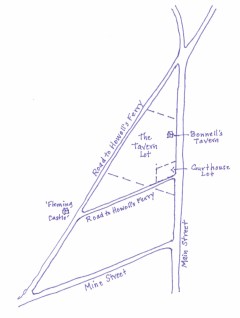 Being “a four-rod road,” meant that the road was one chain or 66 feet wide. A road that wide would be a heavily traveled one in the 1790s. Curiously, it was not the route of today’s Court Street, which runs perpendicular to Main Street. Court Street as we know it now was not laid out until 1849.
(Apologies for the very amateurish drawing.)
One might argue that this was not really a change in the Ferry Road but merely an alternative to it. That was probably the case. But it is fascinating to consider that this alternative did not rely on the location of the courthouse—it existed before the courthouse was built.
I suspect that after the Revolution, the lots on Main Street laid out by Lowrey & Lee in 1767 were being developed. Travelers coming into Flemington from the north would wish to travel along that section of Main Street to stop at the Alexander tavern or the Mattison tavern and other properties on the east side of the street. If they intended to continue on to Howell’s Ferry and travel over to Pennsylvania, they would want to get back on the Ferry Road as easily as possible. An angled path from Main to the Ferry Road would be used. The same could be said for travelers coming from the south along the Ferry Road, wishing to cut over to the Main Street properties.
This shortcut probably originated as a path used by the early owners of ‘Fleming Castle’ that was gradually turned into a public road.
Fleming Castle
‘Fleming Castle’ was long thought to be the home of Samuel Fleming and his family in the mid-18th century. It is in fact the oldest house standing in Flemington today. But according to research by Dennis Bertland,13 it probably was not the residence of Samuel Fleming.
Its construction dates to the mid-18th century, but there is no way to be certain who its builder was. It is possible Fleming built it between the years 1741 when he acquired 210 acres from the Penn brothers, but by 1766 he and his tavern were located in an area north of Capner Street. If it was constructed after 1766, it could have been built during the ownerships of William Pidgeon, Richard Lanning or Thomas Clark. In 1791, when the courthouse lot was sold to the Freeholders, it was the property of Thomas Skelton and wife Elizabeth Lowrey.
The map of 1822 indicates the house as #15, “Fleming’s house.” The Cornell map of 1851 shows the house as “Cha’s Miller,” and the 1873 Atlas shows “C. Miller.”
The house appears west of and close to the road to Howell’s Ferry on today’s Bonnell Street, but that street did not exist as it is today until 1849, the same year that Court Street was laid out as well as Park Avenue, originally known as New Street.
Miller had been living in the ‘Fleming Castle’ for several years before Alexander V. Bonnell, Esq., grandson of the Main Street tavern owner Alexander Bonnell, conveyed the house and lot to Charles’ son Robert for $550 in 1849. The lot bordered other property of A. V. Bonnell’s as well as “a street newly laid out.”14
The alternate route along what became the courthouse lot lines up with the old ‘Fleming Castle’ suggesting it was first used for the convenience of the Fleming Castle residents.
Earliest reference to Flemington
The earliest use of the name Flemington that I’ve found so far was in January 1772, for the marriage announcement of Thomas Skelton with Elizabeth Lowrey, “Daughter of Mr. Thomas Lowrey of Amwell,” as published in the Pennsylvania Chronicle.15
“Lately married, at Flemington, in New-Jersey, Mr. Thomas Skelton of the Island of Jamaica and Miss Elizabeth Lowrey, Daughter of Mr. Thomas Lowrey, of Amwell, in said Province, Merchant.”
A month later, when the fire at Lowrey’s house and store was described in the same newspaper, Lowrey was a “merchant in Flemington in Hunterdon County.” When Lowrey offered his huge real estate holdings for sale in 1780, they were located “in and near Flemington.”
The Pennsylvania paper suggests that readers knew where Flemington was in 1772 and that the place must have had that name for some time previous to that year.
Samuel Fleming & wife Elizabeth left Flemington for Frenchtown about 1774, so the town’s name was in use while he was still living there. It probably originated as a reference to Fleming’s tavern, which was in operation as early as the mid 1740s. Early deeds often say Fleming’s Town.
The 1796 Road Petition
After Flemington became the county seat for Hunterdon County in 1791, traffic must have increased dramatically. More traffic meant the need for better, or at least more convenient, roads, to the extent that dirt roads can be better.
A new alternative to Howell’s Ferry Road was contemplated in 1796. During the August term of the Court of Common Pleas, a petition was made
. . . for the relay of a public road altering the road as it now runs and formerly did run between Joseph Capner’s and Flemington, to wit, to vacate the road as it now runs and formerly did run from where the west line of the plantation of Lucius W. Stockton crosses the sd road to Flemington aforesaid . . .16
Sadly, no map was included with this petition, and nothing was said about the road that bordered the courthouse lot in 1791.
Joseph Capner’s Property
The Capner property was situated just west of central Flemington and had been part of the plantation of Johann Phillip Case.
On March 20, 1787, Rachel White, “widow and relict” of Johann Philip Case, conveyed to Joseph Capnerhurst, “late of Great Britain, now of Amwell Township in Hunterdon County in the western division of New Jersey,” for £600, a tract of 169 acres 2 roods and 21 perches in Amwell Twp. The property was part of the 172 acres that was set off to her in her husband’s will.17
The deed from Rachel White said nothing about the road to Howell’s Ferry, but an earlier deed in 1775 located a half-acre lot conveyed to Philip Case on the Howell’s Ferry road. The deed stated that it was part of the original 374 acres owned by Johann Phillip Case, that his will ordered his executors Peter Aller & Peter Young to dispose of part of the same. This half-acre came out of the 172 acres purchased by Rachel White.18
I have not identified the parents of Rachel Housel (c.1720-c.1807). She was Johann Philip Case’s second wife, after the death of his first wife Anna Elizabeth Jung in 1721. In addition to the eight children Phillip Case had with Anna, he had four more with Rachel.
After Phillip’s death in March 1756, Rachel remarried one John White, who was deceased when she bid on the tract of 172 acres offered for sale by the Case executors on May 4, 1772.
Rachel wrote her will on August 7, 1805, leaving to son John her ten-plate stove, to son Philip a cow, to daughter Catherin Mershon £3 and wearing apparel, and bed and bedding to granddaughter Rachel Case (daughter of son Henry dec’d).
She named her sons Philip and John her executors and ordered them to divide her estate into four parts, each part going to each child. Sons Peter and Henry were deceased, so their quarters went to their heirs. Luther Opdycke and Job Thatcher witnessed the will, which was recorded on May 5, 1807. Her neighbor Joseph Capner and George Maxwell made the inventory of the estate, which amounted to £2,838.57.19
The property conveyed to Joseph Capner by Rachel White was bordered on the east by 155 acres that originally was owned by Thomas Skelton and later by the Cumming/Stockton family. In 1801, it was conveyed to John Phillips of Maidenhead, minus the 10 acres belonging to Lucius W. Stockton.20
Thus, the properties along Mine Street from the Dvoor Circle to Main Street Flemington, starting from the circle, were owned by Philip Case, his widow Rachel White, Joseph Capner, John Phillips and Lucius W. Stockton.
The Proposed Route of 1796
The proposed road would begin
. . . at sd west line [i.e., the west line of Stockton’s plantation] and running on a right line with the thorn hedges of Joseph Capner on each side of sd Road across land of sd Stockton to the southwest corner of his garden fence lately erected or as near thereto as the said commissioners may think proper, from thence on a line with his said garden fence an East course to the road that leads from Price’s Tavern [in Ringoes] to Flemington. Dated Ringoes, now Price’s Tavern, August term, 1796.
It is interesting that the 12 petitioners were meeting at Ringoes, where the road was not affected, instead of in Flemington. The petition was signed by L. W. Stockton, Philip Case, John Hartpence, Hontice Case, Cornelius Polhemus, Judiah Higgins, Jos. Atkinson, Thomas Williams, Hugh Hicks, Jos. Capner, Isaac Passand and John Buchanan.
Notices of the petition were posted at the taverns of John Buchanon (Buchannan’s tavern at the crossroads of Routes 523 & 579), Nathan Price (at Ringoes), and Alexander Bonnell in Flemington.
The petition did not include a map, but the property description strongly suggests that the proposed route followed today’s Mine Street until it reached Stockton’s lot, when it went perpendicular to Main instead of at the angle that Mine Street does now.
1798 Petition & Survey
It seems the first petition of 1796 was not accepted, so a second one was offered, in February 1798.
“Petition for a road in the township of Amwell to begin at the bridge near Jesse Pettit’s house on the road leading from Buchannon’s to Flemington, thence the several courses of the said road as it now runs till it comes to Joseph Capner’s gate, thence on a straight line with his hedges until it intersects the road leading from Flemington to Ringoes Old Tavern [Main St., Rte 31]. Dated February 1798.”21
This petition was signed by Philip Case, Judiah Higgins, Jesse Pettit, Robt. Stevenson, James Clark, Stephen Yard, Thomas Williams, Samuel Hill, Jos. Atkinson and Samuel Taylor. Surprisingly, it was not signed by Lucius W. Stockton even though he was the first to sign in 1796. Four of the other 1796 signatories also did not sign (John Hartpence, Hontice Case, Cornelius Polhemus and Judiah Higgins).
One month later, on March 10, 1798, surveyors of Readington and Tewksbury Townships met “at the house of Lucius W. Stockton in Flemington” to consider the opening of a road in Amwell.
I thought it is curious that the Freeholders chose to meet at Stockton’s house, rather than at the Bonnell tavern. But that is probably because whenever Freeholders and surveyors met to consider a new bridge or a new road, they chose a place as near as possible to the location to be considered.
Perhaps this is just a coincidence, but not long after the Howell’s Ferry Road was realigned, Peter Case built his new house on Mine Street, the grand stone mansion on Dvoor Circle.
From Pettit’s Bridge to Capner’s Hedge
The route was to begin at “J. Petits” [sic] bridge and run to the end of Joseph Capner’s hedge. From there it would run across Lucius W. Stockton’s property to the great road from Flemington to Ringoes old tavern.22
The record gives the metes & bounds of the road from Pettit’s bridge, a total distance of 85.91 chains or 5,670 feet. The course of the road can be seen on an aerial view beginning at the bridge next to 28 Sergeantsville Road, making a curve around the Dvoor circle (which does not exist yet), then continuing down Mine Street to a point near present-day Stangl Road.
It then continues “from the end of Joseph Capner’s hedge to the great road leading from Flemington to Ringos old tavern” (i.e., Main Street).
The Surveyors were John Whicoff, James Emans, Abram Van Dike, Wm Dimon. The survey was recorded on March 20, 1798 – 5 o clock P.M.
I was disappointed to see that nothing was said about vacating the old route through Flemington or the alternate route next to the courthouse.
Where was Pettit’s Bridge?
“J. Petit” was Jesse Pettit (c.1747-1814), a Revolutionary War veteran who resided near the Elijah Carman farm that I wrote about in “Carman-Hoagland-Higgins.” Sometime after the Revolution, Pettit married Anna Mary Johnson (1772-1833), daughter of Jacobus Johnson. They had six children, from c.1790-1805.
I have not been able to identify Jesse’s parents, despite there being many families of the Pettit name in early Hunterdon County. (Readers’ suggestions are welcome.)
On my first reading, I jumped to the conclusion that Pettit’s bridge was the one on Mine Street that crosses Walnut Brook, just east of the Case farm. But a deed search never put Pettit in that vicinity. So where was the bridge?
I found the answer in a deed of 1812.
On April 1, 1812, Jesse Pettit & wife Anna of Amwell Township sold to Andrew Vanfleet, also of Amwell, for $3,458.27, a tract of 71 acres. This price shows that the property had been improved with a house, barn, and farmed acreage. It bordered Philip Case, Isaac Hill, a brook above the bridge [my emphasis], Judiah Higgins, the road from Flemington to Howell’s ferry [more emphasis], land in the possession of Judiah Higgins, and Adam Runkle.23
By searching for existing roads and hedge rows with Google maps, it did not take long to find this 71-acre tract.
The property sold to Vanfleet was located on the west side of today’s Old Croton/Dayton Road, which the deed referred to as “another road” along property of Philip Case. The southern boundary ran along Route 523. The bridge stood over the First Neshanic where it crosses Route 523 between Orchard Drive and Meadowbrook Road.
That being the case, the road petition begins well outside of Flemington itself.
The deed to Vanfleet stated that this was the same property conveyed to Pettit by Jeremiah and Walter Smith and their wives, Mary and Catharine. On February 10, 1795, Jeremiah and Walter Smith offered for sale
. . . a lot in Amwell Twp., HC, near Flemington courthouse, fronting the great road that leads from Flemington to Howell’s ferry on the Delaware, containing 66 and ¾ acres. There is a stone house, a frame shoemaker’s shop, a new frame barn, two frame barracks and a small orchard which produceth good fruit. For terms apply to the subscribers living on the premises.”24.

Jesse Pettit purchased this property on May 23, 1795, from the heirs of John Smith dec’d of ‘Readingtown’ for £350.25
The Smith-Harsell Family
The deed stated that John Smith “owned several lots in Amwell, having been a part of his father’s plantation.” Unfortunately, John Smith’s father was not named, but it is more than likely the father was Matthias Smith (1685-1753). He and wife Christeen had sons, John, Lodewick, Mathis, Abraham and Jacob, and a daughter Christeen.
Son John (c.1725-1774) lived on his parents’ property in Amwell for a time before moving to Readington. In 1748 he married Mary Harsell (1729-1783), daughter of John Christian Harsell and wife Elizabeth. They had four children: Elizabeth, Jeremiah, Walter and Harsell Smith.
John Smith went into debt, and his property was levied upon and sold on June 22, 1775, by Sheriff Isaac DeCow, Esq. According to the deed, it was purchased by the new widow’s mother, Elizabeth Harshell [sic], and consisted of four lots that made up together a tract of 67.65 acres.
I have no information on Johan Christian Harsell or of Elizabeth’s parents. Elizabeth Harsell of Readington wrote her will on May 4, 1791, in which she left a tract of 66.75 acres in Amwell to her grandsons, Jeremiah, Walter and Harsall Smith, “on which Jeremiah & Walter now live.” There was a stone house on the property.
Soon afterwards, Harshall Smith conveyed his right in the estate of their father to his brothers.
The property description in the deed of May 23, 1795, in which the Smith brothers conveyed four lots to Jesse Pettit, described the first lot of 3.75 acres as bordering “the king’s road leading to the ferry known as Howells ferry.” It also crossed “a run of water.” I suspect that the stone house was located on this smaller lot, close to the road and the bridge.
A later deed of 1811 (from Isaac & Margarette Hill of Amwell to Jediah Higgins) concerned a lot of 28.1 acres that bordered the road from Howell’s ferry to Flemington, land of Jesse Pettit, and “the brook at the bridge.”26
So, the change in the Howell’s Ferry road that took place in 1798 began not at Pettit’ bridge, but at “Joseph Capner’s gate, thence on a straight line with his hedges” through the property belonging to Lucius W. Stockton, “until it intersects the road leading from Flemington to Ringoes Old Tavern.”
A final note on Stockton’s property. In 1798, Lucius W. Stockton still had ownership of the entire 165-acre tract of land once owned by Thomas Skelton, then by Thomas Lowrey, who conveyed it to Roger Bowman. In the 1790s, Bowman agreed to sell it all to Lucius W. Stockton, but Stockton was unable to pay the full asking price. The matter was not settled until 1801 when Stockton’s uncle, John N. Cumming, paid the balance due. (See Part Eight, Tavern Lot & Scoundrel.)
Conclusion
It appears that the original route of the road from Flemington to Howell’s Ferry, the one shown on the map of 1822 running through Flemington at a diagonal, was never officially vacated, just as it had never been officially recorded. It probably continued in use for several years but was undoubtedly abandoned by 1849 when today’s Park Avenue was laid out. That road return made no mention of the old route.
I considered continuing the study of this old road by locating the house of Lucius W. Stockton on Main Street. There was no quick and easy answer to this challenge, and since I am eager to get back to the old Alexander tavern on Main Street, I will set that aside for now.
I have spent far more time dwelling on the events in Flemington during the 1790s than I ever imagined I would. The next episode will finally step into the 19th century.
Footnotes:
- Commissions AAA 265, Oct. 25, 1746; Josiah Granville Leach, as found in his book Genealogical and Biographical Memorials of the Reading, Howell, Yerkes, Watts, Latham and Elkins Families, Philadelphia: J. B. Lippincott Co., 1898, p. 158. ↩
- Guide to Flemington New Jersey by Barbara Clayton & Kathleen Whitely, 1987. ↩
- James P. Snell, History of Hunterdon & Sussex Counties (1881), p.328-29. Snell did not give the source for that map. ↩
- Manuscript Map by D. Stanton Hammond, J.D., compiled and drawn from Official Land Records for the Genealogical Society of NJ., 1963, map series #4. ↩
- Hunterdon County Deed Book 49 p. 80. ↩
- Recital, Deed Book 5 p. 345. ↩
- Recital, H.D. Deed Book 13 p. 169. ↩
- Snell p. 326; he did not state where the original map came from. ↩
- H.C. Deed Book 5 p.345. ↩
- H.C. Deed Book 22 p.48. ↩
- “Transportation” in The First 275 Years of Hunterdon County, 1714-1909, published by the Hunterdon County Cultural and Heritage Commission. ↩
- H.C. Deed Book 1 p. 584. ↩
- Preservation Plan for Fleming Castle; Prepared by Historic Building Architects, LLC, and Dennis Bertland Associates, November 2006, III-1. See Historic Building Architects, https://hba-llc.com/meet-the-team/. ↩
- H.C. Deed Bk 95 p.124, May 26, 1849. Miller’s ownership of Fleming Castle is described by Dennis Bertland in his article “Fleming Castle.” ↩
- NJ News Notices, compiled by Wm Nelson, 1916, Extracts from American Newspapers, Vol. IX, 1772-1773, p. 29, Pennsylvania Chronicle, No.263, Jan 20-27, 1772. ↩
- Road Petition August Term, 1796, file 18-7-62, transcribed by Phyllis D’Autrechy. ↩
- H.C. Deed Book 1 p. 290. ↩
- H.C. Deed Book 11 p.491. The deed was not recorded until August 26, 1805. ↩
- NJA State Archives, Abstracts of Wills, NJA 2284J. ↩
- H.C. Deed Book 4 p. 398. ↩
- Hunterdon County Road Petition, file #20-5-26. NO MAP. Notices were posted but locations not given. ↩
- H.C. Road Records, Vol. 1, p. 223. ↩
- H.C. Deed Book 19 p. 306. ↩
- New Jersey State Gazette, Trenton, from Thomas B. Wilson and Dorothy Agans Sratford, Notices from New Jersey Newspapers, 1791-1795, p. 382 ↩
- H.C. Deed Book 14 p.61. ↩
- H.C. Deed Book 18 p.194. ↩