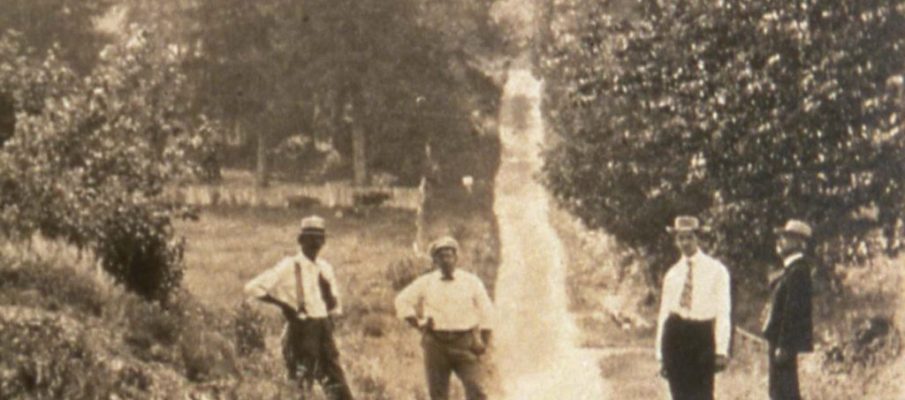
I am no expert on the Lenape language. In fact, like most people, I am clueless. Recently someone asked me if I knew the meaning of a Lenape creek name, Octoraro. This is the answer I sent him:
Marfy Goodspeed
Posts by Marfy Goodspeed:
In Days When The Great Fire Up The Chimney Roared
Fireplace Was the Center of Family Life and Activity;
Chimney Sweeps Common
by Egbert T. Bush, Stockton, NJ, March 20, 1930
Mr. Bush has good advice for those of us who enjoy a warm fire in winter. Note that the illustrations were not included with the original article.
“The great fire up the chimney roared.” Indeed it did, and how could it be otherwise? There was so much of greatness around that fire that it could not help either being great or roaring with its own greatness and that of its surroundings. That fire was not built on the economic Indian plan: “Injun make little fire—go close by;” but rather according to the Indian’s description of the uneconomic way of the paleface: “White man make big fire—go ‘way off.”
Passing of Old Canal Feeder Matter For Regret
Bool’s Island Formed Natural Opening for Waterway;
Early Engineers Found;
Cholera Took Heavy Toll Among Workers
Entirely Abandoned, A Sorry Spectacle
by Egbert T. Bush, Stockton, NJ,
published in the Hunterdon County Democrat, June 8, 1933
The project of connecting the Delaware River with the Raritan by means of a canal caught the imagination of engineers and business men quite early.
Civil War Taxes-Part 4
Occupations to be Licensed
The occupations included in the tax lists gives us a window into life in the mid 19th-century. It is just as interesting to see what occupations were not listed as which ones were. I have not yet found a complete list of all occupations to be taxed, but the Revenue Act of 1864 lists these principal occupations in this order:
Big Fish and Big Snows in Old Days
Great Catches of Shad in the Delaware River Were Common
Heavy Snow of 1874
by Egbert T. Bush, Stockton, NJ, April 24, 1930
Note: These observations by Mr. Bush on the blizzard of 1874 seemed especially appropriate for this time of year.
Civil War Taxes–Part 3
“States in Insurrection”
When first reading the Revenue Act of 1864, I couldn’t help but wonder if the taxes were intended to be levied on just the northern states, or if the authors preferred to ignore the existence of the confederacy and apply the law to everyone in what had become a very fragmented Union. The answer came in Section 46 of the Revenue Act, dealing with those southern states where any tax collector for the federal government who attempted to carry out his duties would likely be shot. The act was intended to govern all citizens of the United States, whether their states seceded or not. But it did acknowledge the current situation to the extent that if the laws of the United States could not be executed in any part of the country, the President was authorized to carry out the provisions of the act “as soon as the authority of the United States . . . shall be re-established.” Awkward, and a little disturbing to imagine the tax collector following rapidly on the heels of the Union Army.
Civil War Taxes–Part Two
After discovering the Civil War tax lists available online (more about that here), I was inspired to read the legislation (The Revenue Act of 1864) and to write about the residents of Hunterdon who were listed in the tax levy of 1865. Since this is a time of remembrance of the Civil War, it seemed appropriate. The article will appear in the spring issue of “Hunterdon Historical Newsletter” published by the Hunterdon County Historical Society. Even though the editor graciously allowed me two full pages, I found myself frustrated by how much I had to leave out. Which is why blogs are so wonderful.
The Taverns of Delaware Township
Although I have not yet followed through on my intention to post my previously published cemetery articles here on my website, I am initiating yet another project—a study of the taverns of Delaware Township. The Delaware Township Historical Society is anxious to map these institutions, so it is time to begin an inventory.
Death of a “Negro Woman Servant”
The Burlington County Court Book has little to offer about Thomas Greene, but there was one incident witnessed by him that tells us a lot about life (and death) in West New Jersey in the 1680s.
The Thomas Green(e)s of West New Jersey
The original post on Thomas Greene included a story about his appearance as a witness in a disturbing court case. It came at the end of a long post, and I realized afterwards that it deserved its own space. You can read it here.
It’s been a long time since I wrote anything about the Green family. It was Samuel Green who got me started on this series of posts about early West New Jersey. Now that I’m up to 1690, it’s time to take another look at the Greens.