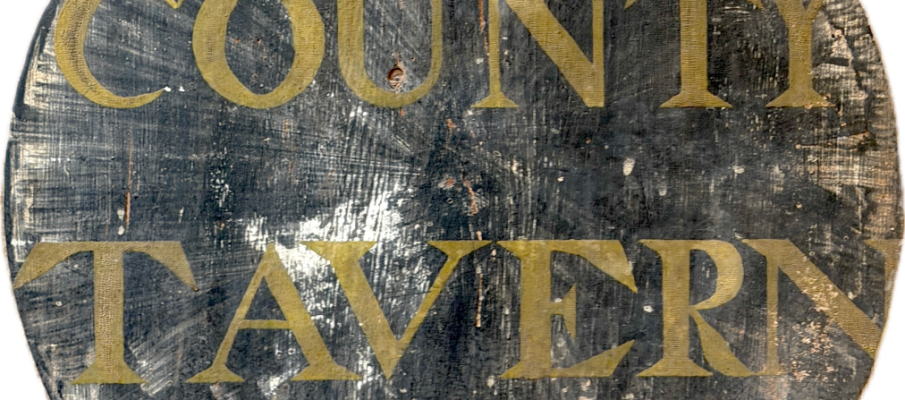
This is an article by Egbert T. Bush about the village of Cherryville in Franklin Township, Hunterdon County. It serves as a follow-up to my article on the earliest owners of the Cherryville Tavern, back when the village was known as Anderson Town, after the early tavern owner, James Anderson.
Cherryville, Once Called Dogtown,
Has Long History
Nobody Knows When the Old “Dogtown Tavern” Was Built
Some Neighborhood History1
by Egbert T. Bush, Stockton, N.J.
Hunterdon Co. Democrat, December 19, 1929
My previous article served as an introduction to the subject of the interesting buildings on Flemington’s Main Street that all feature an arch in the middle of their front roofline. Now let’s focus on each of them individually, starting with:
Postscript to Flemington’s First Bank, parts one & two
It was a challenge to decide what to include in my previous article and what to leave out. I now find I left out quite a lot and am compelled to add a part three to the bank’s history.
My previous articlediscussed the evolution of political parties in the early 1850s, both nationally and in Hunterdon County. The Democratic party was still going strong, while the Whig party was fading away and two new parties had come on the scene: the Republican party and the American party, better known as the Know Nothings.
I am going to step away briefly from the life of John C. Hopewell to shed some light on a political movement that Hopewell and many other Flemington notables got caught up in.
After existing for 166 years, through the thick and thins of the American economy, the Hunterdon County National Bank that once was a mainstay on Flemington’s Main Street was taken over by a much bigger national bank in 1983. The HCNB had occupied its beautiful building for nearly that long, about 157 years.
Senator John Lambert of Amwell is one of Hunterdon’s most interesting historical figures.1 He served in the state legislature during the Revolution and afterwards served as Acting Governor before being elected to Congress and then to the U.S. Senate.
“There is something in a village celebration of great events, that has a character peculiar to itself.” Charles George, editor of the Hunterdon Gazette, July 5, 1826.
Disturbing news of late, somehow reminiscent of the lead-up to America’s first Civil War. Whilst scrolling through the Hunterdon Gazette recently, I came across an item that caught my attention, published on Christmas Eve, December 24, 1859:
Recently, my son, Ben Zimmer, sent me a clipping that a friend of his had found in the Trenton True American for March 7, 1803. This friend, Barry Popik, was researching the expression “Uncle Sam,” (see “New Light on “Uncle Sam”), and had found an instance of its use in this letter to the editor: