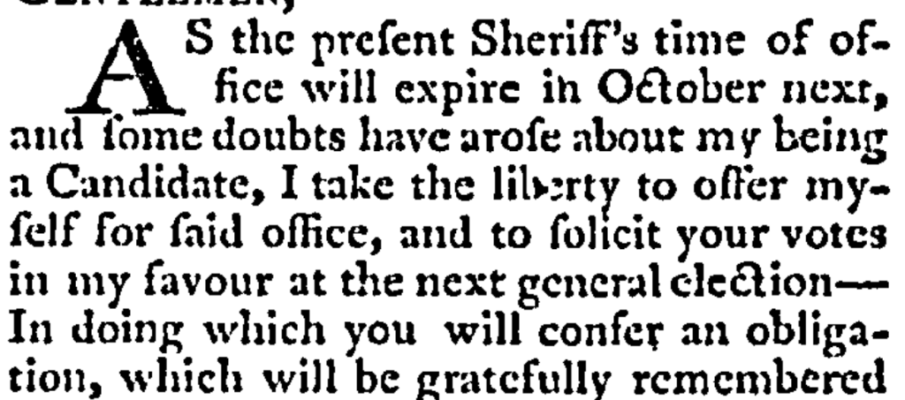
Part Five concluded with the election of October 1794 when Jacob Anderson was chosen as Sheriff, despite being attacked by his opponent William Lowrey. In addition to maligning Anderson, William Lowrey had actually taken him to court, claiming he was not a qualified freeholder. The court affirmed Anderson’s standing, but the case is especially interesting because of the people who backed Lowrey’s claim and because opposition to Anderson was rooted in political differences.
When researching history, I find that you can start off with a plan, but before long one thing will lead to another, or even several ‘anothers,’ that are completely unexpected. Which makes it challenging to stay on course. That was definitely the case while I was preparing this chapter.
This tree has been compiled to accompany my article on the Anderson tavern at Cherryville (“James Anderson’s Tavern”). It seems to have more holes than my usual trees. I had hoped to publish another Anderson Tree in conjunction with this one, for an entirely different Anderson family—the one connected with John Anderson, who ran a tavern near Ringoes (“Anderson’s Tavern”). But that one has even more holes in it and is not ready for publication.
This article will be followed by one written by Egbert T. Bush titled “Cherryville, Once Called Dogtown, Has Long History.” He knew the Cherryville Tavern was an old tavern, but could only get back as far as Reuben McPherson, who owned it from 1827 until his death in 1831.
By the time of the Civil War, Flemington had grown considerably, but the war had dampened commercial spirits and citizens were eager for a comeback. This was demonstrated by an item from the editor of the Hunterdon Republican, on Nov. 1, 1865:
Recently, my son, Ben Zimmer, sent me a clipping that a friend of his had found in the Trenton True American for March 7, 1803. This friend, Barry Popik, was researching the expression “Uncle Sam,” (see “New Light on “Uncle Sam”), and had found an instance of its use in this letter to the editor:
Recently I had the pleasure of visiting the old John Anderson tavern on Route 31 south of Ringoes. The building is inconspicuous with its tall evergreen hedge along the road, but inside one can see it was once a fine 18th century building.
The owners (New Jersey Barn Co.) are lovingly and very carefully restoring it to the period of John Anderson’s tenure as innkeeper during the Revolutionary War. He did not build the house, however. There is reason to think it might have been built around 1740 or earlier.1
In writing about Nathaniel Saxton in my series on Raven Rock, I learned about his investments outside of that village. One of his earliest deeds involved the sale in 1807 of 47.27 acres to Ann Anderson for $422.69.1 This property in today’s Stockton village has an interesting story, one which shows how vulnerable 18th and early 19th century people were to the miserable consequences of debt.