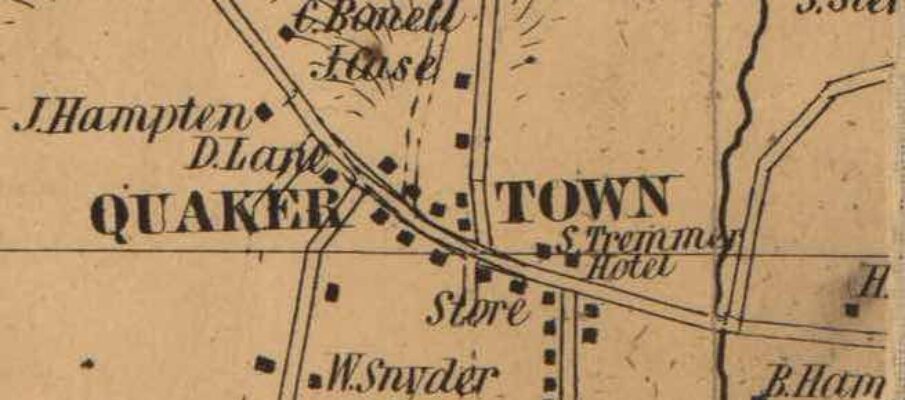
There was a time when the sleepy little village of Quakertown was a lively place, back when it had two taverns. I learned this from Egbert T. Bush, who wrote a couple articles about the village.
Since I am focusing on taverns these days, I will publish parts of Mr. Bush’s first article on the village, the parts concerning its taverns.
Interesting Facts About Quakertown
by Egbert T. Bush, Stockton, N.J.
Hunterdon Co. Democrat, February 27, 1930
There are so many interesting points about Quakertown that one does not know where to begin.

“There is something in a village celebration of great events, that has a character peculiar to itself.” Charles George, editor of the Hunterdon Gazette, July 5, 1826.
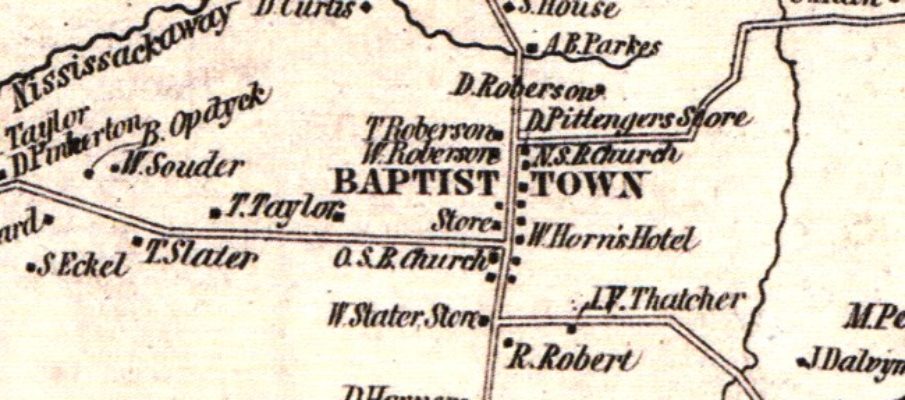
Recently there has been much discussion on the Facebook page “Historical Kingwood Township” about the history of Baptistown. So, it seems appropriate now to publish this article by Egbert T. Bush with his memories of the ancient village.
After November’s big snowstorm, when so many people trying to drive home found themselves in crashes or stuck in a ditch, I began to wonder what sort of trouble people got into back in the last half of the 19th century. Luckily for me, I had Bill Hartman’s abstract of the Hunterdon Republican, 1856-1900, to turn to. With his abstracts collected into one pdf file, it was easy to search on a word like “accidents.” I found quite a few of them.
Egbert T. Bush was very fond of grand old trees, and when they had to come down, he lamented the loss in his articles, including one that I published awhile ago, titled “Old Sentinel Oak Has Passed.” That huge tree, or as Bush would call it, a “Monarch,” once stood along Route 523 as you enter Stockton. Today’s article should have preceded “Old Sentinel Oak,” as it concerns the neighborhood of that great tree before it was taken down.
Back in February, I published an article on the cemetery connected with the Locktown Baptist church. Previously I have written about the Baptist congregation here as well as the Locktown Christian Church and its Cemetery. It seems appropriate now to include Mr. Bush’s own history of this neighborhood, which was published in the Hunterdon Democrat, on May 22, 1930. Along with the churches, Mr. Bush discusses the school house, the distillery and the Locktown Hotel, which began its life as a humble tavern, and also some of the old families, like the Chamberlins, Heaths, Lairs, Rittenhouses, Smiths and Suttons. Photographs in this article were provided by Paul Kurzenberger.
One of the most notable people in the neighborhood of Locktown in Hunterdon County was Daniel Rittenhouse. His life makes an interesting story, which we know something of thanks to the collection known as The Rittenhouse Papers, on file at the Hunterdon County Historical Society.
Alcohol consumption in the 19th century is always an interesting subject because of how much alcohol was consumed back then. It is one of the ways we measure how much things have changed. We are far more aware now of the dangers of addiction, but in the 1820’s, the county coroner could tell you it was sometimes fatal. Here is the sad story of John Rake, a member of that same family I have written about in other posts.
This article by Egbert T. Bush describes an old sawmill on the Wickecheoke located on a perilous little road, known appropriately as Old Mill Road in Delaware Township.
After publishing my last post on the Covered Bridge, in which I described Eric Sloane’s encounter with a fellow who lived near the bridge named Sparky, I came across a drawing that was published many years ago in the Hunterdon Democrat, that shows the Gelvin house, the one-lane covered bridge, and the old Brown hatchery building.