Detail of survey by Reading Howell, 1774 click to enlarge
The dotted line in this picture is a survey line, drawn by Reading Howell in 1774, and as you can see, one of the lines goes right through the middle of the house, which is labeled “Ferry House.” Strangely enough, this house has long been known as the tavern house at Howell’s Ferry (Stockton) which I wrote about in “Jacob’s Path, an 1813 Shortcut.” So why was the tavern house called the Ferry House in 1774? And why did the surveyor run a line right through the middle? Therein lies a story.
Little Known of Mill That Existed Prior to John Prall’s
When the Canal Was Dug
by Egbert T. Bush, Stockton, N.J. published in the Hunterdon County Democrat, February 13, 1930
It is common to speak of John Prall Jr. as the builder of the first mill in this hamlet. But his titles date back to early 1792; and to some of us it seemed strange that a site so attractive with the Wickecheoke Creek rushing into the Delaware, with an established ferry close at hand, and with a solid community back of it should have been so long without a mill. While investigation has so far failed to reveal all that was hoped for, it has demonstrated that Prall was far from being first to carry on milling business here.
In 1878 when the bridge on Raven Rock Road was built, the Freeholder Director of Hunterdon County was Joseph H. Boozer of Lambertville. He was one of the six freeholders who were charged with overseeing construction of the bridge spanning the Lockatong Creek. With such an unusual name, he certainly stands out, and I could not resist the urge to learn about him and his family.
In my previous post I wrote about the history of the Lambertville Iron Works, the company that constructed the Lockatong bridge. At that time, after several months of work and an initial bridge opening, the bridge was closed again in order to repair the repairs. It has since been reopened, and is definitely worth a visit. It is not exactly the bridge it used to be, but it has been beautifully restored, and all concerned should take pride in it.
Hunterdon County probably holds the record for the most 19th century iron truss bridges that are still in use. In Delaware Township alone there are nine iron truss bridges, not including the Covered Bridge, which is also a truss bridge. The most important of these iron truss bridges is the one crossing the Lockatong Creek on Rosemont-Raven Rock Road. That bridge is an outstanding example of the urge to lend some grandeur to a very functional structure. None of the other township bridges quite matches it.
The Road from Howell’s Mills and
John Reading’s Plantation to Trenton
Recently I wrote about the earliest known public road in Hunterdon County, recorded in January 1721/22 (The Amwell Road of 1721.) The next earliest, at least for the southern part of the county, was dated 1736, and followed part of the earlier route.
I will give the record in full, and then try to identify each course along the route.1
Similar Enthusiasm Seldom Seen Nowadays, Says Observer
Political Tactics Are Recalled
by Egbert T. Bush, Stockton, N.J.
Hunterdon County Democrat, November 3, 1932
Mr. Bush stated at one time that he did not chose the headlines for his articles—that was left to the editors of the Hunterdon Democrat. So, although he does discuss those July 4th toasts, there is much more in this article.
There is something fascinating about old roads, especially when their routes differ from the ones we know today. One of the very oldest roads in Hunterdon County was “layed out” in December 1721 and recorded in January 1721/22.
Here is the full text, as transcribed in Snell’s History of Hunterdon County (p. 347), which I will follow with my attempt to decipher what route was being described.1
In his article, “Old Sentinel Oak Has Passed,” Egbert T. Bush wrote that the old oak, across the road from the Baptist Church in Stockton, close to where Route 523 meets Main Street, stood near a “never-failing stream.” This stream runs along Route 523 for some distance and today is a little hard to find. But it does show up on Google maps, and is a clue to two interesting road records of 1813.
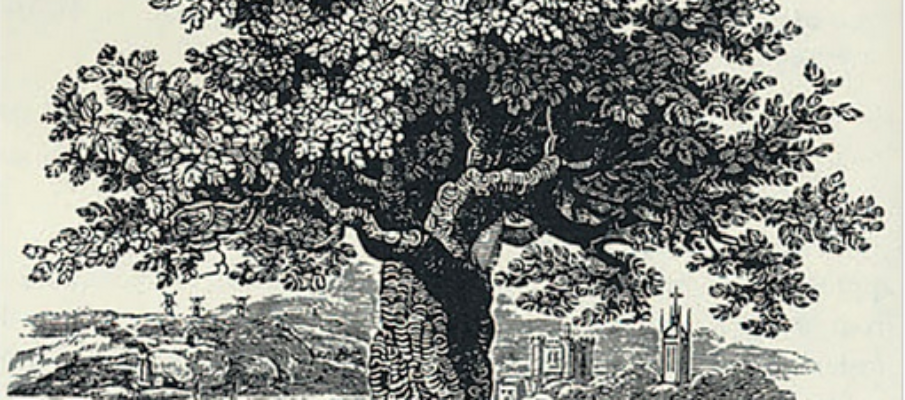
Trees were a subject dear to Mr. Bush’s heart. This article is just one of many in which he waxed both poetic and nostalgic about the grand old trees of his neighborhood.
Included in this article is some early history of the area of Stockton where Route 523, Old Prallsville Road, Ferry Street and Route 29 (Risler Street) all come together. Rather than interrupt Mr. Bush with a long parentheses, I will save my comments for the end of his article.