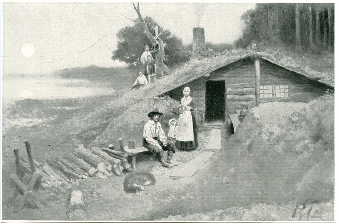
How to Survive in West New Jersey
Recently a friend, Ian Schoenherr, sent me a copy of a painting by Howard Pyle that beautifully depicts the life of the first settlers along the Delaware River.
Note: This article is the 11th in a series that I began on August 20, 2009, concerning the Green family and the early settlement of the Province of West New Jersey.
Through letters to the proprietors in West Jersey, Edward Byllinge had made it clear that he had no intention of acceding to the demands of their Assembly. In response, during the Assembly session of March 1684, Samuel Jennings and Thomas Budd were appointed to travel to England to make their demands to Byllinge in person. Thomas Olive was chosen to act as deputy governor during their absence.
Just to review, in 1680, James Duke of York, with prodding from William Penn, agreed to confirm the 1664 grant of West New Jersey to John Lord Berkeley. This, along with a special deed, confirmed the grant to Edward Byllinge, Berkeley’s successor. Byllinge thereby claimed the governorship of the colony, even though there was no provision for the position of Governor in the Concessions & Agreements.1
The Irish TenthDuring the winter, the Irish Quakers who had arrived at West New Jersey in September 1681, were given shelter in Salem. When spring 1682 arrived, they set to work building their own settlement. The location they chose was a site opposite what would soon be Philadelphia. They laid out their own Tenth, running from Timber Creek to Pennsauken Creek, and established a town center called Newton. The original site of Newton was in the present-day city of Camden.
This post is another side trip in my journey through Hunterdon history by way of Samuel Green. While looking through the Delaware Papers by Charles T. Gehring, I happened upon some interesting items dating to 1680.
Well, it looks as if I can’t get more than one year’s worth of information in a single post. Can’t help it—the times were just too interesting.
In January 1680/81, Gov. Andros, who had been carrying out the wishes of his patron, James Duke of York, was recalled to England to answer charges of financial corruption. His heavy-handed tactics, especially in East New Jersey, had made him a liability to James, who was having problems of his own. Andros returned home in May 1681, but instead of imprisonment, he was knighted, after the charges were dropped in December 1681.
While Mahlon Stacy was enjoying the fruitful new land he and his fellow Quakers had settled in, a time bomb was ticking, set off by a poorly spelled letter written in Sept. 1679 by the Attorney General in England, Sir John Werden,1, which concluded with this: Quaere?
Sorry for the delay. Got waylaid by a virus.
I was thinking about that cold winter when the ‘Shield’ arrived in the Delaware River and the passengers walked to land over ice, and then, thinking about how Mahlon Stacy wrote about the bountiful life in the Yorkshire Tenth. It was a little surprising that he did not mention the chilly weather. Of course, Stacy intended his letter to be reread to English Quakers who were debating whether or not to make the trip to America, so he put the best face of things.
The history of the newly created Province of West New Jersey shaped the history of the creation of Hunterdon County.