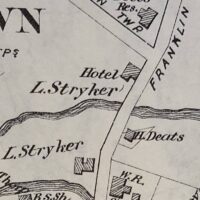
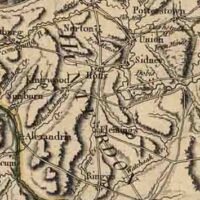
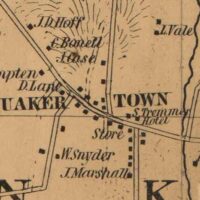
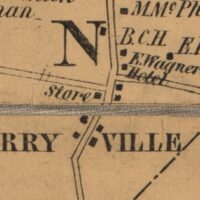
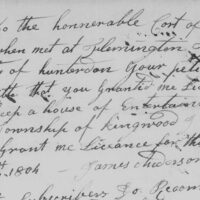
A Tavern & A Courthouse The history of a hotel that once stood on the west side of Flemington’s Main Street has quickly turned into something much more. Part One began with Flemington’s first European property owners and ended with the Revolution. This article goes on from there, but only as far as the 1790s, […]
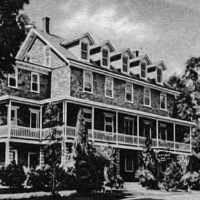
This is one of my favorite photographs.1 The building is Mount’s Hotel on Flemington’s Main Street, across from and a little north of the Union Hotel. It was replaced in the 1970s by the group of shops called ‘New Market,’ built by Don Shuman.
Following the Revolution, Moore Furman moved back to Trenton and left his Pittstown properties to son John & Benj. Guild, until it was time to build anew.
The occupations included in the tax lists gives us a window into life in the mid 19th-century. It is just as interesting to see what occupations were not listed as which ones were. I have not yet found a complete list of all occupations to be taxed, but the Revenue Act of 1864 lists these principal occupations in this order:
When first reading the Revenue Act of 1864, I couldn’t help but wonder if the taxes were intended to be levied on just the northern states, or if the authors preferred to ignore the existence of the confederacy and apply the law to everyone in what had become a very fragmented Union. The answer came in Section 46 of the Revenue Act, dealing with those southern states where any tax collector for the federal government who attempted to carry out his duties would likely be shot. The act was intended to govern all citizens of the United States, whether their states seceded or not. But it did acknowledge the current situation to the extent that if the laws of the United States could not be executed in any part of the country, the President was authorized to carry out the provisions of the act “as soon as the authority of the United States . . . shall be re-established.” Awkward, and a little disturbing to imagine the tax collector following rapidly on the heels of the Union Army.
After discovering the Civil War tax lists available online (more about that here), I was inspired to read the legislation (The Revenue Act of 1864) and to write about the residents of Hunterdon who were listed in the tax levy of 1865. Since this is a time of remembrance of the Civil War, it seemed appropriate. The article will appear in the spring issue of “Hunterdon Historical Newsletter” published by the Hunterdon County Historical Society. Even though the editor graciously allowed me two full pages, I found myself frustrated by how much I had to leave out. Which is why blogs are so wonderful.
Although I have not yet followed through on my intention to post my previously published cemetery articles here on my website, I am initiating yet another project—a study of the taverns of Delaware Township. The Delaware Township Historical Society is anxious to map these institutions, so it is time to begin an inventory.
The Burlington County Court Book has little to offer about Thomas Greene, but there was one incident witnessed by him that tells us a lot about life (and death) in West New Jersey in the 1680s.
The original post on Thomas Greene included a story about his appearance as a witness in a disturbing court case. It came at the end of a long post, and I realized afterwards that it deserved its own space. You can read it here.
It’s been a long time since I wrote anything about the Green family. It was Samuel Green who got me started on this series of posts about early West New Jersey. Now that I’m up to 1690, it’s time to take another look at the Greens.
In 1689, affected by the uncertainty of the times, the West Jersey Proprietors wrote to Daniel Coxe that they would proclaim him governor if he would just provide his own writ of quo warranto. They “stressed the urgency of the situation” but Coxe, who also felt the uncertainty of the times, delayed his answer for several months.1
I am going to collect in this post (and add to it over time) the sources used for the early history of the Province of West New Jersey. It will serve as a way to collect in one place all the sources used, and at the same time, make each post a little less cumbersome to read (I hope).
In a previous post related to Dr. Daniel Coxe, I described a lawsuit involving himself and John Hooke. Hooke had hoped to establish a settlement in America for Dissenters persecuted by the popish policies of Charles II and James II. Once the Glorious Revolution had taken place, things took on a different complexion.