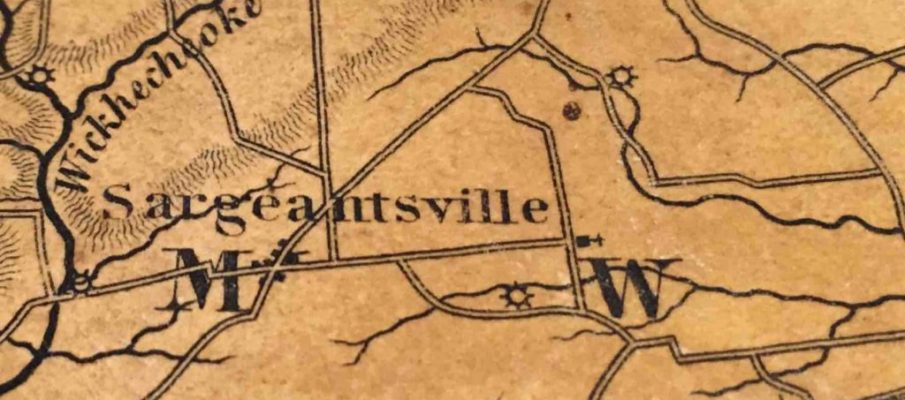
There is a fascinating article on water-powered mills to be found on “History–Now and Then” giving detailed information on how the ancient grist mills worked. The author, known as “Jerseyman,” explains how overshot wheels were designed and how much more efficient they were than undershot wheels. Immediately I thought of a locally famous overshot wheel at the old Sergeant’s mill near the Wickecheoke. Here’s a picture that says it all–the perfect example of an overshot wheel.
Hunterdon County was once well supplied with covered bridges. Now the lonely last one stands at what has long been known as “Green Sergeant’s Mills.” Some say that there is no other such bridge in New Jersey today. I cannot vouch for that; but the covered bridge is almost a thing of the past.
The Covered Bridge has been a landmark for quite a long time. Next year the bridge will be 140 years old—not bad for a bridge. It has had a lot of work done on it over the years, and some adaptations have been made to allow it to continue standing. I’ve been making adaptations to some of my articles as well. This second essay on the Covered Bridge is adapted from an article that first appeared in the Delaware Township newsletter, “The Bridge,” and from an article published in the Hunterdon Historical Newsletter, Fall 2003 issue.
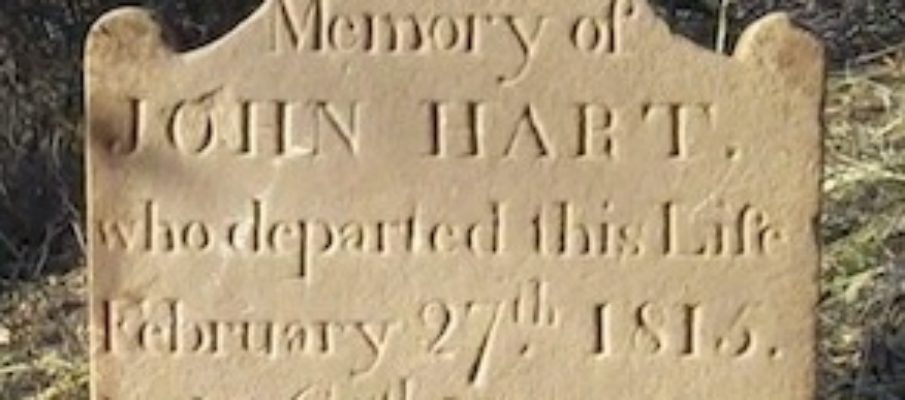
Some time ago I wrote a series of articles on the Rake Cemetery in Delaware Township. You can find the first of them here. In the second post (here), I mentioned that both John and Else Rake did not have gravestones in this cemetery, even though they were the first owners of the property. I also speculated that Else Rake, might be buried in the Rockafellar Cemetery in East Amwell. I have since learned that is not the case.
Fifty years ago, on September 15, 1961, the “reconstructed” covered bridge was dedicated. An alert reporter at the Star Ledger, Mike Frassinelli, reminded me of this fact, and that inspired me to reprint an article I wrote for “The Bridge,” the newsletter for Delaware Township, back in 2001, and also in the Hunterdon Historical Newsletter, Fall 2003 issue.
This past month there were several fires in southern Hunterdon County, all of them accidental. One of those fires gutted a house that I had researched many years ago, so I, along with current and past owners, feel somewhat heartbroken that this lovely home has been destroyed. It is located a short distance south of the village of Sand Brook, along the Sand Brook-Headquarters Road.
The above view of this old mansion now standing on the farm of Manning Dilts in Raritan Township, at the top of what is known as Buchanan’s or Dilley’s Hill, built in 1725, making it one hundred and seventy-six years old, was recently photographed by Mr. J. C. Sunderlin of Flemington.1 From this elevation the eye has a view of the Raritan valley as far east as Bound Brook. Also from this point a view can be had of the Sourland Mountain range from the Delaware on the west, extending through the counties of Hunterdon and Somerset, presenting to the view a greater scope of country than can probably be seen from any other point in the county.
This old building, erected in 1758 at Head Quarters, now Grover, standing on the corner of the road on the farm at present owned by Smith Skinner, was, between the dates given above, used as a recruiting station.1 As shown by papers in possession of the writer, Captain David Jones, of the Continental line, was the recruiting officer, and at this point, when the alarm was given that the then hated minions of King George had made a landing at Paulus Hook (Jersey City) or Amboy, would assemble the patriotic old citizen-soldiery, armed with the flint-locks, home-made bullets and powder horns, and from thence hasten to the front to assist the great Washington in beating back the invaders.2