A Tavern & A Courthouse The history of a hotel that once stood on the west side of Flemington’s Main Street has quickly turned into something much more. Part One began with Flemington’s first European property owners and ended with the Revolution. This article goes on from there, but only as far as the 1790s, […]
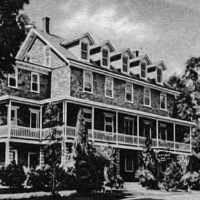
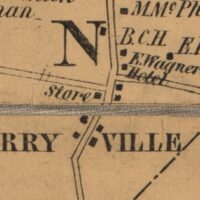
This is one of my favorite photographs.1 The building is Mount’s Hotel on Flemington’s Main Street, across from and a little north of the Union Hotel. It was replaced in the 1970s by the group of shops called ‘New Market,’ built by Don Shuman.
Following the Revolution, Moore Furman moved back to Trenton and left his Pittstown properties to son John & Benj. Guild, until it was time to build anew.
Never, never assume. That’s a lesson I have just learned again. When I began looking into the history of Buchanan’s Tavern, I was operating on the assumption that the original 18th century tavern was the old stone house at the top of the hill on Route 579, just north of the intersection of County Routes 523 and 579. And the newer Buchanan’s was the old house on the northeast corner of the intersection, now owned by the Micek family. Turns out, I was wrong, but now I know why. And I’ve gotten a chance to write about one of my favorite early settlers, Daniel Robins. Here is the tale:
Property Was Formerly Owned by Judge Adam O. Robbins Stood at Important Crossroads
by Egbert T. Bush, Stockton, N.J. published in the Hunterdon County Democrat, August 7, 1930
This article needs many more footnote annotations than most of the Bush articles I have published so far. In fact, despite the 24 footnotes in this article, there is so much to say about it, that I find it necessary to write a separate post. It is called “The Two Taverns at Robins Hill.“
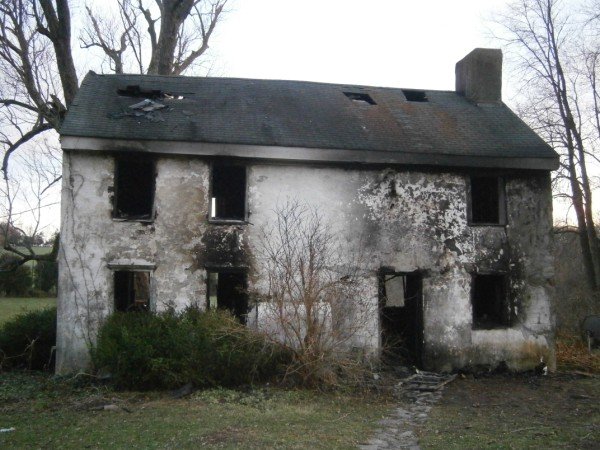
Fisher Tenant House, Nov. 13, 2012, photographed by Renee Kiriluk-Hill
photograph found on NJ.com, taken by Renée Kiriluk-Hill for the Hunterdon County Democrat http://connect.nj.com/user/rbhill/photos.html
On November 13, 2012, the home of Brian McVey and his 11-year-old son Calvin was destroyed by fire. Not only did they lose all their possessions, they also lost their dog, who for reasons unknown ran back into the house while the McVeys were escaping. The community is coming together to help the McVeys get back on their feet. Gift cards to places like Target, Walmart, Lowes, etc. can be delivered to the Delaware Township school, in an envelope marked for Eileen Ventimiglia and Sue Whitlock.
beginning in 1807 when Lambert was a member of Congress ending in 1815 when Lambert was in his last year as a U. S. Senator
The original letters can be found in the Emma Finney Welch Collection of the Historical Society of Pennsylvania. I have transcribed the letters as Lambert wrote them, which is why there is an absence of commas and periods. My only change is the addition of paragraph breaks to make the letters easier to follow. Check my running glossary of names mentioned by Lambert to see who he’s referring to.
In this week’s edition of the Hunterdon County Democrat, the regular feature “Old Ink” had an interesting item:
1887
PRESIDENTIAL–The house owned by Mr. George Hoppock at Rosemont is now undergoing an overhauling. This is an old relic, built in 1754. The rafters were raised on the day of Braddock’s defeat. It was long known as Rittenhouse’s tavern. It is reported that Gen. Washington took dinner in the house during the period of the Revolutionary War.
I don’t do book reviews, so this is not that. But I just got my copy of New Jersey, A History of the Garden State, edited by Maxine N. Lurie and Richard Veit, with an introduction by Marc Mappen, and I’ve got to say—run out and get this book! It’s a terrific collection of articles on the different periods in New Jersey’s history, starting with Richard Veit’s excellent first chapter on Native Americans who lived here, as far back as 12,000 years ago and into the colonial period. Thank you Rich. It came just in time to help me sort out this confusing history for my own blog.
I’m really looking forward to reading the next chapters, because they are all written by the top people in the field: Michael Birkner, John Fea, Howard Gillete Jr., Brian Greenberg, Larry Greene, Graham Russell Gao Hodges, Paul Israel, Maxine N. Lurie, G. Kurt Piehler and Richard Viet.
No doubt about it. If you love New Jersey, you’ll love this book.
beginning in 1807 when Lambert was a member of Congress ending in 1815 when Lambert was in his last year as a U. S. Senator
The original letters can be found in the Emma Finney Welch Collection of the Historical Society of Pennsylvania. I have transcribed the letters as Lambert wrote them, which is why there is an absence of commas and periods, and many misspelled words. My only change is the addition of paragraph breaks to make the letters easier to follow and letters in brackets where they are needed. For cumulative information on the people mentioned in Lambert’s letters, see the Lambert Glossary.
People Mentioned in the Letters of John Lambert to Susan M. Hoppock, arranged alphabetically first by given names that have no surnames, then by surname (married women are listed under their maiden names).
I have begun to realize that it is a challenge to keep track of all the people mentioned by John Lambert, mostly family but also friends and neighbors. So here is a list of them all so far, which I will add to whenever someone new is mentioned. This is most definitely a work in progress, and any help that readers can lend me for some of my mysteries will be most appreciated. I will include a link to this post with each subsequent letter published. To view those letters, click on the topic “John Lambert” in the right-hand column.
beginning in 1807 when Lambert was a member of Congress ending in 1815 when Lambert was in his last year as a U. S. Senator
The original letters can be found in the Emma Finney Welch Collection of the Historical Society of Pennsylvania. I have transcribed the letters as Lambert wrote them, which is why there is an absence of commas and periods. My only change is the addition of paragraph breaks to make the letters easier to follow.
This is the beginning of a series of articles on the Lenape people who eventually came to live in southern Hunterdon County, before moving further west into Pennsylvania.
By Their Names You Shall Know Them
In the late 17th century, a Lenape Sachem named Caponokonickon walked the paths of “Scheyechbi.” His name was spelled many ways, such as Coponnockous, Capenokanickon, Kapanockanickon, Caponeaoconeacon, Caponakonikikkon or Caponokon. He was a Lenape Sachema or Sarkemaker or Sachamaker, and walked the paths of central New Jersey, known as “Scheyechbi” or Lënape Ehendawikihtit.”