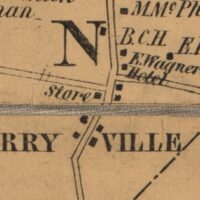
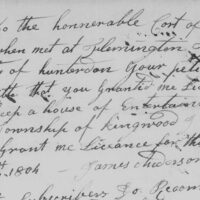
A Tavern & A Courthouse The history of a hotel that once stood on the west side of Flemington’s Main Street has quickly turned into something much more. Part One began with Flemington’s first European property owners and ended with the Revolution. This article goes on from there, but only as far as the 1790s, […]
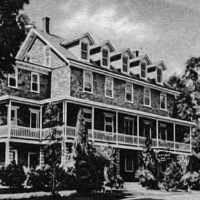
This is one of my favorite photographs.1 The building is Mount’s Hotel on Flemington’s Main Street, across from and a little north of the Union Hotel. It was replaced in the 1970s by the group of shops called ‘New Market,’ built by Don Shuman.
Following the Revolution, Moore Furman moved back to Trenton and left his Pittstown properties to son John & Benj. Guild, until it was time to build anew.
“Village Might Appropriately Have been Called Riven Rock Quarry Once Busy Place”
By Egbert T. Bush, Stockton, N.J.
published in the Hunterdon Co. Democrat, February 12, 1931
Note: This article was written by Egbert T. Bush, not by me. I have only added some footnotes for clarification and the photograph of Raven Rock Station, which was not part of the original article.
In 1802, Nathaniel Saxton witnessed the will and codicil of Guilbert Van Camp, who lived just east of Raven Rock. In 1807, he witnessed a deed from the estate of William Reading deceased, whose property was in the same vicinity.1 These two events, and probably others I have not found yet, may have served to acquaint him with the neighborhood of Raven Rock.
Nathaniel Saxton Esq. is one of the more intriguing characters to appear in Hunterdon County history. I have been looking forward to writing about him for a long time.
Before I write about the new owners of the Raven Rock mills (Nathaniel Saxton and George Holcombe), I must give due notice to Moses Quinby and the remainder of his stay in Amwell (Delaware) Township.
Much to my dismay, I have written very little on this blog during 2011. There were reasons, of course, but I very much regret losing the thread of so many interesting subjects. I hope I can pick up those threads in the next few months, and follow where they lead.
It is too bad that Cooper and Curry could not hang on long enough to enjoy the short-lived prosperity caused by the War of 1812. But perhaps that surge in economic activity helped them to recover from their losses in Hunterdon County. I do not know how their creditors recovered, since the sales of the mill property brought in so little ($7 and $50). I gather that Cooper and Curry were not expected to make up the difference, having lost everything in the lawsuit.
It has been a long time since I published my last installment in the saga of Raven Rock. The last post described Moses Quinby’s purchase of the 75 acres adjoining Bull’s Island. This one will discuss the millers Mahlon Cooper and Robert Curry, whose 10-acre mill lot was adjacent to the 75 acres and to Bull’s Island.
As the end of the 18th century approached, ownership of Raven Rock and Bull’s Island was changed from a single large landowner to multiple owners with different ways of exploiting the resources of the neighborhood.
Fishing rights in the Delaware River were legally transferable, and that gives us a hint of what was happening at Raven Rock and Bull’s Island in the 18th century. In 1782, Isaiah Quinby leased fishing rights in the Delaware River to various people. He may have done this before 1782, but this is the earliest record available.
John Ladd was one of the Quaker immigrants who came to West New Jersey in 1678. He was also on hand when William Penn was designing the layout of his new town of Philadelphia. Family tradition says that Penn offered him a choice of one of the best squares in the city or £30, and that Ladd chose the money, whereupon Penn said: “John thou art a ladd by name and a lad by nature, doesn’t thee know that Philadelphia will be a great city?” (Ah, Penn—such a joker.)