A Tavern & A Courthouse The history of a hotel that once stood on the west side of Flemington’s Main Street has quickly turned into something much more. Part One began with Flemington’s first European property owners and ended with the Revolution. This article goes on from there, but only as far as the 1790s, […]
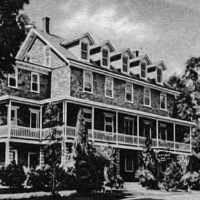
This is one of my favorite photographs.1 The building is Mount’s Hotel on Flemington’s Main Street, across from and a little north of the Union Hotel. It was replaced in the 1970s by the group of shops called ‘New Market,’ built by Don Shuman.
Following the Revolution, Moore Furman moved back to Trenton and left his Pittstown properties to son John & Benj. Guild, until it was time to build anew.
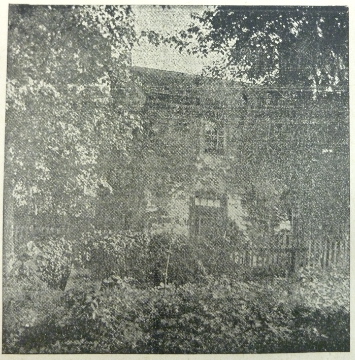
The above view of this old mansion now standing on the farm of Manning Dilts in Raritan Township, at the top of what is known as Buchanan’s or Dilley’s Hill, built in 1725, making it one hundred and seventy-six years old, was recently photographed by Mr. J. C. Sunderlin of Flemington.1 From this elevation the eye has a view of the Raritan valley as far east as Bound Brook. Also from this point a view can be had of the Sourland Mountain range from the Delaware on the west, extending through the counties of Hunterdon and Somerset, presenting to the view a greater scope of country than can probably be seen from any other point in the county.
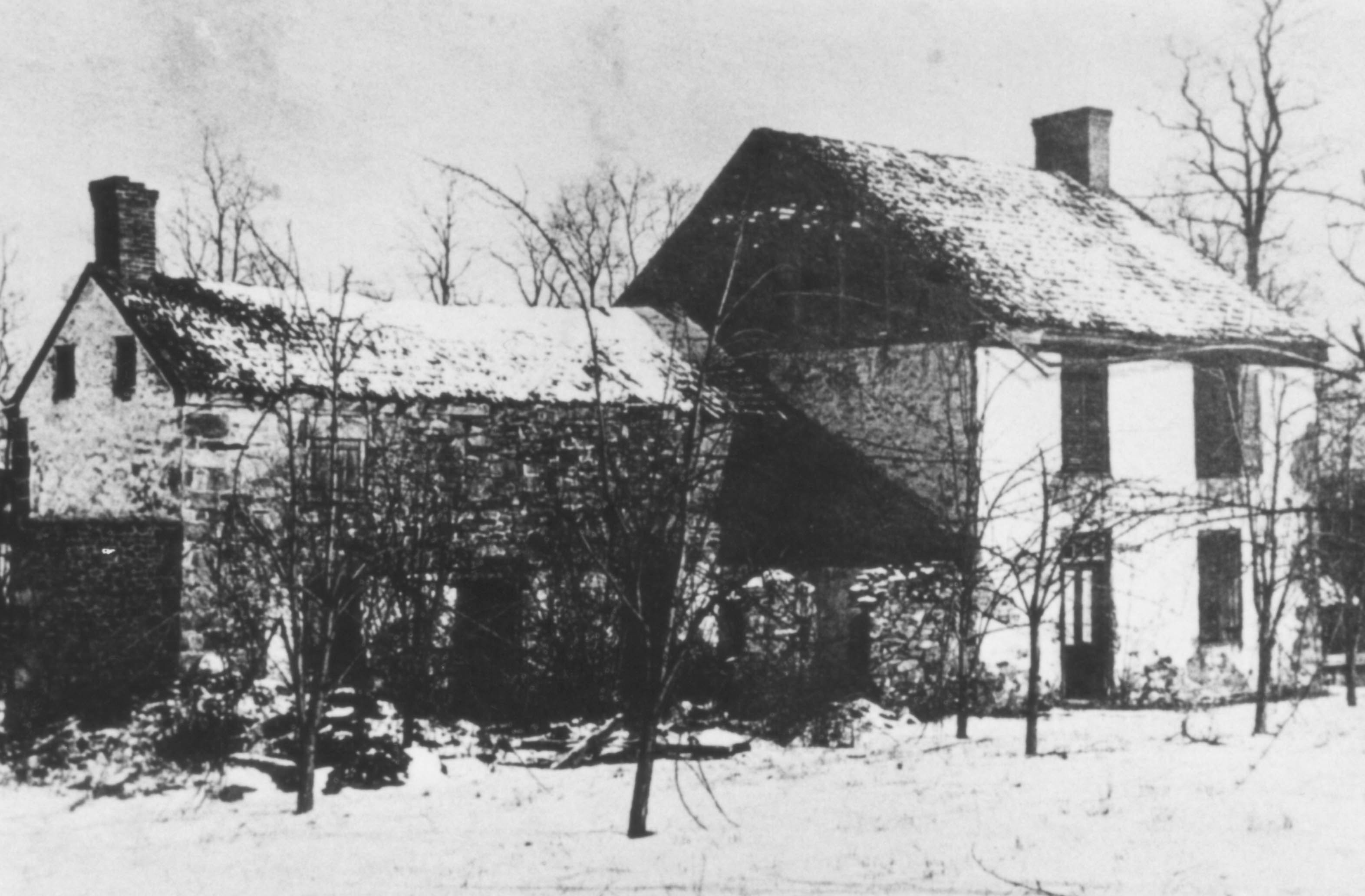
This old building, erected in 1758 at Head Quarters, now Grover, standing on the corner of the road on the farm at present owned by Smith Skinner, was, between the dates given above, used as a recruiting station.1 As shown by papers in possession of the writer, Captain David Jones, of the Continental line, was the recruiting officer, and at this point, when the alarm was given that the then hated minions of King George had made a landing at Paulus Hook (Jersey City) or Amboy, would assemble the patriotic old citizen-soldiery, armed with the flint-locks, home-made bullets and powder horns, and from thence hasten to the front to assist the great Washington in beating back the invaders.2
John Kuhl, a Hunterdon historian of the Civil War, pointed out to me in an email that
“Bonds and loans initially financed the war, the 5-20s, 7-30s, and 10-40s as advertised in the local newspapers. And the increased taxes took it from there. Besides your income tax, there were hefty boosts in real estate taxes to especially cover the local soldier bounties paid by the municipalities.”
I intend to publish the articles written by J. M. Hoppock, with commentary in footnotes, but thought it wise to begin with his obituary, so that readers can get an idea of who he was. The obituary itself is a marvel, redolent of the turn of the 20th century in its phrasing and perspective.
In my last post I wrote about the durable story that George Washington visited with John Opdycke and that, as a result, the village where Opdycke lived took on the name of Headquarters. Some people will read that sentence and conclude that it happened and is not a myth. They will ignore that phrase “durable story.”
And he probably didn’t visit either. But the notion that he spent a leisurely afternoon drinking fresh water under a shady tree in the company of John Opdycke just won’t go away. It probably never will.
I am no expert on the Lenape language. In fact, like most people, I am clueless. Recently someone asked me if I knew the meaning of a Lenape creek name, Octoraro. This is the answer I sent him:
Fireplace Was the Center of Family Life and Activity; Chimney Sweeps Common
by Egbert T. Bush, Stockton, NJ, March 20, 1930
Mr. Bush has good advice for those of us who enjoy a warm fire in winter. Note that the illustrations were not included with the original article.
“The great fire up the chimney roared.” Indeed it did, and how could it be otherwise? There was so much of greatness around that fire that it could not help either being great or roaring with its own greatness and that of its surroundings. That fire was not built on the economic Indian plan: “Injun make little fire—go close by;” but rather according to the Indian’s description of the uneconomic way of the paleface: “White man make big fire—go ‘way off.”