

This article will be followed by one written by Egbert T. Bush titled “Cherryville, Once Called Dogtown, Has Long History.” He knew the Cherryville Tavern was an old tavern, but could only get back as far as Reuben McPherson, who owned it from 1827 until his death in 1831.
Hunterdon
Point Tavern
or “Peter Cherry’s Inn”
on the Klinesville-Cherryville Road,
in Raritan Township
“Point Tavern” is surely one of the oddest names for a tavern. When Egbert T. Bush wrote his article, Klinesville Once Had A Tavern, he pointed out (sorry) that
. . it was a place of note in its day, and reference was made to the old “Pint Tavern” and to some of the doings there, long after it had fallen into disuse. The name is said to have been given because of its location on the point. But everybody called it the “Pint Tavern,” and as such it is remembered.
Klinesville Tavern(s)
This article by Egbert T. Bush describes a particular neighborhood, not far northwest of Flemington, at the intersection of today’s Thatcher’s Hill Road and Sand Hill Road.
Klinesville People
In preparing to publish Mr. Bush’s article on the Klinesville neighborhood, I found so many interesting people and places that it became too difficult to add all my comments as asides to the Bush article. So, I’ve collected some of them in a separate article. They are listed here in the order in which Mr. Bush mentioned them in Klinesville Once Had A Tavern.
Hopewell’s Buildings
Today I am returning to the buildings on the east side of Flemington’s Main Street that feature an arch along the front of their roofs, in particular, the two buildings constructed by John C. Hopewell, one on either side of the bank building that he put up in 1866 (See Flemington’s First Bank).
Johnson’s Tavern
In my research I have often come across references to Johnson’s Tavern as a landmark. Deeds refer to it when identifying roads, like “the road from Swamp Meeting House (Locktown) to Johnson’s Tavern” or “the road from Rittenhouse Tavern (Rosemont) to Johnson’s Tavern.” And sometimes it is just “the great road to Johnson’s Tavern,” which is today’s Route 519 through Kingwood Township.
Fulper’s Store
or The Gilded Age on Main Street
By the time of the Civil War, Flemington had grown considerably, but the war had dampened commercial spirits and citizens were eager for a comeback. This was demonstrated by an item from the editor of the Hunterdon Republican, on Nov. 1, 1865:
The Swamp Meeting House Tavern
I have written about Locktown’s tavern before—in my article on the life of Daniel Rittenhouse. At the time that I wrote it, I thought he had established the original tavern. That turns out to be not true.
Union Hotel, part 3
The history of the Union Hotel continues, following the sale in 1850 by innkeeper Mahlon C. Hart and wife Maria to a partnership of real estate investors.
Union Hotel, part 2
Flemington, New Jersey
My last article studying the history of the Union Hotel began with the beginning of the Village of Flemington in the 18th century and left off in 1809 with Neal Hart as owner of what was then known as “the House of Neal Hart in Flemington.”
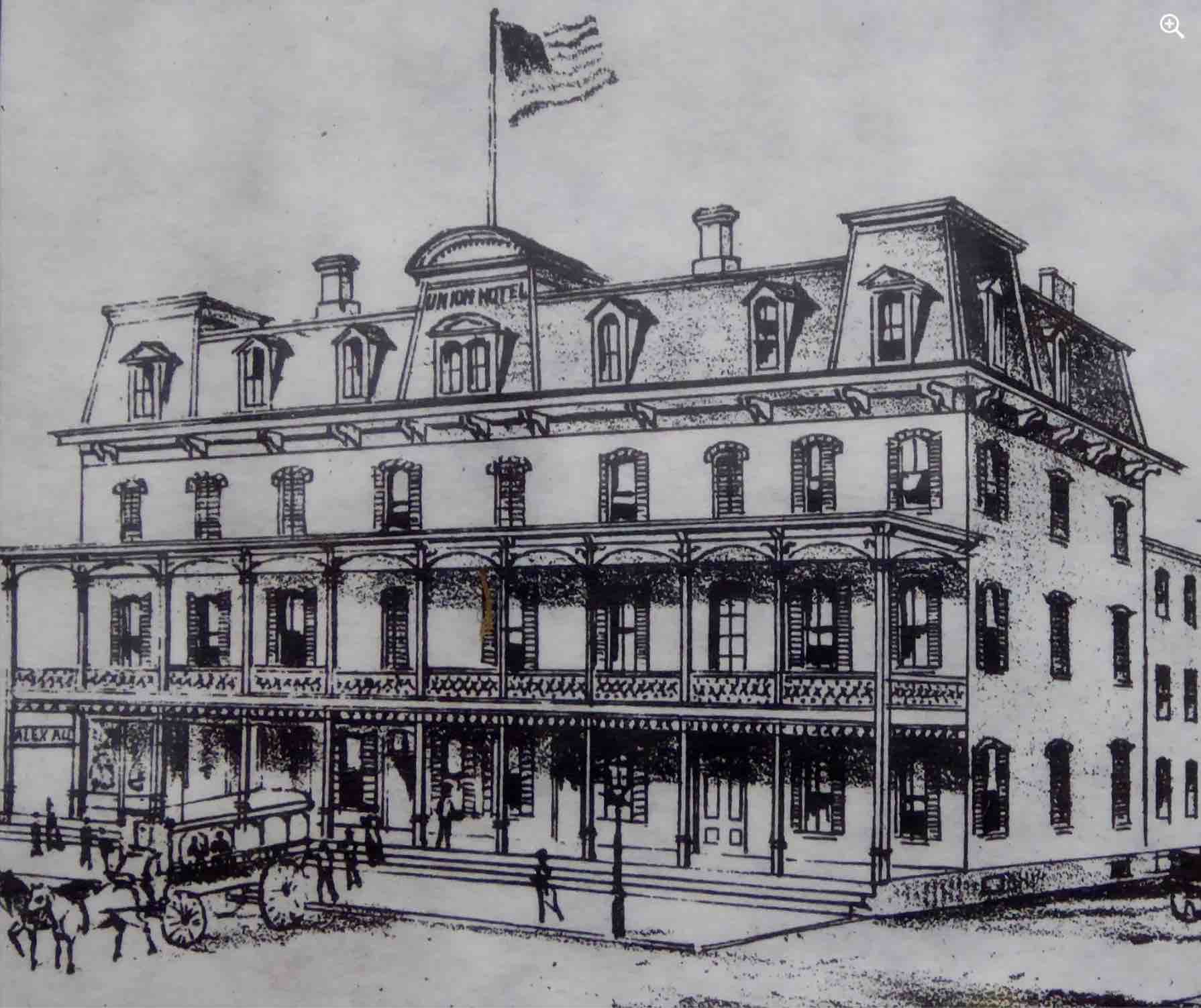
A sketch of the hotel in its later years.