Most of you, my dear readers, know that the famous Rockafellar family had its roots in Amwell Township, Hunterdon County. And we’re all familiar with one particular descendant of this German immigrant family, a man who prospered hugely from the opportunities afforded him in America—the famous John D. Rockafellar. Another descendant, although not a direct ancestor of John D., became the tavernkeeper at Skunktown (now known as Sergeantsville), and I am much more interested in him.
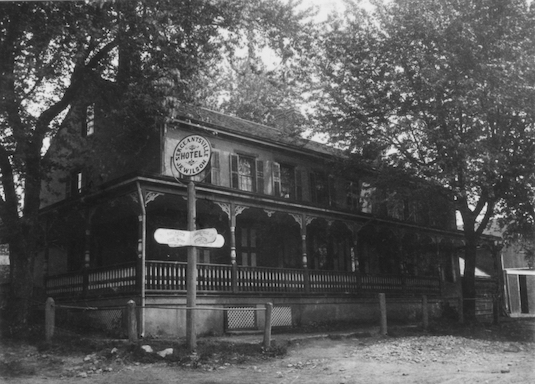
As I began work on this article I soon realized that I have neglected to publish an article on this website about the Skunktown Tavern itself, which later on got the title of the “Sergeantsville Hotel.”1 That would have been after 1827, when the name Skunktown was changed to Sergeantsville.
Sometimes in my researches on Hunterdon people of the past, odd things turn up. Something very odd turned up when I came across Cornelius H. Barber, who lived from 1804 to 1884. I had been asked about the Prall tanyard, which was located a short distance south of Sergeantsville in the early 1800s, and discovered that Barber had briefly been an owner.
So let me tell you a little about Cornelius Hoppock Barber before describing the odd thing I found.
My previous article discussed the Bearder family and the home of Andrew Bearder, Sr. on the Locktown Flemington Road. Just east of this farm was another tract that Bearder shared with his son Jacob, but whose ownership goes back much further.
Andrew Bearder, Sr.’s homestead farm was part of Jacob Snyder’s plantation. But the farm next to it on the east was part of the 700 acres first sold by the Haddons to Daniel Robins. (For background on the Haddons, see The Haddon Tract, part one.)
This is part two of a series on some of the properties created in the Haddon Tract of Amwell Township, Hunterdon County.
Jacob Peter Sniter and Nicholas Sayn jointly purchased 1300 acres in Amwell Township from Elizabeth Haddon Estaugh in 1748. The two men sold off several lots and then divided the land remaining between them. Part One dealt with Nicholas Sayn/Sine, who acquired the southern half. This article deals with Jacob Peter Sniter who got the northern half.
Ducks, A Vanished School, and The Dawn of the Space Age
“The ‘Oregon’ and Other Schools,” continued
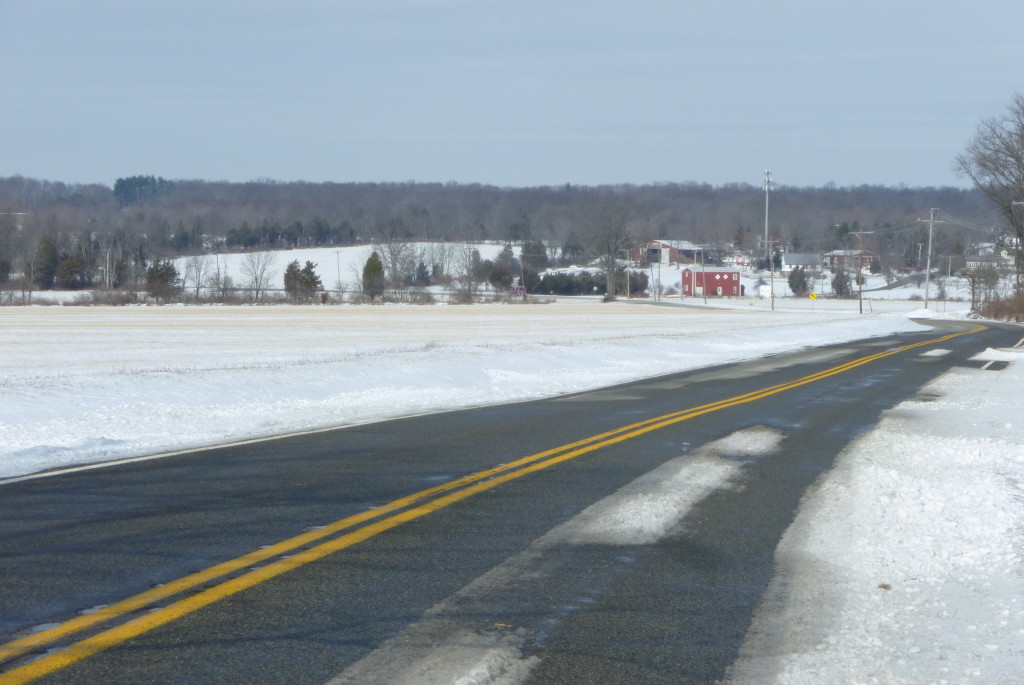
Ducks’ Flat, view from Route 519 looking north
With a name like Ducks’ Flat, you just know there must be a story there. But first, is it Duck’s Flat or Ducks’ Flat? I pitch for Ducks’, since it must have been a place where migrating ducks would gather. That’s the way Egbert T. Bush saw it. In his article “The ‘Oregon’ and Other Schools,” which I recently published in its entirety.1
This series of posts has been based on an article by Egbert T. Bush called “Sergeant’s Mills Once a Prosperous Place.” My previous post dealt with two of the four farms located in the Rosemont valley, on the north side of the road from Rittenhouse’s Tavern (Rosemont) to Skunk Town (Sergeantsville), otherwise known as Route 604. This post will describe the owner of the third farm, and include the rest of Mr. Bush’s article.
Being part three in a four-part post about an article written by Egbert T. Bush titled “Sergeant’s Mills Once a Prosperous Place” and published in the Hunterdon County Democrat on January 16, 1930.
In a recent post on the life of John P. Rittenhouse, I mentioned that his parents, Samuel & Hannah Rittenhouse, lived near the covered bridge in Delaware Township. This reminded me of the interesting article written by Egbert T. Bush about the history of the area around Sergeant’s Mill.